Results by title
90 books match the query 'Colonial period, ca. 1600-1775' and 2 start with n
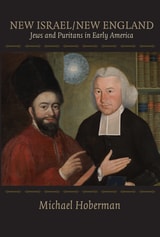
New Israel / New England
Jews and Puritans in Early AmericaMichael Hoberman
University of Massachusetts Press, 2011
The New England Puritans' fascination with the legacy of the Jewish religion has been well documented, but their interactions with actual Jews have escaped sustained historical attention. New Israel/New England tells the story of the Sephardic merchants who traded and sojourned in Boston and Newport between the mid-seventeenth century and the era of the American Revolution. It also explores the complex and often contradictory meanings that the Puritans attached to Judaism and the fraught attitudes that they bore toward the Jews as a people.
More often than not, Michael Hoberman shows, Puritans thought and wrote about Jews in order to resolve their own theological and cultural dilemmas. A number of prominent New Englanders, including Roger Williams, Increase Mather, Samuel Sewall, Benjamin Colman, Cotton Mather, Jonathan Edwards, and Ezra Stiles, wrote extensively about post-biblical Jews, in some cases drawing on their own personal acquaintance with Jewish contemporaries.
Among the intriguing episodes that Hoberman investigates is the recruitment and conversion of Harvard's first permanent instructor of Hebrew, the Jewish-born Judah Monis. Later chapters describe the ecumenical friendship between Newport minister Ezra Stiles and Haim Carigal, an itinerant rabbi from Palestine, as well as the life and career of Moses Michael Hays, the prominent freemason who was Boston's first permanently established Jewish businessman, a founder of its insurance industry, an early sponsor of the Bank of Massachusetts, and a personal friend of Paul Revere.
[more]
New World, Known World
Shaping Knowledge in Early Anglo-American WritingDavid Read
University of Missouri Press, 2005
New World, Known World examines the works of four writers closely associated with the early period of English colonization, from 1624 to 1649: John Smith’s Generall Historie of Virginia, William Bradford’s Of Plymouth Plantation, Thomas Morton’s New English Canaan, and Roger Williams’s A Key into the Language of America (in conjunction with another of Williams’s major works, The Bloudy Tenent of Persecution). David Read addresses these texts as examples of what he refers to as “individual knowledge projects”— the writers’ attempts to shape raw information and experience into patterns and narratives that can be compared with and assessed against others from a given society’s fund of accepted knowledge.
Read argues that the body of Western knowledge in the period immediately before the development of well-defined scientific disciplines is primarily the work of individuals functioning in relative isolation, rather than institutions working in concert. The European colonization of other regions in the same period exposes in a way few historical situations do both the complexity and the uncertainty involved in the task of producing knowledge.
Read treats each work as the project of a specific mind, reflecting a high degree of intentionality and design, and not simply as a collection of documentary evidence to be culled in the service of a large-scale argument. He shows that each author adds a distinct voice to the experience of North American colonization and that each articulates it in ways that are open to analysis in terms of form, style, convention, rhetorical strategies, and applications of metaphor and allegory.
By applying the tools of literary interpretation to colonial texts, Read reaches a fuller understanding of the immediate consequences of English colonization in North America on the culture’s base of knowledge. Students and scholars of early modern colonialism and transatlantic studies, as well as those with interests in seventeenth-century American and English literature, should find this book of particular value.
[more]