Results by title
126 books match the query 'Communism' and 3 start with n

Naija Marxisms
Revolutionary Thought in NigeriaAdam Mayer
Pluto Press, 2016

New Asian Marxisms
Tani E. Barlow, ed.
Duke University Press, 2002
While some of these essays take up key thinkers in Marxist history or draw attention to outstanding problematics, others focus on national literature and discourse in North and South Korea, the "Mao Zedong Fever" of the 1990s, the implications of Li Dazhao's poetry, and the Indian Naxalite movement. Illustrating the importance of central analytical categories like exploitation, alienation, and violence to studies on the politics of knowledge, contributors confront prevailing global consumerist fantasies
with accounts of political struggle, cultural displacement, and theoretical strategies.
Contributors. Tani E. Barlow, Dai Jinhua, Michael Dutton, D. R. Howland, Marshall Johnson, Liu Kang, You-me Park, William Pietz, Claudia Pozzana, Alessandro Russo, Sanjay Seth, Gi-Wook Shin, Sugiyama Mitsunobu, Jing Wang
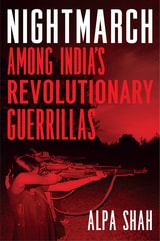
Nightmarch
Among India’s Revolutionary GuerrillasAlpa Shah
University of Chicago Press, 2019
Winner of the 2020 Association for Political and Legal Anthropology Book Prize
Shortlisted for the Orwell Prize
Shortlisted for the New India Foundation Book Prize
Anthropologist Alpa Shah found herself in an active platoon of Naxalites—one of the longest-running guerrilla insurgencies in the world. The only woman, and the only person without a weapon, she walked alongside the militants for seven nights across 150 miles of dense, hilly forests in eastern India. Nightmarch is the riveting story of Shah's journey, grounded in her years of living with India’s tribal people, an eye-opening exploration of the movement’s history and future and a powerful contemplation of how disadvantaged people fight back against unjust systems in today’s world.
The Naxalites have fought for a communist society for the past fifty years, caught in a conflict that has so far claimed at least forty thousand lives. Yet surprisingly little is known about these fighters in the West. Framed by the Indian state as a deadly terrorist group, the movement is actually made up of Marxist ideologues and lower-caste and tribal combatants, all of whom seek to overthrow a system that has abused them for decades. In Nightmarch, Shah shares some of their gritty untold stories: here we meet a high-caste leader who spent almost thirty years underground, a young Adivasi foot soldier, and an Adivasi youth who defected. Speaking with them and living for years with villagers in guerrilla strongholds, Shah has sought to understand why some of India’s poor have shunned the world’s largest democracy and taken up arms to fight for a fairer society—and asks whether they might be undermining their own aims.
By shining a light on this largely ignored corner of the world, Shah raises important questions about the uncaring advance of capitalism and offers a compelling reflection on dispossession and conflict at the heart of contemporary India.