80 books match the query 'Composition and exercises' and 4 start with n
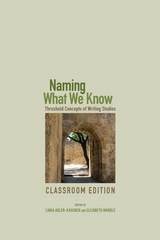
cover of Naming What We Know, Classroom Edition: Threshold Concepts of Writing Studies

Naming What We Know, Classroom Edition

Threshold Concepts of Writing Studies

Linda Adler-Kassner

Utah State University Press, 2016
Naming What We Know, Classroom Edition examines the core principles of knowledge in the discipline of writing studies, using the lens of “threshold concepts”—concepts that are critical for epistemological participation in a discipline. This edition focuses on the working definitions of thirty-seven threshold concepts that run throughout the research, teaching, assessment, and public work in writing studies. Developed from the highly regarded original edition in response to grassroots demand from teachers in writing programs around the United States and written by some of the field’s most active researchers and teachers, the classroom edition is clear and accessible for an audience of even first-year writing students.
[more]
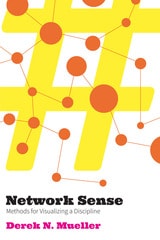
cover of Network Sense: Methods for Visualizing a Discipline

Network Sense

Methods for Visualizing a Discipline

Derek N. Mueller

University Press of Colorado, 2018
In this book, the first published in the #writing series, Derek N. Mueller offers a methodological response to recent efforts by scholars in rhetoric and composition/writing studies to account for patterns indicative of the discipline's maturation. Influenced by work on distant reading (Moretti, 2005) and thin description (Love, 2010 & 2013), this monograph attends to forms of knowledge newly available via computationally mined, aggregated data from large collections of texts, which is then used to build experimental models for discerning non-obvious relationships. By shedding light on large-scale patterns, the models promote what Mueller refers to as a network sense of the field, which regards these as crucial structures of participation for orienting newcomers to the shifting terrain of disciplinary knowledge and for sustaining a generalist's wherewithal in the midst of a growing archive of increasingly specialized scholarship.
[more]
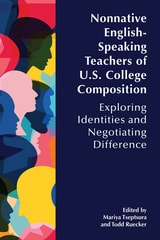
cover of Nonnative English-Speaking Teachers of U.S. College Composition: Exploring Identities and Negotiating Difference

Nonnative English-Speaking Teachers of U.S. College Composition

Exploring Identities and Negotiating Difference

Mariya Tseptsura

University Press of Colorado, 2024
Featuring the voices of 22 linguistically and geographically diverse authors from a variety of institutional contexts throughout the United States, this edited collection calls attention to the experiences of an important and growing group of writing instructors: those who have learned English as an additional language. Focusing on this critical part of the growing linguistic and cultural diversity of writing programs and classrooms, the contributors to his collection deepen our understanding of an important but relatively unexamined aspect of U.S. writing instruction. By exploring ways that writing programs can build on the strengths that multilingual students and teachers bring to the classroom, this collection offers promising strategies for creating more inclusive writing programs.
[more]
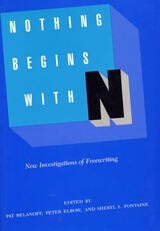
cover of Nothing Begins with N: New Investigations of Freewriting

Nothing Begins with N

New Investigations of Freewriting

Edited by Pat Belanoff, Peter Elbow, and Sheryl I. Fontaine

Southern Illinois University Press, 1991

The 16 essays in this book provide a theoretical underpinning for freewriting.

Sheryl I. Fontaine opens the book with a description of the organization, purpose, and content of students’ 10-minute unfocused freewriting.

Pat Belanoff discusses the relationship between skilled and unskilled student writers.

Richard H. Haswell analyzes forms of freewriting.

Lynn Hammond describes the focused freewriting strategies used in legal writing and in the analysis of poetry.

Joy Marsella and Thomas L. Hilgers suggest ways of teaching freewriting as a heuristic.

Diana George and Art Young show what teachers learned about the writing abilities of three engineering students through freewriting journals.

Anne E. Mullin seeks to determine whether freewriting lives up to claims made for it.

Barbara W. Cheshire assesses the efficacy of freewriting.

James W. Pennebaker checks the short- and long-term effects of freewriting on students’ emotional lives.

Ken Macrorie notes that freewriting means being freed to use certain powers.

Peter Elbow shows how authors use freewriting.

Robert Whitney tells "why I hate to freewrite."

Karen Ferro considers her own freewriting, showing how it leads to a deeper self-understanding.

Chris Anderson discusses the qualities in freewriting that we should maintain in revision.

Burton Hatlen shows the parallels between writing projective verse and freewriting.

Sheridan Blau describes the results of experiments with invisible writing.

[more]