Results by title
103 books match the query 'Conservation' and 5 start with n
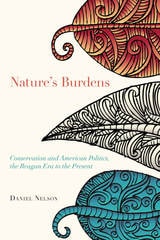
Nature's Burdens
Conservation and American Politics, The Reagan Era to the PresentDaniel Nelson
Utah State University Press, 2017
Nature’s Burdens is a political and intellectual history of American natural resource conservation from the 1980s into the twenty-first century—a period of intense political turmoil, shifting priorities among federal policymakers, and changing ideas about the goals of conservation. Telling a story of persistent activism, conflict, and frustration but also of striking achievement, it is an account of how new ideas and policies regarding human relationships to plants, animals, and their surroundings have become vital features of modern environmentalism.
In the 1960s and 1970s, Congress embraced the largely dormant movement to preserve distinctive landscapes and the growing demand for outdoor recreation, establishing an unprecedented number of parks, monuments, and recreation areas. The election of Ronald Reagan and a shift to a Republican-controlled Senate brought this activity to an abrupt halt and introduced a period of intense partisanship and legislative gridlock that extends to the present. In this political climate, three developments largely defined the role of conservation in contemporary society: environmental organizations have struggled to defend the legal status quo, private land conservation has become increasingly important, and the emergence of potent scientific voices has promoted the protection of animals and plants and injected a new sense of urgency into the larger cause.
These developments mark this period as a distinctive and important chapter in the history of American conservation. Scrupulously researched, scientifically and politically well informed, concise, and accessibly written, Nature’s Burdens is the most comprehensive examination of recent efforts to protect and enhance the natural world. It will be of interest to environmental historians, environmental activists, and any general reader interested in conservation.

Neotropical Birds
Ecology and ConservationDouglas F. Stotz, John W. Fitzpatrick, Theodore A. Parker III, and Debra K. Moskovits
University of Chicago Press, 1996
Because bird communities are good indicators of habitat type and condition, and because extensive bird surveys can be done quickly, bird communities are critical to rapid evaluations of an ecosystem's biological value and integrity. The authors analyze the bird species of major habitats from a conservation perspective, and develop specific guidelines to illustrate how governments, conservation organizations, and wildlife managers can use this ecological information to anchor conservation strategies on sound biological reality.
"Students of ecology and wildlife management, as well as conservationists, will benefit from this book . . . . Governmental and conservation agencies should use this book when making critical decisions about where to focus their efforts as they work to preserve the environment in fragile regions of the world." —Edward I. Saiff, Science Books & Films
Neotropical Wildlife Use and Conservation
Edited by John G. Robinson and Kent H. Redford
University of Chicago Press, 1991
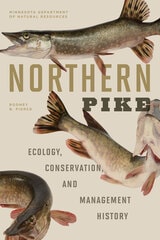
Northern Pike
Ecology, Conservation, and Management HistoryRodney B. Pierce
University of Minnesota Press, 2012
The northern pike—sometimes affectionately known as the “aquatic wolf”—is one of the most sought after and mythologized fishes in Minnesota, but until now there have been few books devoted to the history and ecological management of the species. Based on pioneering research carried out in Minnesota by leading pike specialist Rodney B. Pierce, Northern Pike Ecology, Conservation, and Management History is the most complete collection of information to date on the species, for everyone from scientists and conservation biologists to general readers and recreational anglers.
A tremendously important game fish and resource both in Minnesota and throughout the northern hemisphere, northern pike populations directly reflect local geology and human influence, playing a key role in the health of freshwater ecosystems. As urbanization spreads and the human population continues to grow, pike populations face increasing pressure, requiring new ways of looking at and managing the species. In Minnesota, groundbreaking work has been conducted on northern pike: analyses of stocking success and investigations into the relationships within fish communities, the management of rearing marshes, environmental effects on natural production, the genetics of northern pike, and strategies for scientifically monitoring pike. The state has been a leader in developing fishing regulations to help restore large pike, among many other measures designed to ensure the future quantity and health of a key species in Minnesota’s waterways.
Weaving significant historical scientific literature and technical details together with his own research, Pierce’s benchmark study documents and synthesizes the long history of northern pike management and describes the latest efforts being taken to better understand and manage this critical and renowned species.
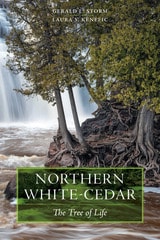
Northern White-Cedar
The Tree of LifeGerald L. Storm
Michigan State University Press, 2022