Results by title
459 books match the query 'Criminology' and 7 start with n

Natural Born Celebrities
Serial Killers in American CultureDavid Schmid
University of Chicago Press, 2005
David Schmid provides a historical account of how serial killers became famous and how that fame has been used in popular media and the corridors of the FBI alike. Ranging from H. H. Holmes, whose killing spree during the 1893 Chicago World's Fair inspired The Devil in the White City, right up to Aileen Wuornos, the lesbian prostitute whose vicious murder of seven men would serve as the basis for the hit film Monster, Schmid unveils a new understanding of serial killers by emphasizing both the social dimensions of their crimes and their susceptibility to multiple interpretations and uses. He also explores why serial killers have become endemic in popular culture, from their depiction in The Silence of the Lambs and The X-Files to their becoming the stuff of trading cards and even Web sites where you can buy their hair and nail clippings.
Bringing his fascinating history right up to the present, Schmid ultimately argues that America needs the perversely familiar figure of the serial killer now more than ever to manage the fear posed by Osama bin Laden since September 11.
Negotiating Responsibility in the Criminal Justice System
Edited by Jack Kamerman. Foreword by Gilbert Geis
Southern Illinois University Press, 1998
With this collection of essays, Jack Kamerman presents the first sustained examination of one of the underpinnings of the operation of the criminal justice system: the issue of responsibility for actions and, as a consequence, the issue of accountability.
Unique in the breadth of its approach, this volume examines the issue of responsibility from the perspectives of criminal justice professionals, sociologists, philosophers, and public administrators from four countries. Attacking the problem on various levels, the essayists look first at the assumptions made by criminal justice institutions regarding offender responsibility, then turn to the views of offenders on the causes of their own actions and to the consequences of offenders either to accept or deny responsibility.
These scholars also examine the social and psychological circumstances under which people in general accept or deny responsibility for what they do, thus providing the basis for understanding the process of social distance as a major precondition for people to commit atrocities without seeing themselves as responsible. Understanding the circumstances under which people either distance themselves from or embrace responsibility enables criminologists to make grounded recommendations for reordering responsibility in the criminal justice system and, more generally, for restoring a sense of responsibility to organizations, occupations, and society.
Aside from Kamerman, the contributors are William C. Collins, Charles Fethe, Gilbert Geis, Robert J. Kelly, Alison Liebling, Jess Maghan, Mark Harrison Moore, Paul Neurath, John Rakis, William Rentzmann, and José E. Sánchez.

Neither Villain nor Victim
Empowerment and Agency among Women Substance AbusersAnderson, Tammy
Rutgers University Press, 2008
Essays explore a range of topics, including the many ways that women negotiate the illicit drug world, how former drug addicts manage the more intimate aspects of their lives as they try to achieve abstinence, how women tend to use intervention resources more positively than their male counterparts, and how society can improve its response to female substance abusers by moving away from social controls (such as the criminalization of prostitution) and rehabilitative programs that have been shown to fail women in the long term.
Advancing important new perspectives about the position of women in the drug world, this book is essential reading in courses on women and crime, feminist theory, and criminal justice.

Neodomestic American Fiction
Kristin J. Jacobson
The Ohio State University Press, 2010
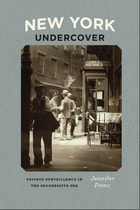
New York Undercover
Private Surveillance in the Progressive EraJennifer Fronc
University of Chicago Press, 2009
To combat behavior they viewed as sexually promiscuous, politically undesirable, or downright criminal, social activists in Progressive-era New York employed private investigators to uncover the roots of society’s problems. New York Undercover follows these investigators—often journalists or social workers with no training in surveillance—on their information-gathering visits to gambling parlors, brothels, and meetings of criminal gangs and radical political organizations.
Drawing on the hundreds of detailed reports that resulted from these missions, Jennifer Fronc reconstructs the process by which organizations like the National Civic Federation and the Committee of Fourteen generated the knowledge they needed to change urban conditions. This information, Fronc demonstrates, eventually empowered government regulators in the Progressive era and beyond, strengthening a federal state that grew increasingly repressive in the interest of pursuing a national security agenda. Revealing the central role of undercover investigation in both social change and the constitution of political authority, New York Undercover narrates previously untold chapters in the history of vice and the emergence of the modern surveillance state.
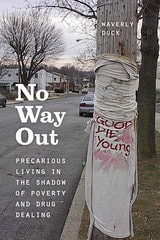
No Way Out
Precarious Living in the Shadow of Poverty and Drug DealingWaverly Duck
University of Chicago Press, 2015
Duck’s short stay in Bristol Hill quickly transformed into a long-term study—one that forms the core of No Way Out. This landmark book challenges the common misconception of urban ghettoes as chaotic places where drug dealing, street crime, and random violence make daily life dangerous for their residents. Through close observations of daily life in these neighborhoods, Duck shows how the prevailing social order ensures that residents can go about their lives in relative safety, despite the risks that are embedded in living amid the drug trade. In a neighborhood plagued by failing schools, chronic unemployment, punitive law enforcement, and high rates of incarceration, residents are knit together by long-term ties of kinship and friendship, and they base their actions on a profound sense of community fairness and accountability. Duck presents powerful case studies of individuals whose difficulties flow not from their values, or a lack thereof, but rather from the multiple obstacles they encounter on a daily basis.
No Way Out explores how ordinary people make sense of their lives within severe constraints and how they choose among unrewarding prospects, rather than freely acting upon their own values. What emerges is an important and revelatory new perspective on the culture of the urban poor.

Notorious New Jersey
100 True Tales of Murders and Mobsters, Scandals and ScoundrelsJon Blackwell
Rutgers University Press, 2007
Notorious New Jersey is the definitive guide to murder, mayhem, the mob, and corruption in the Garden State. With tabloid punch, Jon Blackwell tells riveting accounts of Alexander Hamilton falling mortally wounded on the dueling grounds of Weehawken; Dutch Schultz getting pumped full of lead in the men’s room of the Palace Chop House in Newark; and a gang of Islamic terrorists in Jersey City mixing the witch’s brew of explosives that became the first bomb to rock the World Trade Center. Along with these dramatic stories are tales of lesser-known oddities, such as the nineteenth-century murderer whose skin was turned into leather souvenirs, and the state senator from Jersey City who faked his death in a scuba accident in the 1970s in an effort to avoid prison.
Blackwell also sheds light on some historical whodunits—was Bruno Hauptmann really guilty of kidnapping the Lindbergh baby? Who was behind the anthrax attacks of 2001? Not forgotten either are notorious characters who may actually be innocent, including Rubin “Hurricane” Carter, and those who have never been convicted of wrongdoing although they left office in scandal, including Robert Torricelli and James McGreevey.
Through 100 historic true-crime tales that span over 300 years of history, Blackwell shows readers a side of New Jersey that would make even the Sopranos shudder.