Results by title
126 books match the query 'Decolonization' and 7 start with n
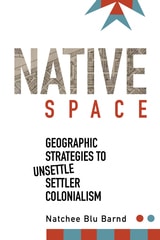
Native Space
Geographic Strategies to Unsettle Settler ColonialismNatchee Blu Barnd
Oregon State University Press, 2017
What are the limits and potentials of indigenous acts of spatial production? Native Space argues that control over the notion of “Indianness” still sits at the center of how space is produced in a neocolonial nation, and shows how non-indigenous communities uniquely deploy Native identities in the direct construction of colonial geographies. In short, “the Indian” serves to create White space in concrete ways. Yet, Native geographies effectively reclaim indigenous identities, assert ongoing relations to the land, and refuse the claims of settler colonialism.
Barnd creatively and persuasively uses original cartographic research and demographic data, a series of interrelated stories set in the Midwestern Plains states of Kansas and Oklahoma, an examination of visual art by contemporary indigenous artists, and discussions of several forms of indigenous activism to support his argument. With its highly original, interdisciplinary approach, Native Space makes a significant contribution to the literature in cultural and critical geography, comparative ethnic studies, indigenous studies, cultural studies, American Studies, and related fields.
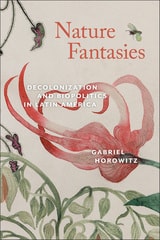
Nature Fantasies
Decolonization and Biopolitics in Latin AmericaGabriel Horowitz
Bucknell University Press, 2024
In this original study, Gabriel Horowitz examines the work of select nineteenth- and twentieth-century Latin American writers through the lens of contemporary theoretical debates about nature, postcoloniality, and national identity. In the work of José Martí, Gertrudis Gómez de Avellaneda, Jorge Luis Borges, Augusto Roa Bastos, Cesar Aira, and others, he traces historical constructions of nature in regional intellectual traditions and texts as they inform political culture on the broader global stage. By investigating national literary discourses from Cuba, Argentina, and Paraguay, he identifies a common narrative thread that imagines the utopian wilderness of the New World as a symbolic site of independence from Spain. In these texts, Horowitz argues, an expressed desire to return to the nation’s foundational nature contributed to a movement away from political and social engagement and toward a “biopolitical state,” in which nature, traditionally seen as pre-political, conversely becomes its center.
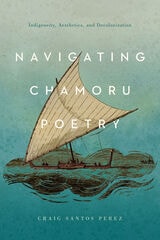
Navigating CHamoru Poetry
Indigeneity, Aesthetics, and DecolonizationCraig Santos Perez
University of Arizona Press, 2021
This book shows that CHamoru poetry has been an inspiring and empowering act of protest, resistance, and testimony in the decolonization, demilitarization, and environmental justice movements of Guåhan. Perez roots his intersectional cultural and literary analyses within the fields of CHamoru studies, Pacific Islands studies, Native American studies, and decolonial studies, using his research to assert that new CHamoru literature has been—and continues to be—a crucial vessel for expressing the continuities and resilience of CHamoru identities. This book is a vital contribution that introduces local, national, and international readers and scholars to contemporary CHamoru poetry and poetics.
Necropolitics
Achille Mbembe
Duke University Press, 2019
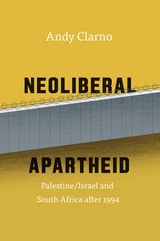
Neoliberal Apartheid
Palestine/Israel and South Africa after 1994Andy Clarno
University of Chicago Press, 2017
After a decade of research in the Johannesburg and Jerusalem regions, Andy Clarno presents here a detailed ethnographic study of the precariousness of the poor in Alexandra township, the dynamics of colonization and enclosure in Bethlehem, the growth of fortress suburbs and private security in Johannesburg, and the regime of security coordination between the Israeli military and the Palestinian Authority in the West Bank. The first comparative study of the changes in these two areas since the early 1990s, the book addresses the limitations of liberation in South Africa, highlights the impact of neoliberal restructuring in Palestine, and argues that a new form of neoliberal apartheid has emerged in both contexts.
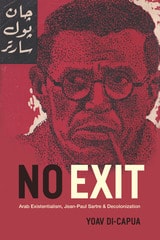
No Exit
Arab Existentialism, Jean-Paul Sartre, and DecolonizationYoav Di-Capua
University of Chicago Press, 2018
By closely following the remarkable career of Arab existentialism, Yoav Di-Capua reconstructs the cosmopolitan milieu of the generation that tried to articulate a political and philosophical vision for an egalitarian postcolonial world. He tells this story by touring a fascinating selection of Arabic and Hebrew archives, including unpublished diaries and interviews. Tragically, the warm and hopeful relationships forged between Arab intellectuals, Sartre, Simone de Beauvoir, and others ended when, on the eve of the 1967 war, Sartre failed to embrace the Palestinian cause. Today, when the prospect of global ethical engagement seems to be slipping ever farther out of reach, No Exit provides a timely, humanistic account of the intellectual hopes, struggles, and victories that shaped the Arab experience of decolonization and a delightfully wide-ranging excavation of existentialism’s non-Western history.
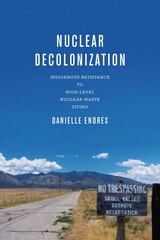
Nuclear Decolonization
Indigenous Resistance to High-Level Nuclear Waste SitingDanielle Endres
The Ohio State University Press, 2023
Honorable Mention, 2024 NCA Public Address Division’s Marie Hochmuth Nichols Award
Honorable Mention, 2025 Association for the Rhetoric of Science, Technology, and Medicine Book Award
While research demonstrates how Indigenous populations have been disproportionately affected by the global nuclear production complex, less attention has been given to tactics that have successfully resisted such projects. Danielle Endres’s Nuclear Decolonization shifts the conversation around nuclear colonialism in important ways, offering an account of how the Western Shoshone, Southern Paiute, and Skull Valley Goshute peoples and nations prevented two high-level nuclear waste sites from being built on their lands.
Using a decolonial approach, Endres highlights two sets of rhetorical tactics—Indigenous Lands rhetorics and national interest rhetorics—used to fight nuclear colonialism. The book reframes nuclear decolonization as fundamentally a struggle for the return of Indigenous lands while also revealing how Native activists selectively move between Indigenous nationhood and US citizenship in order to resist settler decision-making. Working at the intersection of Indigenous antinuclear advocacy, Indigenized environmental justice, and decolonization, Nuclear Decolonization centers Native activism and voices while amplifying the power and resilience of Indigenous peoples and nations.