Results by title
71 books match the query 'Digital' and 5 start with n
Natures of Data
A Discussion between Biologists, Artists and Science ScholarsPhilipp Fischer, Gabriele Gramelsberger, Christoph Hoffmann, Hans Hofmann, Hans-Jörg Rheinberger, and Hannes Rickli
Diaphanes, 2020
Necromedia
Marcel O'Gorman
University of Minnesota Press, 2015
In Necromedia, media activist Marcel O’Gorman takes aim at “the collusion of death and technology,” drawing on a broad arsenal that ranges from posthumanist philosophy and social psychology to digital art and handmade “objects-to-think-with.” Throughout, O’Gorman mixes philosophical speculation with artistic creation, personal memoir, and existential dread. He is not so much arguing against technoculture as documenting a struggle to embrace the technical essence of human being without permitting technology worshippers to have the last word on what it means to be human.
Inspired in part by the work of cultural anthropologist Ernest Becker, O’Gorman begins by suggesting that technology provides human beings with a cultural hero system built on the denial of death and a false promise of immortality. This theory adds an existential zest to the book, allowing the author not only to devise a creative diagnosis of what Bernard Stiegler has called the malaise of contemporary technoculture but also to contribute a potential therapy—one that requires embracing human finitude, infusing care into the process of technological production, and recognizing the vulnerability of all things, human and nonhuman. With this goal in mind, Necromedia prescribes new research practices in the humanities that involve both written work and the creation of objects-to-think-with that are designed to infiltrate and shape the technoculture that surrounds us.
New Media Futures
The Rise of Women in the Digital ArtsEdited by Donna J. Cox, Ellen Sandor, and Janine Fron
University of Illinois Press, 2018
Noise Channels
Glitch and Error in Digital CulturePeter Krapp
University of Minnesota Press, 2011
To err is human; to err in digital culture is design. In the glitches, inefficiencies, and errors that ergonomics and usability engineering strive to surmount, Peter Krapp identifies creative reservoirs of computer-mediated interaction. Throughout new media cultures, he traces a resistance to the heritage of motion studies, ergonomics, and efficiency; in doing so, he shows how creativity is stirred within the networks of digital culture.
Noise Channels offers a fresh look at hypertext and tactical media, tunes into laptop music, and situates the emergent forms of computer gaming and machinima in media history. Krapp analyzes text, image, sound, virtual spaces, and gestures in noisy channels of computer-mediated communication that seek to embrace—rather than overcome—the limitations and misfires of computing. Equally at home with online literature, the visual tactics of hacktivism, the recuperation of glitches in sound art, electronica, and videogames, or machinima as an emerging media practice, he explores distinctions between noise and information, and how games pivot on errors at the human–computer interface.
Grounding the digital humanities in the conditions of possibility of computing culture, Krapp puts forth his insight on the critical role of information in the creative process.
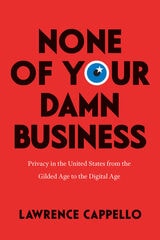
None of Your Damn Business
Privacy in the United States from the Gilded Age to the Digital AgeLawrence Cappello
University of Chicago Press, 2019
Every day, Americans surrender their private information to entities claiming to have their best interests in mind. This trade-off has long been taken for granted, but the extent of its nefariousness has recently become much clearer. As None of Your Damn Business reveals, the problem is not so much that data will be used in ways we don’t want, but rather how willing we have been to have our information used, abused, and sold right back to us. In this startling book, Lawrence Cappello targets moments from the past 130 years of US history when privacy was central to battles over journalistic freedom, national security, surveillance, big data, and reproductive rights. As he makes dismayingly clear, Americans have had numerous opportunities to protect the public good while simultaneously safeguarding our information, and we’ve squandered them every time. None of Your Damn Business is a rich and provocative survey of an alarming topic that grows only more relevant with each fresh outrage of trust betrayed.