436 books match the query 'Disability' and 5 start with n
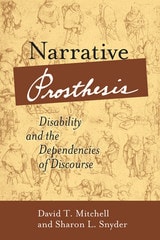
cover of Narrative Prosthesis: Disability and the Dependencies of Discourse

Narrative Prosthesis

Disability and the Dependencies of Discourse

David T. Mitchell and Sharon L. Snyder

University of Michigan Press, 2001
Narrative Prosthesis: Disability and the Dependencies of Discourse develops a narrative theory of the pervasive use of disability as a device of characterization in literature and film. It argues that, while other marginalized identities have suffered cultural exclusion due to a dearth of images reflecting their experience, the marginality of disabled people has occurred in the midst of the perpetual circulation of images of disability in print and visual media. The manuscript's six chapters offer comparative readings of key texts in the history of disability representation, including the tin soldier and lame Oedipus, Montaigne's "infinities of forms" and Nietzsche's "higher men," the performance history of Shakespeare's Richard III, Melville's Captain Ahab, the small town grotesques of Sherwood Anderson's Winesburg, Ohio and Katherine Dunn's self-induced freaks in Geek Love.
David T. Mitchell is Associate Professor of Literature and Cultural Studies, Northern Michigan University. Sharon L. Snyder is Assistant Professor of Film and Literature, Northern Michigan University.
[more]
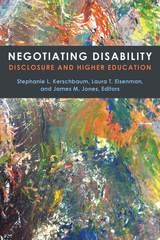
cover of Negotiating Disability: Disclosure and Higher Education

Negotiating Disability

Disclosure and Higher Education

Stephanie L. Kerschbaum, Laura T. Eisenman, and James M. Jones, Editors

University of Michigan Press, 2017
Disability is not always central to claims about diversity and inclusion in higher education, but should be. This collection reveals the pervasiveness of disability issues and considerations within many higher education populations and settings, from classrooms to physical environments to policy impacts on students, faculty, administrators, and staff.  While disclosing one’s disability and identifying shared experiences can engender moments of solidarity, the situation is always complicated by the intersecting factors of race and ethnicity, gender, sexuality, and class. With disability disclosure as a central point of departure, this collection of essays builds on scholarship that highlights the deeply rhetorical nature of disclosure and embodied movement, emphasizing disability disclosure as a complex calculus in which degrees of perceptibility are dependent on contexts, types of interactions that are unfolding, interlocutors’ long- and short-term goals, disabilities, and disability experiences, and many other contingencies.

 
[more]
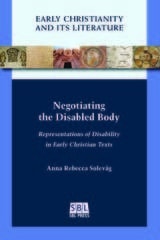
cover of Negotiating the Disabled Body: Representations of Disability in Early Christian Texts

Negotiating the Disabled Body

Representations of Disability in Early Christian Texts

Anna Rebecca Solevåg

SBL Press, 2018

An intersectional study of New Testament and noncanonical literature

Anna Rebecca Solevåg explores how nonnormative bodies are presented in early Christian literature through the lens of disability studies. In a number of case studies, Solevåg shows how early Christians struggled to come to terms with issues relating to body, health, and dis/ability in the gospel stories, apocryphal narratives, Pauline letters, and patristic expositions. Solevåg uses the concepts of narrative prosthesis, gaze and stare, stigma, monster theory, and crip theory to examine early Christian material to reveal the multiple, polyphonous, contradictory ways in which nonnormative bodies appear.

Features:

  • Case studies that reveal a variety of understandings, attitudes, medical frameworks, and taxonomies for how disabled bodies were interpreted
  • A methodology that uses disability as an analytical tool that contributes insights about cultural categories, ideas of otherness, and social groups’ access to or lack of power
  • An intersectional perspective drawing on feminist, gender, queer, race, class, and postcolonial studies
[more]
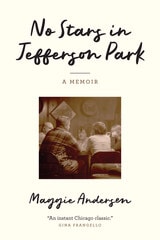
cover of No Stars in Jefferson Park: A Memoir

No Stars in Jefferson Park

A Memoir

Maggie Andersen

Northwestern University Press, 2026

A Chicagoan’s coming-of-age memoir finds courage in the face of immense loss

In her early twenties, Maggie Andersen was a founding ensemble member of Chicago’s storied Gift Theatre with her then-boyfriend, Michael Patrick Thornton. But after a series of spinal strokes left Thornton paralyzed, Andersen made the heart-wrenching decision to leave him, along with their growing company and, later, her beloved city. No Stars in Jefferson Park alternates between two narratives: the energy and excitement of making art in Chicago’s thriving storefront theater scene and the devastating day-to-day realities of rehabilitation and rebuilding—and somewhere in the middle finding the courage to choose yourself.

Over the past twenty-plus years, the Gift—now performing in the working-class neighborhood of Portage Park—has become one of the most vital storefront theaters in Chicago, with Thornton’s career taking him to Hollywood and Broadway. But Andersen’s story has brought her back home. No Stars in Jefferson Park is a testament to lifelong friendship, a love letter to Chicago, and a profound coming-of-age story about the pain and necessity of putting yourself first.
[more]
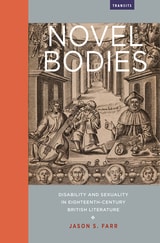
cover of Novel Bodies: Disability and Sexuality in Eighteenth-Century British Literature

Novel Bodies

Disability and Sexuality in Eighteenth-Century British Literature

Jason S. Farr

Bucknell University Press, 2019

Novel Bodies examines how disability shapes the British literary history of sexuality. Jason Farr shows that various eighteenth-century novelists represent disability and sexuality in flexible ways to reconfigure the political and social landscapes of eighteenth-century Britain. In imagining the lived experience of disability as analogous to—and as informed by—queer genders and sexualities, the authors featured in Novel Bodies expose emerging ideas of able-bodiedness and heterosexuality as interconnected systems that sustain dominant models of courtship, reproduction, and degeneracy. Further, Farr argues that they use intersections of disability and queerness to stage an array of contemporaneous debates covering topics as wide-ranging as education, feminism, domesticity, medicine, and plantation life. In his close attention to the fiction of Eliza Haywood, Samuel Richardson, Sarah Scott, Maria Edgeworth, and Frances Burney, Farr demonstrates that disabled and queer characters inhabit strict social orders in unconventional ways, and thus opened up new avenues of expression for readers from the eighteenth century forward.


Published by Bucknell University Press. Distributed worldwide by Rutgers University Press.
[more]