Results by title
138 books match the query 'Discovery and exploration' and 4 start with n
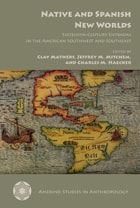
Native and Spanish New Worlds
Sixteenth-Century Entradas in the American Southwest and SoutheastEdited by Clay Mathers, Jeffrey M. Mitchem, and Charles M. Haecker
University of Arizona Press, 2013
Spanish-led entradas—expeditions bent on the exploration and control of new territories—took place throughout the sixteenth century in what is now the southern United States. Although their impact was profound, both locally and globally, detailed analyses of these encounters are notably scarce. Focusing on several major themes—social, economic, political, military, environmental, and demographic—the contributions gathered here explore not only the cultures and peoples involved in these unique engagements but also the wider connections and disparities between these borderlands and the colonial world in general during the first century of Native–European contact in North America. Bringing together research from both the southwestern and southeastern United States, this book offers a comparative synthesis of Native–European contacts and their consequences in both regions. The chapters also engage at different scales of analysis, from locally based research to macro-level evaluations, using documentary, paleoclimatic, and regional archaeological data.
No other volume assembles such a wide variety of archaeological, ethnohistorical, environmental, and biological information to elucidate the experience of Natives and Europeans in the early colonial world of Northern New Spain, and the global implications of entradas during this formative period in borderlands history.
No other volume assembles such a wide variety of archaeological, ethnohistorical, environmental, and biological information to elucidate the experience of Natives and Europeans in the early colonial world of Northern New Spain, and the global implications of entradas during this formative period in borderlands history.
[more]
Natives of My Person
George Lamming
University of Michigan Press, 1992
A compelling novel of slavery and colonialism
[more]
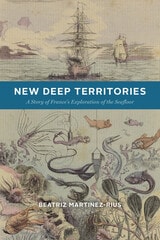
New Deep Territories
A Story of France’s Exploration of the SeafloorBeatriz Martinez-Rius
University of Chicago Press, 2026
How France integrated the seafloor into its national territory through an interplay of science, technology, and geopolitical ambition during the Cold War.
Beneath the surface of the seas and oceans lies a territory as important for human societies as the exposed land and the airspace above them: the seafloor. Our daily life is inextricably linked to the seafloor and its resources, from global telecommunications infrastructure to offshore oil and gas extraction to strategic mineral mining.
By focusing on France, a country with an underwater territory seventeen times larger than its emerged lands, New Deep Territories explains how the seafloor emerged as a territory during the second half of the twentieth century. Beatriz Martinez-Rius traces the evolution of the country’s seafloor exploration and the motivations that fueled it from the aftermath of World War I to the late 1970s. In the early 1960s, the seafloor, instead of colonial territories, came to be seen as a source of natural resources. The French government, corporations such as oil companies, and scientists all imagined future uses of the seafloor, and these ever-evolving aspirations drove the development of technologies, techniques, and scientific fields that built up the submerged territory. Government officers and industrial stakeholders massively invested in technoscientific development to prepare for a future reliant on seafloor resources, including oil, gas, and minerals, well before it was technologically possible, economically feasible, and legally acceptable to extract them. The future they envisioned did not arrive, but their investment resulted in an unprecedented understanding of the ocean’s crust. Today, once again, national governments, international organizations, and private stakeholders are turning their attention to the seafloor.
[more]
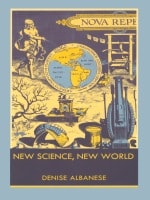
New Science, New World
Denise Albanese
Duke University Press, 1996
In New Science, New World Denise Albanese examines the discursive interconnections between two practices that emerged in the seventeenth century—modern science and colonialism. Drawing on the discourse analysis of Foucault, the ideology-critique of Marxist cultural studies, and de Certeau’s assertion that the modern world produces itself through alterity, she argues that the beginnings of colonialism are intertwined in complex fashion with the ways in which the literary became the exotic “other” and undervalued opposite of the scientific.
Albanese reads the inaugurators of the scientific revolution against the canonical authors of early modern literature, discussing Galileo’s Dialogue on the Two Chief World Systems and Bacon’s New Atlantis as well as Milton’s Paradise Lost and Shakespeare’s The Tempest. She examines how the newness or “novelty” of investigating nature is expressed through representations of the New World, including the native, the feminine, the body, and the heavens. “New” is therefore shown to be a double sign, referring both to the excitement associated with a knowledge oriented away from past practices, and to the oppression and domination typical of the colonialist enterprise. Exploring the connections between the New World and the New Science, and the simultaneously emerging patterns of thought and forms of writing characteristic of modernity, Albanese insists that science is at its inception a form of power-knowledge, and that the modern and postmodern division of “Two Cultures,” the literary and the scientific, has its antecedents in the early modern world.
New Science, New World makes an important contribution to feminist, new historicist, and cultural materialist debates about the extent to which the culture of seventeenth-century England is proto-modern. It will offer scholars and students from a wide range of fields a new critical model for historical practice.
[more]