Results by title
808 books match the query 'Drama' and 8 start with n

Nabucodonosor
Dramma lirico in Four Parts by Temistocle SoleraGiuseppe Verdi
University of Chicago Press, 1988
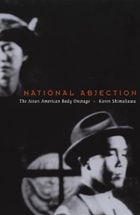
National Abjection
The Asian American Body OnstageKaren Shimakawa
Duke University Press, 2002
Shimakawa looks at the origins of Asian American theater, particularly through the memories of some of its pioneers. Her examination of the emergence of Asian American theater companies illuminates their strategies for countering the stereotypes of Asian Americans and the lack of visibility of Asian American performers within the theater world. She shows how some plays—Wakako Yamauchi’s 12-1-A, Frank Chin’s Chickencoop Chinaman, and The Year of the Dragon—have both directly and indirectly addressed the displacement of Asian Americans. She analyzes works attempting to negate the process of abjection—such as the 1988 Broadway production of M. Butterfly as well as Miss Saigon, a mainstream production that enacted the process of cultural displacement both onstage and off. Finally, Shimakawa considers Asian Americanness in the context of globalization by meditating on the work of Ping Chong, particularly his East-West Quartet.
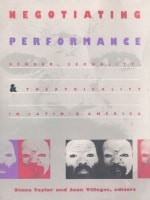
Negotiating Performance
Gender, Sexuality, and Theatricality in Latin/o AmericaDiana Taylor and Juan Villegas, ed.
Duke University Press, 1994
The Latin/o America examined here stretches from Patagonia to New York City, bridging the political and geographical divides between U.S. Latinos and Latin Americans. Moving from Nuyorican casitas in the South Bronx, to subversive street performances in Buenos Aires, to border art from San Diego/Tijuana, this volume negotiates the borders that bring Americans together and keep them apart, while at the same time debating the use of the contested term "Latino/a." In the emerging dialogue, contributors reenvision an inclusive "América," a Latin/o America that does not pit nationality against ethnicity—in other words, a shared space, and a home to all Latin/o Americans.
Negotiating Performance opens up the field of Latin/o American theater and performance criticism by looking at performance work by Mayans, women, gays, lesbians, and other marginalized groups. In so doing, this volume will interest a wide audience of students and scholars in feminist and gender studies, theater and performance studies, and Latin American and Latino cultural studies.
Contributors. Judith Bettelheim, Sue-Ellen Case, Juan Flores, Jean Franco, Donald H. Frischmann, Guillermo Gómez-Peña, Jorge Huerta, Tiffany Ana López, Jacqueline Lazú, María Teresa Marrero, Cherríe Moraga, Kirsten F. Nigro, Patrick O’Connor, Jorge Salessi, Alberto Sandoval, Cynthia Steele, Diana Taylor, Juan Villegas, Marguerite Waller
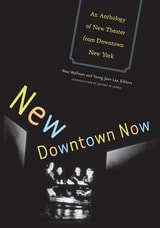
New Downtown Now
An Anthology Of New Theater From Downtown New YorkMac Wellman
University of Minnesota Press, 2006
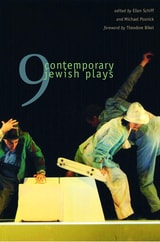
Nine Contemporary Jewish Plays
Edited by Ellen Schiff and Michael Posnick
University of Texas Press, 2005
Jewish theatre—plays about and usually by Jews—enters the twenty-first century with a long and distinguished history. To keep this vibrant tradition alive, the National Foundation for Jewish Culture established the New Play Commissions in Jewish Theatre in 1994. The commissions are awarded in an annual competition. Their goal is to help emerging and established dramatists develop new works in collaboration with a wide variety of theatres. Since its inception, the New Play Commissions has contributed support to more than seventy-five professional productions, staged readings, and workshops.
This anthology brings together nine commissioned plays that have gone on to full production. Ellen Schiff and Michael Posnick have selected works that reflect many of the historical and social forces that have shaped contemporary Jewish experience and defined Jewish identity—among them, surviving the Holocaust, the Israeli-Palestinian conflict, and the lives of newcomers in America, Israel, and Argentina. Following a foreword by Theodore Bikel, the editors provide introductory explanations of the New Play Commissions and an overview of Jewish theatre. The playwrights comment on the genesis of their work and its production history.

None a Stranger There
England and/in Europe on the Early Modern StageEdited by Scott Oldenburg and Matteo Pangallo
University of Alabama Press, 2025

Not God
A Play in VerseMarc J. Straus
Northwestern University Press, 2006
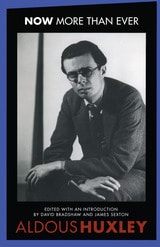
Now More Than Ever
By Aldous Huxley
University of Texas Press, 2000
Over the course of his career, British writer Aldous Huxley (1894-1963) shifted away from elitist social satires and an atheistic outlook toward greater concern for the masses and the use of religious terms and imagery. This change in Huxley's thinking underlies the previously unpublished play Now More Than Ever.
Written in 1932-1933 just after Brave New World, Now More Than Ever is a response to the social, economic, and political upheavals of its time. Huxley's protagonist is an idealistic financier whose grandiose schemes for controlling the means of production drive him to swindling and finally to suicide. His fate allows Huxley to expose the evils he perceives in free-market capitalism while pleading the case for national economic planning and the rationalization of Britain's industrial base.
This volume contains the full text of Now More Than Ever, which was believed to be lost until 1976, when a copy was found at the Harry Ransom Humanities Research Center of the University of Texas at Austin. A "thinker's play" that has never been produced on stage, it is the last previously unpublished piece of Huxley's major writings and immensely important to understanding his development as a writer. The editors of this volume have annotated the play for contemporary readers. Their introduction sets the play in the context of Huxley's intellectual life.