Results by title
126 books match the query 'Early modern, 1500-1700' and 3 start with n
New Perspectives on the Life and Art of Richard Crashaw
Edited by John R. Roberts
University of Missouri Press, 1990
Richard Crashaw (1612/13-1649) has been one of the most neglected, misunderstood, misread, and unappreciated of the so-called major metaphysical poets. Critics have long labeled Crashaw’s poetry “foreign,” “grotesque,: “deficient in judgment and taste,” and even “sexually perverse.” In recent years, however, Crashaw’s role in providing an understanding and appreciation of seventeenth century poetic theory and aesthetics has become increasingly more evident to literary scholars and critics. They now generally agree that his poetry occupies a permanent and significant position in the intellectual, religious, and literary history of his time.
This collection of ten original critical and historical essays on the life and art of Crashaw will serve as a further impetus to the renewed interest in Crashaw. In the introduction, John R. Roberts and Lorraine M. Roberts survey past Crashavian criticism, giving the reader an overall view of the critical response to Crashaw and his work. The introduction also signals new directions for future scholarship. Scholars, critics, and students of metaphysical, baroque, and religious poetry will find these essays engaging and insightful.
New Science, New World
Denise Albanese
Duke University Press, 1996
Albanese reads the inaugurators of the scientific revolution against the canonical authors of early modern literature, discussing Galileo’s Dialogue on the Two Chief World Systems and Bacon’s New Atlantis as well as Milton’s Paradise Lost and Shakespeare’s The Tempest. She examines how the newness or “novelty” of investigating nature is expressed through representations of the New World, including the native, the feminine, the body, and the heavens. “New” is therefore shown to be a double sign, referring both to the excitement associated with a knowledge oriented away from past practices, and to the oppression and domination typical of the colonialist enterprise. Exploring the connections between the New World and the New Science, and the simultaneously emerging patterns of thought and forms of writing characteristic of modernity, Albanese insists that science is at its inception a form of power-knowledge, and that the modern and postmodern division of “Two Cultures,” the literary and the scientific, has its antecedents in the early modern world.
New Science, New World makes an important contribution to feminist, new historicist, and cultural materialist debates about the extent to which the culture of seventeenth-century England is proto-modern. It will offer scholars and students from a wide range of fields a new critical model for historical practice.
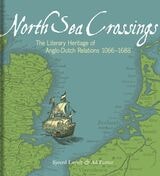
North Sea Crossings
The Literary Heritage of Anglo-Dutch Relations 1066–1688Sjoerd Levelt and Ad Putter
Bodleian Library Publishing, 2022
This richly illustrated book tells the story of cultural exchange between the people of the Low Countries and England in the Middle Ages and the Early Modern period, revealing how Anglo-Dutch connections changed the literary landscape on both sides of the North Sea.
Ranging from the Norman Conquest of 1066 to the “Glorious Revolution” of 1688, North Sea Crossings uncovers the lasting impact of contacts and collaborations between Dutch and English speakers on historical writing, map-making, manuscript production, and early printing. The literary heritage of Anglo-Dutch relations is explored and lavishly illustrated through a unique collection of manuscripts, early prints, maps, and other treasures from the Bodleian Library.