Results by title
347 books match the query 'Early works to 1800' and 6 start with n
Natural Questions
Lucius Annaeus Seneca
University of Chicago Press, 2010
Lucius Annaeus Seneca (4 BCE–65 CE) was a Roman Stoic philosopher, dramatist, statesman, and adviser to the emperor Nero, all during the Silver Age of Latin literature. The Complete Works of Lucius Annaeus Seneca is a fresh and compelling series of new English-language translations of his works in seven accessible volumes. Edited by world-renowned classicists Elizabeth Asmis, Shadi Bartsch, and Martha C. Nussbaum, this engaging collection restores Seneca—whose works have been highly praised by modern authors from Desiderius Erasmus to Ralph Waldo Emerson—to his rightful place among the classical writers most widely studied in the humanities.
Written near the end of Seneca’s life, Natural Questions is a work in which Seneca expounds and comments on the natural sciences of his day—rivers and earthquakes, wind and snow, meteors and comets—offering us a valuable look at the ancient scientific mind at work. The modern reader will find fascinating insights into ancient philosophical and scientific approaches to the physical world and also vivid evocations of the grandeur, beauty, and terror of nature.
Natural and Moral History of the Indies
José de Acosta
Duke University Press, 2002
A significant contribution to Renaissance Europe's thinking about the New World, Acosta's Natural and Moral History of the Indies reveals an effort to incorporate new information into a Christian, Renaissance worldview. He attempted to confirm for his European readers that a "new" continent did indeed exist and that human beings could and did live in equatorial climates. A keen observer and prescient thinker, Acosta hypothesized that Latin America's indigenous peoples migrated to the region from Asia, an idea put forth more than a century before Europeans learned of the Bering Strait. Acosta's work established a hierarchical classification of Amerindian peoples and thus contributed to what today is understood as the colonial difference in Renaissance European thinking.
New Observations on the French Language, with Praises of Illustrious Learned Women
Marguerite Buffet
Iter Press, 2023
According to the few historical records that mention Marguerite Buffet, she lived her entire life in seventeenth-century Paris where she taught French to aristocratic women. Buffet’s vivid example of proper language use in New Observations on the French Language offers a rare glimpse into the life, habits, and culture of seventeenth-century France. She describes common errors in contemporary language use and gives examples of correct expressions for speaking and writing all the while encouraging women to aspire to higher levels of intellectual achievement.
In addition, her Praises of Illustrious Learned Women, a catalog of biographies of women who displayed exemplary intellect, wit, and conversation, includes a number of the author’s contemporaries such as Anna Maria van Schurman and Madeleine de Scudéry. Buffet’s collected praises of these women, many of whom were connected to the court of Louis XIV, show her unique position as both a participant in and historian of the intellectual and social world of the French salon.
This volume presents Buffet’s work in its near entirety for the first time in English, bringing to light Buffet’s unique contribution to the centuries-long debate concerning the status of women known as the querelle des femmes.
New Philosophy of Human Nature
Neither Known to Nor Attained by the Great Ancient Philosophers, Which Will Improve Human Life and HelathOliva Sabuco de Nantes Barrera
University of Illinois Press, 2006
Fifty years before Descartes, Sabuco posited a dualism that accounted for mind/body interaction. She was first among the moderns to argue that the brain--not the heart--controls the body. Her account also anticipates the role of cerebrospinal fluid, the relationship between mental and physical health, and the absorption of nutrients through digestion. This extensively annotated translation features an ample introduction demonstrating the work’s importance to the history of science, philosophy of medicine, and women’s studies.

Newton's Optical Writings
A Guided StudyDennis Sepper
Rutgers University Press, 1994
Isaac Newton’s classic writings on light and optics are the heart of this volume in the series, Masterworks of Discovery: Guided Studies of Great Texts in Science. The innovative series is aimed at making the great works of scientific discovery accessible to students and lay readers. For each volume, distinguished historians of science have carefully selected original texts (or extracts) and accompanied them with interpretive commentary, explanatory notes, and bio-bibliographical material. These volumes are not synopses or histories to take the place of the original works. Instead, they enable non-specialists to read these classics for themselves and take an active part in discovering the excitement of scientific discovery.
Newton first revealed his scientific genius in his pathbreaking work on optics and the properties of light. Through Newton’s early 1672 letter to the Royal Society and long extracts from his mature work, Opticks (1704), the reader can follow Newton’s own descriptions of his experiments on prisms and films, his arguments about white and colored light and the “particle” nature of light, and his influential remarks on scientific method. Dennis Sepper’s deft commentaries, diagrams, and notes help clarify difficulties that modern readers are apt to encounter in Newton’s language and science. Sepper also provides an engaging sketch of Newton’s life, the scientific background to these discoveries, and their aftermath.
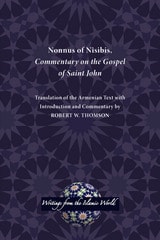
Nonnus of Nisibis, Commentary on the Gospel of Saint John
Robert W. Thomson
SBL Press, 2014
A new English translation of the first text translated from Arabic to Armenian for research and classroom use
Robert W. Thomson translates this ninth-century commentary defending the miaphysite theological position of the Armenian church against the chalcedonian position of the Greek Byzantine church. Nonnus’s exegesis of the gospel falls in the context of trends in Eastern Christian biblical exposition, primarily the Syrian tradition. Therefore, Thomson emphasizes the parallels in Syriac commentaries on the book of John, noting also earlier Greek writers whose works were influential in Syria. This book is essential reading for anyone interested in the Armenian church and church history.
Features:
- Introductory material on the text’s history, manuscript traditions, and theological importance
- Translation of the Armenian text and commentary
- Bibliography covering the Armenian, Greek, Syriac, and Arabic texts as well as secondary sources