Results by title
577 books match the query 'Earth Sciences' and 13 start with n
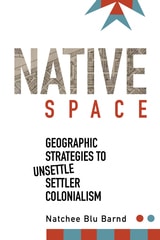
Native Space
Geographic Strategies to Unsettle Settler ColonialismNatchee Blu Barnd
Oregon State University Press, 2017
What are the limits and potentials of indigenous acts of spatial production? Native Space argues that control over the notion of “Indianness” still sits at the center of how space is produced in a neocolonial nation, and shows how non-indigenous communities uniquely deploy Native identities in the direct construction of colonial geographies. In short, “the Indian” serves to create White space in concrete ways. Yet, Native geographies effectively reclaim indigenous identities, assert ongoing relations to the land, and refuse the claims of settler colonialism.
Barnd creatively and persuasively uses original cartographic research and demographic data, a series of interrelated stories set in the Midwestern Plains states of Kansas and Oklahoma, an examination of visual art by contemporary indigenous artists, and discussions of several forms of indigenous activism to support his argument. With its highly original, interdisciplinary approach, Native Space makes a significant contribution to the literature in cultural and critical geography, comparative ethnic studies, indigenous studies, cultural studies, American Studies, and related fields.
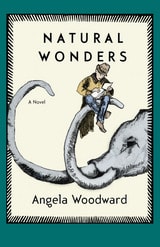
Natural Wonders
A NovelAngela Woodward, Foreword by Stacey Levine
University of Alabama Press, 2016
Natural Wonders is a novel in the form of a series of lectures about the earth and its prehistory. In it, a grieving widow assembles an idiosyncratic history of the earth’s history based on her understanding and impressions of her deceased husband’s papers.
In Natural Wonders, Jenny is given the task of assembling a memorial edition of her recently deceased husband Jonathan’s lecture series about the physical history of the earth. With little knowledge of his work or of Jonathan himself, Jenny constructs from his fragmentary and disorganized notes her own version of our planet’s past.
Presented as a series of lectures, Jenny’s earth history is an amalgam of stories from science and about scientists—a Serbian mathematician and his theory of the ice ages, a Swiss doctor camped on a glacier, the mysterious materia pinguis thought to have drifted down from stars to form fossils. Into these stories she interweaves scenes from their marriage as well as material she finds on Jonathan’s shelves. In her history, an explanation of continental drift becomes enmeshed with a schoolboy’s erotic encounter with an older woman. Icebergs in an Andean lake launch a woman’s jealous affair with a third-rate actor, and H. G. Wells’s Island of Dr. Moreau is dramatically recounted in new form.
Natural Wonders mixes mythology, popular fiction, and a misfired romance with the story of the earth hurtling around the sun. From intimately human to geologic to cosmic, it explores change, love, and loss.
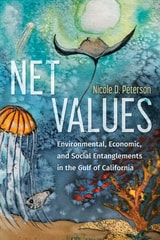
Net Values
Environmental, Economic, and Social Entanglements in the Gulf of CaliforniaNicole D. Peterson
University of Arizona Press, 2025
In Loreto, Baja California Sur, Mexico, artisanal fishing families and staff of Loreto Bay National Park face an array of choices as tourism, environmental concerns, and economic precarity challenge livelihoods and natural resource availability. In Net Values, Nicole D. Peterson offers a critical examination of how the idea of “choice” is understood, and what it means for policies, planning, and programs to ignore the social, political, economic, and cultural contexts surrounding these choices.
Anchored by more than twenty years of research, Peterson provides insight into the fishing community of Loreto and reveals an important role in decision-making that diverges from previous studies. She argues that decisions about fishing, natural resource management, and other aspects of life are influenced by context, values, and expectations in ways that go beyond the typical psychological or cognitive theories of choice. Instead, Net Values highlights the ways that choices are constrained and enabled by values and expectations of cultures, histories, relationships, and experiences, both personal and shared. Peterson answers questions such as “why do the fishermen fish?” or “what is the marine park staff doing?” These decisions and choices are related to the larger implication addressed by this book: that in order to make effective policies around natural resource management and other issues, we must understand how those potential policies interact with the decision processes already underway.
Divided into five chapters, Net Values is rich in ethnographic detail, drawing from real people to inform the narratives, chapters, and theoretical elaboration. Peterson’s interactions with fishers such as Don Javier and his family and friends support the ideas offered around choice, values, and strategies, connecting ideas to real experiences.
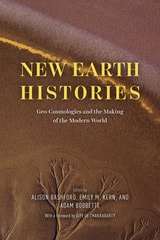
New Earth Histories
Geo-Cosmologies and the Making of the Modern WorldEdited by Alison Bashford, Emily M. Kern, and Adam Bobbette
University of Chicago Press, 2023
This book brings the history of the geosciences and world cosmologies together, exploring many traditions, including Chinese, Pacific, Islamic, South and Southeast Asian conceptions of the earth’s origin and makeup. Together the chapters ask: How have different ideas about the sacred, animate, and earthly changed modern environmental sciences? How have different world traditions understood human and geological origins? How does the inclusion of multiple cosmologies change the meaning of the Anthropocene and the global climate crisis? By carefully examining these questions, New Earth Histories sets an ambitious agenda for how we think about the earth.
The chapters consider debates about the age and structure of the earth, how humans and earth systems interact, and how empire has been conceived in multiple traditions. The methods the authors deploy are diverse—from cultural history and visual and material studies to ethnography, geography, and Indigenous studies—and the effect is to highlight how earth knowledge emerged from historically specific situations. New Earth Histories provides both a framework for studying science at a global scale and fascinating examples to educate as well as inspire future work. Essential reading for students and scholars of earth science history, environmental humanities, history of science and religion, and science and empire.

New England Weather, New England Climate
Gregory A. Zielinski
University of New Hampshire Press, 2005
Combining a scholarly appreciation of weather systems and events with an ability to transmit their passion to a general audience, Gregory A. Zielinski and Barry D. Keim have written a one-of-a-kind guide to New England weather and climate. Not only are weather patterns in New England more changeable and more extreme than almost anywhere in the country, New England is the ultimate destination of nearly all storm tracks nationwide. Recently, newsworthy items such as global warming, El Niño, and La Niña have significantly impacted our local weather, in both the short and long term. Luckily, the science of meteorology and climatology and their tools of observation and analysis have made great strides in the past few years.
The authors offer an in-depth explanation of the latest theoretical insights into New England's weather along with a flurry of stories and lore about the vagaries of our clime. The book is divided into the seasons as we actually experience them—ski season, mud season, beach and lake season, and foliage season. It includes photos and illustrations: some all too familiar, many hard to believe. Zielinski and Keim succeed in providing an illuminating and entertaining analysis and commentary while whole-heartedly embracing our region's atmospheric peculiarities. This book won't do anything about New England's weather or climate but it will help you understand each of them.
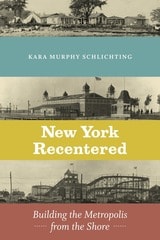
New York Recentered
Building the Metropolis from the ShoreKara Murphy Schlichting
University of Chicago Press, 2019
The history of New York City’s urban development often centers on titanic municipal figures like Robert Moses and on prominent inner Manhattan sites like Central Park. New York Recentered boldly shifts the focus to the city’s geographic edges—the coastlines and waterways—and to the small-time unelected locals who quietly shaped the modern city. Kara Murphy Schlichting details how the vernacular planning done by small businessmen and real estate operators, performed independently of large scale governmental efforts, refigured marginal locales like Flushing Meadows and the shores of Long Island Sound and the East River in the late nineteenth and early twentieth centuries. The result is a synthesis of planning history, environmental history, and urban history that recasts the story of New York as we know it.

Newton's Optical Writings
A Guided StudyDennis Sepper
Rutgers University Press, 1994
Isaac Newton’s classic writings on light and optics are the heart of this volume in the series, Masterworks of Discovery: Guided Studies of Great Texts in Science. The innovative series is aimed at making the great works of scientific discovery accessible to students and lay readers. For each volume, distinguished historians of science have carefully selected original texts (or extracts) and accompanied them with interpretive commentary, explanatory notes, and bio-bibliographical material. These volumes are not synopses or histories to take the place of the original works. Instead, they enable non-specialists to read these classics for themselves and take an active part in discovering the excitement of scientific discovery.
Newton first revealed his scientific genius in his pathbreaking work on optics and the properties of light. Through Newton’s early 1672 letter to the Royal Society and long extracts from his mature work, Opticks (1704), the reader can follow Newton’s own descriptions of his experiments on prisms and films, his arguments about white and colored light and the “particle” nature of light, and his influential remarks on scientific method. Dennis Sepper’s deft commentaries, diagrams, and notes help clarify difficulties that modern readers are apt to encounter in Newton’s language and science. Sepper also provides an engaging sketch of Newton’s life, the scientific background to these discoveries, and their aftermath.
Nineteenth-Century Geographies
The Transformation of Space from the Victorian Age to the American CenturyThomas, Ronald R
Rutgers University Press, 2002
The nineteenth century was a time of unprecedented discovery and exploration throughout the globe, a period when the “blank spaces” of the earth were systematically investigated, occupied, and exploited by the major imperial powers of Western Europe and the United States. The lived experience of space was also changing in dramatic ways for people as a result of new developments in technology, communication, and transportation. As a result, the century was characterized by a new and intense interest in place, both local and global.
The collection is comprised of seventeen essays from various disciplines organized into four areas of geographic concern. The first, “Time Zones,” examines several ways that place gets expressed as time during the period, how geography becomes history. A second grouping, “Commodities and Exchanges,” explores the role of geographic origin as it was embodied in particular objects, from the souvenir map to imported tea. The set of essays on “Domestic Fronts” moves the discussion from the public to the private sphere by looking at how domestic space became defined in terms of its boundary with the foreign. The final section, “Orientations,” takes up the changing relations of bodies, identities, and the spaces they inhabit and through which they moved. The collection as a whole also traces the development of the discipline of geography with its different institutional and political trajectories in the United States and Great Britain.
No Dig, No Fly, No Go
How Maps Restrict and ControlMark Monmonier
University of Chicago Press, 2010
Some maps help us find our way; others restrict where we go and what we do. These maps control behavior, regulating activities from flying to fishing, prohibiting students from one part of town from being schooled on the other, and banishing certain individuals and industries to the periphery. This restrictive cartography has boomed in recent decades as governments seek regulate activities as diverse as hiking, building a residence, opening a store, locating a chemical plant, or painting your house anything but regulation colors. It is this aspect of mapping—its power to prohibit—that celebrated geographer Mark Monmonier tackles in No Dig, No Fly, No Go.
Rooted in ancient Egypt’s need to reestablish property boundaries following the annual retreat of the Nile’s floodwaters, restrictive mapping has been indispensable in settling the American West, claiming slices of Antarctica, protecting fragile ocean fisheries, and keeping sex offenders away from playgrounds. But it has also been used for opprobrium: during one of the darkest moments in American history, cartographic exclusion orders helped send thousands of Japanese Americans to remote detention camps. Tracing the power of prohibitive mapping at multiple levels—from regional to international—and multiple dimensions—from property to cyberspace—Monmonier demonstrates how much boundaries influence our experience—from homeownership and voting to taxation and airline travel. A worthy successor to his critically acclaimed How to Lie with Maps, the book is replete with all of the hallmarks of a Monmonier classic, including the wry observations and witty humor.
In the end, Monmonier looks far beyond the lines on the page to observe that mapped boundaries, however persuasive their appearance, are not always as permanent and impermeable as their cartographic lines might suggest. Written for anyone who votes, owns a home, or aspires to be an informed citizen, No Dig, No Fly. No Go will change the way we look at maps forever.
Nonfuel Minerals
Foreign Dependence and National SecurityRaymond F. Mikesell
University of Michigan Press, 1987
Nonsense on Stilts
How to Tell Science from BunkMassimo Pigliucci
University of Chicago Press, 2010
Recent polls suggest that fewer than 40 percent of Americans believe in Darwin’s theory of evolution, despite it being one of science’s best-established findings. More and more parents are refusing to vaccinate their children for fear it causes autism, though this link can been consistently disproved. And about 40 percent of Americans believe that the threat of global warming is exaggerated, despite near consensus in the scientific community that manmade climate change is real.
Why do people believe bunk? And what causes them to embrace such pseudoscientific beliefs and practices? Noted skeptic Massimo Pigliucci sets out to separate the fact from the fantasy in this entertaining exploration of the nature of science, the borderlands of fringe science, and—borrowing a famous phrase from philosopher Jeremy Bentham—the nonsense on stilts. Presenting case studies on a number of controversial topics, Pigliucci cuts through the ambiguity surrounding science to look more closely at how science is conducted, how it is disseminated, how it is interpreted, and what it means to our society. The result is in many ways a “taxonomy of bunk” that explores the intersection of science and culture at large.
No one—not the public intellectuals in the culture wars between defenders and detractors of science nor the believers of pseudoscience themselves—is spared Pigliucci’s incisive analysis. In the end, Nonsense on Stilts is a timely reminder of the need to maintain a line between expertise and assumption. Broad in scope and implication, it is also ultimately a captivating guide for the intelligent citizen who wishes to make up her own mind while navigating the perilous debates that will affect the future of our planet.
North Woods River
The St. Croix River in Upper Midwest HistoryEileen M. McMahon and Theodore J. Karamanski
University of Wisconsin Press, 2009
North Woods River is a thoughtful biography of the river over the course of more than three hundred years. Eileen McMahon and Theodore Karamanski track the river’s social and environmental transformation as newcomers changed the river basin and, in turn, were changed by it. The history of the St. Croix revealed here offers larger lessons about the future management of beautiful and fragile wild waters.
Novel Science
Fiction and the Invention of Nineteenth-Century GeologyAdelene Buckland
University of Chicago Press, 2013