Results by title
94 books match the query 'Economy' and 3 start with n
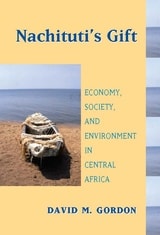
Nachituti's Gift
Economy, Society, and Environment in Central AfricaDavid M. Gordon
University of Wisconsin Press, 2006
Nachituti’s Gift challenges conventional theories of economic development with a compelling comparative case study of inland fisheries in Zambia and Congo from pre- to postcolonial times. Neoclassical development models conjure a simple, abstract progression from wealth held in people to money or commodities; instead, Gordon argues, primary social networks and oral charters like “Nachituti’s Gift” remained decisive long after the rise of intensive trade and market activities. Interweaving oral traditions, songs, and interviews as well as extensive archival research, Gordon’s lively tale is at once a subtle analysis of economic and social transformations, an insightful exercise in environmental history, and a revealing study of comparative politics.
“A powerful portrayal of the complexity, fluidity, and subtlety of Lake Mweru fishers’ production strategies . . . . Natchituti’s Gift adds nuance and evidence to some of the most important and sophisticated conversations going on in African studies today.”—Kirk Arden Hoppe, International Journal of African Historical Studies
“A lively and intelligent book, which offers a solid contribution to ongoing debates about the interplay of the politics of environment, history and economy.”—Joost Fontein, Africa
“Well researched and referenced . . . . [Natchituti’s Gift] will be of interest to those in a wide variety of disciplines including anthropology, African Studies, history, geography, and environmental studies.”—Heidi G. Frontani, H-SAfrica

Nationalism and the Economy
Explorations into a Neglected RelationshipStefan Berger
Central European University Press, 2019

No Way to Run an Economy
Why the System Failed and How to Put It RightGraham Turner
Pluto Press, 2009
In The Credit Crunch, Graham Turner predicted that banks would be nationalised and interest rates would be reduced too slowly to halt the crisis. His predictions were correct. His new book, No Way to Run an Economy, is the essential guide to the turbulent times ahead.
Turner recommended radical measures, such as quantitative easing, in early 2008 but argues that action has been taken too late and been too timid to make a real difference. He dissects the policy mistakes of the last 12 months including Obama's doomed market-led response to the crisis and the obsession of central banks with the red herring of inflation.
There is no doubt the economy is still in serious trouble, but Turner shows that learning from the mistakes made so far can prevent a situation worse than that of the 1930s crisis.