Results by title
403 books match the query 'Environmental Science' and 11 start with n
Narratives of Educating for Sustainability in Unsustainable Environments
Jane Haladay
Michigan State University Press, 2017
National Parks Forever
Fifty Years of Fighting and a Case for IndependenceJonathan B. Jarvis and T. Destry Jarvis
University of Chicago Press, 2022
The US National Parks, what environmentalist and historian Wallace Stegner called America’s “best idea,” are under siege. Since 1972, partisan political appointees in the Department of the Interior have offered two conflicting views of the National Park Service (NPS): one vision emphasizes preservation and science-based decision-making, and another prioritizes economic benefits and privatization. These politically driven shifts represent a pernicious, existential threat to the very future of our parks.
For the past fifty years, brothers Jonathan B. and T. Destry Jarvis have worked both within and outside NPS as leaders and advocates. National Parks Forever interweaves their two voices to show how our parks must be protected from those who would open them to economic exploitation, while still allowing generations to explore and learn in them. Their history also details how Congress and administration appointees have used budget and staffing cuts to sabotage NPS’s ability to manage the parks and even threatened their existence. Drawing on their experience, Jarvis and Jarvis make a bold and compelling proposal: that it is time for NPS to be removed from the Department of the Interior and made an independent agency, similar to the Smithsonian Institution, giving NPS leaders the ability to manage park resources and plan our parks’ protection, priorities, and future.
National Parks Forever
Fifty Years of Fighting and a Case for IndependenceJonathan B. Jarvis and T. Destry Jarvis
University of Chicago Press, 2022
This is an auto-narrated audiobook edition of this book.
Two leaders of the National Park Service provide a front-row seat to the disastrous impact of partisan politics over the past fifty years—and offer a bold vision for the parks’ future.
The US National Parks, what environmentalist and historian Wallace Stegner called America’s “best idea,” are under siege. Since 1972, partisan political appointees in the Department of the Interior have offered two conflicting views of the National Park Service (NPS): one vision emphasizes preservation and science-based decision-making, and another prioritizes economic benefits and privatization. These politically driven shifts represent a pernicious, existential threat to the very future of our parks.
For the past fifty years, brothers Jonathan B. and T. Destry Jarvis have worked both within and outside NPS as leaders and advocates. National Parks Forever interweaves their two voices to show how our parks must be protected from those who would open them to economic exploitation, while still allowing generations to explore and learn in them. Their history also details how Congress and administration appointees have used budget and staffing cuts to sabotage NPS’s ability to manage the parks and even threatened their existence. Drawing on their experience, Jarvis and Jarvis make a bold and compelling proposal: that it is time for NPS to be removed from the Department of the Interior and made an independent agency, similar to the Smithsonian Institution, giving NPS leaders the ability to manage park resources and plan our parks’ protection, priorities, and future.
Natural Coincidence
The Trip from KalamazooBil Gilbert
University of Michigan Press, 2004
Natural Coincidence collects some of Bil Gilbert's finest writing, covering a diverse range of subjects that include investigations of the biology of Tasmanian devils, the lives and loves of snapping turtles, and an appreciation of the intelligence of crows. Perfectly suiting this eclectic choice of angles is Gilbert's unique writing style, a blend of unprepossessing erudition, wit, and honesty that has been compared to Aldo Leopold's Sand County Almanac.
The collection opens with a memoir of a childhood Christmas in western Michigan, before Gilbert's fascination with the natural world drew him to more exotic locales like Tasmania, Alaska, Nova Scotia, and Manhattan to write about such topics as the javelina, bigfoot, buffalo, and ringtails.
"More than 50 years ago," writes Gilbert, "without a clear notion about why or where I was going, I set off on a trip from Kalamazoo, Michigan. I am still traveling toward an unknown destination. But along the way, much more for reasons of good luck than thoughtful planning, I have met many wonderful beings and happenings. The essays appearing in Natural Coincidence represent an attempt to describe some of these wonders. I like to think, or at least pretend, that the inspiration for and theme of this book is gratitude."
Natural Communities
Lee R. Dice
University of Michigan Press, 1952
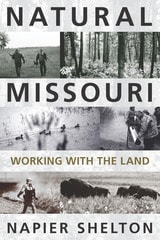
Natural Missouri
Working with the LandNapier Shelton
University of Missouri Press, 2005
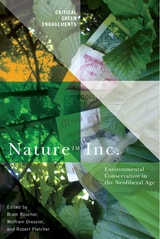
Nature Inc.
Environmental Conservation in the Neoliberal AgeEdited by Bram Büscher, Wolfram Dressler, and Robert Fletcher
University of Arizona Press, 2014
As public funding for conservation efforts grows ever scarcer and the private sector is brimming with ideas about how its role—along with its profits— can grow, market forces have found their way into environmental management to a degree unimaginable only a few years ago. Ecotourism, payment for environmental services (PES), and new conservation finance instruments such as species banking, carbon trading, and biodiversity derivatives are only some of the market mechanisms that have sprung into being. This is “Nature™ Inc.”: a fast-growing frontier of networks, activities, knowledge, and regulations that are rapidly changing the relations between people and nature on both global and local scales.
Nature™ Inc. brings together cutting-edge research by respected scholars from around the world to analyze how “neoliberal conservation” is reshaping human–nature relations that have been fashioned over two centuries of capitalist development. Contributors synthesize and add to a growing body of academic literature that cuts across the disciplinary boundaries of geography, sociology, anthropology, political science, and development studies to critically interrogate the increasing emphasis on neoliberal market-based mechanisms in environmental conservation. They all grapple with one overriding question: can capitalist market mechanisms resolve the environmental problems they have helped create?
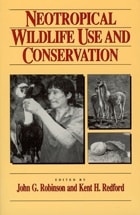
Neotropical Wildlife Use and Conservation
Edited by John G. Robinson and Kent H. Redford
University of Chicago Press, 1991
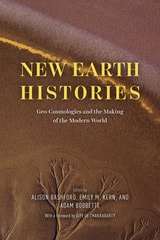
New Earth Histories
Geo-Cosmologies and the Making of the Modern WorldEdited by Alison Bashford, Emily M. Kern, and Adam Bobbette
University of Chicago Press, 2023
This book brings the history of the geosciences and world cosmologies together, exploring many traditions, including Chinese, Pacific, Islamic, South and Southeast Asian conceptions of the earth’s origin and makeup. Together the chapters ask: How have different ideas about the sacred, animate, and earthly changed modern environmental sciences? How have different world traditions understood human and geological origins? How does the inclusion of multiple cosmologies change the meaning of the Anthropocene and the global climate crisis? By carefully examining these questions, New Earth Histories sets an ambitious agenda for how we think about the earth.
The chapters consider debates about the age and structure of the earth, how humans and earth systems interact, and how empire has been conceived in multiple traditions. The methods the authors deploy are diverse—from cultural history and visual and material studies to ethnography, geography, and Indigenous studies—and the effect is to highlight how earth knowledge emerged from historically specific situations. New Earth Histories provides both a framework for studying science at a global scale and fascinating examples to educate as well as inspire future work. Essential reading for students and scholars of earth science history, environmental humanities, history of science and religion, and science and empire.
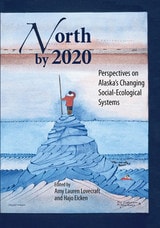
North by 2020
Perspectives on Alaska’s Changing Social-Ecological SystemsEdited by Amy Lauren Lovecraft and Hajo Eicken
University of Alaska Press, 2011
Originating from a series of workshops held at the Alaska Forum of the Fourth International Polar Year, this interdisciplinary volume addresses a host of current concerns regarding the ecology and rapid transformation of the arctic. Concentrating on the most important linked social-ecological systems, including fresh water, marine resources, and oil and gas development, this volume explores opportunities for sustainable development from a variety of perspectives, among them social sciences, natural and applied sciences, and the arts. Individual chapters highlight expressions of climate change in dance, music, and film, as well as from an indigenous knowledge–based perspective.
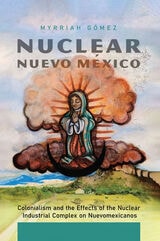
Nuclear Nuevo México
Colonialism and the Effects of the Nuclear Industrial Complex on NuevomexicanosMyrriah Gómez
University of Arizona Press, 2022
Contrary to previous works that suppress Nuevomexicana/o presence throughout U.S. nuclear history, Nuclear Nuevo México focuses on recovering the voices and stories that have been lost or ignored in the telling of this history. By recuperating these narratives, Myrriah Gómez tells a new story of New Mexico, one in which the nuclear history is not separate from the collective colonial history of Nuevo México but instead demonstrates how earlier eras of settler colonialism laid the foundation for nuclear colonialism in New Mexico.
Gómez examines the experiences of Nuevomexicanas/os who have been impacted by the nuclear industrial complex, both the weapons industry and the commercial industry. Gómez argues that Los Alamos was created as a racist project that targeted poor and working-class Nuevomexicana/o farming families, along with their Pueblo neighbors, to create a nuclear empire. The resulting imperialism has left a legacy of disease and distress throughout New Mexico that continues today.