230 books match the query 'Ethnicity' and 13 start with n

cover of Nakagami, Japan: Buraku and the Writing of Ethnicity

Nakagami, Japan

Buraku and the Writing of Ethnicity

Anne McKnight

University of Minnesota Press, 2010

How do you write yourself into a literature that doesn’t know you exist? This was the conundrum confronted by Nakagami Kenji (1946–1992), who counted himself among the buraku-min, Japan’s largest minority. His answer brought the histories and rhetorical traditions of buraku writing into the high culture of Japanese literature for the first time and helped establish him as the most canonical writer born in postwar Japan.

In Nakagami, Japan, Anne McKnight shows how the writer’s exploration of buraku led to a unique blend of fiction and ethnography—which amounted to nothing less than a reimagining of modern Japanese literature. McKnight develops a parallax view of Nakagami’s achievement, allowing us to see him much as he saw himself, as a writer whose accomplishments traversed both buraku literary arts and high literary culture in Japan.

As she considers the ways in which Nakagami and other twentieth-century writers used ethnography to shape Japanese literature, McKnight reveals how ideas about language also imagined a transfigured relation to mainstream culture and politics. Her analysis of the resulting “rhetorical activism” lays bare Nakagami’s unique blending of literature and ethnography within the context of twentieth-century ideas about race, ethnicity, and citizenship—in Japan, but also on an international scale.
[more]
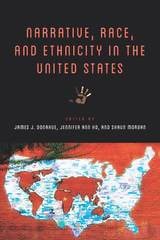
cover of Narrative, Race, and Ethnicity in the United States

Narrative, Race, and Ethnicity in the United States

Edited by James J. Donahue, Jennifer Ann Ho, and Shaun Morgan

The Ohio State University Press, 2017

Narrative, Race, and Ethnicity in the United States, edited by James J. Donahue, Jennifer Ho, and Shaun Morgan, is the first book-length volume of essays devoted to studying the intersection of race/ethnicity and narrative theories. Each chapter offers a sustained engagement with narrative theory and critical race theory as applied to ethnic American literature, exploring the interpretive possibilities of this critical intersection. Taken as a whole, these chapters demonstrate some of the many ways that the formal study of narrative can help us better understand the racial/ethnic tensions of narrative fictions. Similarly, the essays advance the tools of narrative theory by redeploying or redesigning those tools to better account for and articulate the ways that race and ethnicity are formal components of narrative as well as thematic issues.
 
Recognizing that racial/ethnic issues and tensions are often contextualized geographically, this volume focuses on narratives associated with various racial and ethnic communities in the United States. By engaging with new developments in narrative theory and critical race studies, this volume demonstrates the vitality of using the tools of narratology and critical race theory together to understand how race influences narrative and how narratology illuminates a reading of race in ethnic American literature.
 
[more]
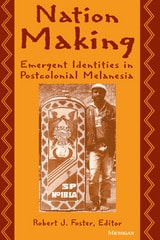
cover of Nation Making: Emergent Identities in Postcolonial Melanesia

Nation Making

Emergent Identities in Postcolonial Melanesia

Robert J. Foster, Editor

University of Michigan Press, 1997


In this theoretically sophisticated volume, contributors examine the process of nation making in Fiji, Papua New Guinea, the Solomon Islands, and Vanuatu- states that attained formal political independence between 1970 and 1980. The remarkable cultural diversity within these states demands close ethnographic study of different groups and their contesting definitions of nationhood and leads to highly original approaches.

The essays explore the political conditions and cultural assumptions that inform how Melanesians variously imagine a national community. The authors interpret a wide range of materials, from political speeches and official ceremonies of state to newspaper advertisements and life crisis rites. They demonstrate both how the legacies of divisive colonial rule, the weakness of the postcolonial state, and the exigencies of capitalist markets undermine the processes of nation making in contemporary Melanesia and how new forms of popular and consumer culture potentially shape an emergent national consciousness.

Comparative and historical in its orientation, this book will appeal to readers not only in anthropology but in political science, social history, and cultural studies. It will be of special value to those interested in comparative politics and history, Pacific studies, ethnicity and nationalism, and colonial and postcolonial studies.

Robert J. Foster is Assistant Professor of Anthropology, University of Rochester.
[more]
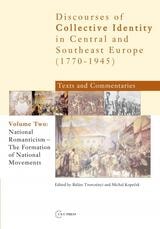
cover of National Romanticism: The Formation of National Movements

National Romanticism

The Formation of National Movements

Miroslav Hroch

Central European University Press, 2007
67 texts, including hymns, manifestos, articles or extracts from lengthy studies exemplify the relation between Romanticism and the national movements in the cultural space ranging from Poland to the Ottoman Empire. Each text is accompanied by a presentation of the author, and by an analysis of the context in which the respective work was born.The end of the 18th century and first decades of the 19th were in many respects a watershed period in European history. The ideas of the Enlightenment and the dramatic convulsions of the French Revolution had shattered the old bonds and cast doubt upon the established moral and social norms of the old corporate society. In culture a new trend, Romanticism, was successfully asserting itself against Classicism and provided a new key for a growing number of activists to 're-imagine' their national community, reaching beyond the traditional frameworks of identification (such as the 'political nation', regional patriotism, or Christian universalism). The collection focuses on the interplay of Romantic cultural discourses and the shaping of national ideology throughout the 19th century, tracing the patterns of cultural transfer with Western Europe as well as the mimetic competition of national ideologies within the region.
[more]
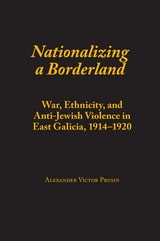
cover of Nationalizing a Borderland: War, Ethnicity, and Anti-Jewish Violence in East Galicia, 1914–1920

Nationalizing a Borderland

War, Ethnicity, and Anti-Jewish Violence in East Galicia, 1914–1920

Alexander Victor Prusin

University of Alabama Press, 2005

Nationalizing a Borderland enriches understanding of ethnic conflict by examining the factors in the Austro-Hungarian province of Galicia between 1914 and 1920 that led to the rise of xenophobic nationalism and to the ethnocide of World War II. From Russian, Polish, Ukrainian, and Austrian archival sources, Prusin argues that while the violence inflicted upon Jews during that period may at first seem irrational and indiscriminate, a closer examination reveals that it was generated by traditional antisemitism and by the security concerns of the Russian and Polish militaries in the front zone. This violence, Prusin contends, served as a means of reshaping the socio-economic and political space of the province by diminishing Jewish cultural and economic influence.
[more]
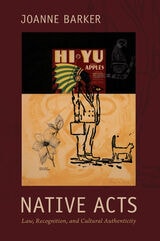
cover of Native Acts: Law, Recognition, and Cultural Authenticity

Native Acts

Law, Recognition, and Cultural Authenticity

Joanne Barker

Duke University Press, 2011
In the United States, Native peoples must be able to demonstrably look and act like the Natives of U.S. national narrations in order to secure their legal rights and standing as Natives. How they choose to navigate these demands and the implications of their choices for Native social formations are the focus of this powerful critique. Joanne Barker contends that the concepts and assumptions of cultural authenticity within Native communities potentially reproduce the very social inequalities and injustices of racism, ethnocentrism, sexism, homophobia, and fundamentalism that define U.S. nationalism and, by extension, Native oppression. She argues that until the hold of these ideologies is genuinely disrupted by Native peoples, the important projects for decolonization and self-determination defining Native movements and cultural revitalization efforts are impossible. These projects fail precisely by reinscribing notions of authenticity that are defined in U.S. nationalism to uphold relations of domination between the United States and Native peoples, as well as within Native social and interpersonal relations. Native Acts is a passionate call for Native peoples to decolonize their own concepts and projects of self-determination.
[more]
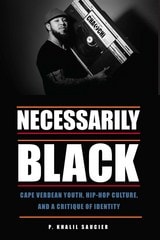
cover of Necessarily Black: Cape Verdean Youth, Hip-Hop Culture, and a Critique of Identity

Necessarily Black

Cape Verdean Youth, Hip-Hop Culture, and a Critique of Identity

P. Khalil Saucier

Michigan State University Press, 2015
Necessarily Black is an ethnographic account of second-generation Cape Verdean youth identity in the United States and a theoretical attempt to broaden and complicate current discussions about race and racial identity in the twenty-first century. P. Khalil Saucier grapples with the performance, embodiment, and nuances of racialized identities (blackened bodies) in empirical contexts. He looks into the durability and (in)flexibility of race and racial discourse through an imbricated and multidimensional understanding of racial identity and racial positioning. In doing so, Saucier examines how Cape Verdean youth negotiate their identity within the popular fabrication of “multiracial America.” He also explores the ways in which racial blackness has come to be lived by Cape Verdean youth in everyday life and how racialization feeds back into the experience of these youth classified as black through a matrix of social and material settings. Saucier examines how ascriptions of blackness and forms of black popular culture inform subjectivities. The author also examines hip-hop culture to see how it is used as a site where new (and old) identities of being, becoming, and belonging are fashioned and reworked. Necessarily Black explores race and how Cape Verdean youth think and feel their identities into existence, while keeping in mind the dynamics and politics of racialization, mixed-race identities, and anti-blackness.
[more]
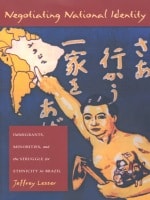
cover of Negotiating National Identity: Immigrants, Minorities, and the Struggle for Ethnicity in Brazil

Negotiating National Identity

Immigrants, Minorities, and the Struggle for Ethnicity in Brazil

Jeffrey Lesser

Duke University Press, 1999

Despite great ethnic and racial diversity, ethnicity in Brazil is often portrayed as a matter of black or white, a distinction reinforced by the ruling elite’s efforts to craft the nation’s identity in its own image—white, Christian, and European. In Negotiating National Identity Jeffrey Lesser explores the crucial role ethnic minorities from China, Japan, North Africa, and the Middle East have played in constructing Brazil’s national identity, thereby challenging dominant notions of nationality and citizenship.
Employing a cross-cultural approach, Lesser examines a variety of acculturating responses by minority groups, from insisting on their own whiteness to becoming ultra-nationalists and even entering secret societies that insisted Japan had won World War II. He discusses how various minority groups engaged in similar, and successful, strategies of integration even as they faced immense discrimination and prejudice. Some believed that their ethnic heritage was too high a price to pay for the “privilege” of being white and created alternative categories for themselves, such as Syrian-Lebanese, Japanese-Brazilian, and so on. By giving voice to the role ethnic minorities have played in weaving a broader definition of national identity, this book challenges the notion that elite discourse is hegemonic and provides the first comprehensive look at Brazilian worlds often ignored by scholars.
Based on extensive research, Negotiating National Identity will be valuable to scholars and students in Brazilian and Latin American studies, as well as those in the fields of immigrant history, ethnic studies, and race relations.
[more]
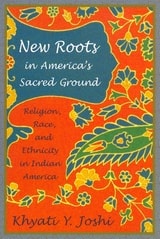
cover of New Roots in America's Sacred Ground: Religion, Race, and Ethnicity in Indian America

New Roots in America's Sacred Ground

Religion, Race, and Ethnicity in Indian America

Joshi, Khyati Y

Rutgers University Press, 2006

In this compelling look at second-generation Indian Americans, Khyati Y. Joshi draws on case studies and interviews with forty-one second-generation Indian Americans, analyzing their experiences involving religion, race, and ethnicity from elementary school to adulthood.  As she maps the crossroads they encounter as they navigate between their homes and the wider American milieu, Joshi shows how their identities have developed differently from their parents’ and their non-Indian peers’ and how religion often exerted a dramatic effect.

The experiences of Joshi’s research participants reveal how race and religion interact, intersect, and affect each other in a society where Christianity and whiteness are the norm. Joshi shows how religion is racialized for Indian Americans and offers important insights in the wake of 9/11 and the backlash against Americans who look Middle Eastern and South Asian.

Through her candid insights into the internal conflicts contemporary Indian Americans face and the religious and racial discrimination they encounter, Joshi provides a timely window into the ways that race, religion, and ethnicity interact in day-to-day life.
[more]
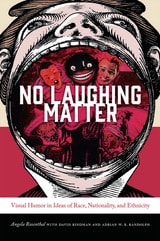
cover of No Laughing Matter: Visual Humor in Ideas of Race, Nationality, and Ethnicity

No Laughing Matter

Visual Humor in Ideas of Race, Nationality, and Ethnicity

Edited by Angela Rosenthal, David Bindman, and Adrian W. B. Randolph

Dartmouth College Press, 2015

In the wake of the Charlie Hebdo attacks, this collection—which gathers scholars in the fields of race, ethnicity, and humor—seems especially urgent. Inspired by Denmark’s Muhammad cartoons controversy, the contributors inquire into the role that racial and ethnic stereotypes play in visual humor and the thin line that separates broad characterization as a source of humor from its power to shock or exploit. The authors investigate the ways in which humor is used to demean or give identity to racial, national, or ethnic groups and explore how humor works differently in different media, such as cartoons, photographs, film, video, television, and physical performance. This is a timely and necessary study that will appeal to scholars across disciplines.
[more]
cover of No Safe Spaces: Re-casting Race, Ethnicity, and Nationality in American Theater

No Safe Spaces

Re-casting Race, Ethnicity, and Nationality in American Theater

Angela C. Pao

University of Michigan Press, 2010

"No Safe Spaces opens up a conversation beyond narrow polemics . . . Although cross-racial casting has been the topic of heated discussion, little sustained scholarship addresses both the historical precedents and theoretical dimensions. Pao illustrates the tensions and contradictions inherent not only in stage representations, but also in the performance of race in everyday life. A wonderful book whose potential readership goes well beyond theater and performance scholars."
---Josephine Lee, University of Minnesota

"Non-traditional casting, increasingly practiced in American theater, is both deeply connected to our country's racial self-image(s) and woefully under-theorized. Pao takes on the practice in its entirety to disentangle the various strands of this vitally important issue."
---Karen Shimakawa, New York University

No Safe Spaces looks at one of the most radical and enduring changes introduced during the Civil Rights era---multiracial and cross-racial casting practices in American theater. The move to cast Latino/a, African American, and Asian American actors in classic stage works by and about white Europeans and Americans is viewed as both social and political gesture and artistic innovation. Nontraditionally cast productions are shown to have participated in the national dialogue about race relations and ethnic identity and served as a source of renewed creativity for the staging of the canonical repertory.

Multiracial casting is explored first through its history, then through its artistic, political, and pragmatic dimensions. Next, the book focuses on case studies from the dominant genres of contemporary American theater: classical tragedy and comedy, modern domestic drama, antirealist drama, and the Broadway musical, using a broad array of archival source materials to enhance and illuminate its arguments.

Angela C. Pao is Associate Professor of Comparative Literature at Indiana University.

A volume in the series Theater: Theory/Text/Performance
[more]
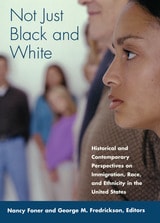
cover of Not Just Black and White: Historical and Contemporary Perspectives on Immgiration, Race, and Ethnicity in the United States

Not Just Black and White

Historical and Contemporary Perspectives on Immgiration, Race, and Ethnicity in the United States

Nancy Foner

Russell Sage Foundation, 2004

Immigration is one of the driving forces behind social change in the United States, continually reshaping the way Americans think about race and ethnicity. How have various racial and ethnic groups—including immigrants from around the globe, indigenous racial minorities, and African Americans—related to each other both historically and today? How have these groups been formed and transformed in the context of the continuous influx of new arrivals to this country? In Not Just Black and White, editors Nancy Foner and George M. Fredrickson bring together a distinguished group of social scientists and historians to consider the relationship between immigration and the ways in which concepts of race and ethnicity have evolved in the United States from the end of the nineteenth century to the present. Not Just Black and White opens with an examination of historical and theoretical perspectives on race and ethnicity. The late John Higham, in the last scholarly contribution of his distinguished career, defines ethnicity broadly as a sense of community based on shared historical memories, using this concept to shed new light on the main contours of American history. The volume also considers the shifting role of state policy with regard to the construction of race and ethnicity. Former U.S. census director Kenneth Prewitt provides a definitive account of how racial and ethnic classifications in the census developed over time and how they operate today. Other contributors address the concept of panethnicity in relation to whites, Latinos, and Asian Americans, and explore socioeconomic trends that have affected, and continue to affect, the development of ethno-racial identities and relations. Joel Perlmann and Mary Waters offer a revealing comparison of patterns of intermarriage among ethnic groups in the early twentieth century and those today. The book concludes with a look at the nature of intergroup relations, both past and present, with special emphasis on how America's principal non-immigrant minority—African Americans—fits into this mosaic. With its attention to contemporary and historical scholarship, Not Just Black and White provides a wealth of new insights about immigration, race, and ethnicity that are fundamental to our understanding of how American society has developed thus far, and what it may look like in the future.
[more]
cover of Not from Here: A Memoir

Not from Here

A Memoir

Allan Johnson

Temple University Press, 2015

When Allan Johnson asked his dying father where he wanted his ashes to be placed, his father replied—without hesitation—that it made no difference to him at all. In his poignant, powerful memoir, Not from Here, Johnson embarks on an extraordinary, 2,000-mile journey across the Upper Midwest and Northern Plains to find the place where his father’s ashes belonged.
 
As a white man with Norwegian and English lineage, Johnson explores both America and the question of belonging to a place whose history holds the continuing legacy of the displacement, dispossession, and genocide of Native peoples.
 
More than a personal narrative, Not from Here illuminates the national silence around unresolved questions of accountability, race, and identity politics, and the dilemma of how to take responsibility for “a past we did not create.” Johnson’s story—about the past living in the present; of redemption, fate, family, tribe, and nation; of love and grief—raises profound questions about belonging, identity, and place.
[more]