Results by title
375 books match the query 'Excavations (Archaeology)' and 8 start with n

Networks of Power
Political Relations in the Late Postclassic Naco ValleyEdward Schortman
University Press of Colorado, 2011
Describing the material and behavioral patterns pertaining to the Late Postclassic period using components of three settlements in the Naco Valley of northwestern Honduras, the book focuses on how contests for power shaped political structures. Power-seeking individuals, including but not restricted to ruling elites, depended on networks of allies to support their political objectives. Ongoing and partially successful competitions waged within networks led to the incorporation of exotic ideas and imported items into the daily practices of all Naco Valley occupants. The result was a fragile hierarchical structure forever vulnerable to the initiatives of agents operating on local and distant stages.
Networks of Power describes who was involved in these competitions and in which networks they participated; what resources were mustered within these webs; which projects were fueled by these assets; and how, and to what extent, they contributed to the achievement of political aims.
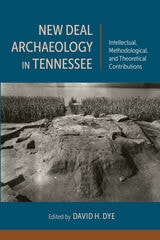
New Deal Archaeology in Tennessee
Intellectual, Methodological, and Theoretical ContributionsEdited by David H. Dye
University of Alabama Press, 2016
Exploring how New Deal innovation transformed archaeology in the American South.
New Deal Archaeology in Tennessee tells the engrossing story of Southeastern archaeology in the 1930s. The Tennessee Valley Authority Act of May 1933 initiated an ambitious program of flood control and power generation by way of a chain of hydroelectric dams on the Tennessee River. The construction of these dams flooded hundreds of thousands of square miles of river bottoms, campsites, villages, and towns that had been homes to Native Americans for centuries. This triggered an urgent need to undertake extensive archaeological fieldwork throughout the region. Those studies continue to influence contemporary archaeology.
The state of Tennessee and the Tennessee Valley were especially well suited research targets thanks to their mild climate and long field seasons. A third benefit in the 1930s was the abundance of labor supplied by Tennesseans unemployed during the Great Depression. Within months of the passage of the Tennessee Valley Authority Act, teams of archaeologists fanned out across the state and region under the farsighted direction of Smithsonian Institution curators Neil M. Judd, Frank H. H. Roberts, and Frank M. Setzler. The early months of 1934 would become the busiest period of archaeological fieldwork in US history.
The twelve insightful essays in New Deal Archaeology in Tennessee document and explore this unique peak in archaeological study. Chapters highlight then-new techniques such as mound “peeling” and stratigraphic excavation adapted from the University of Chicago; the four specific New Deal sites of Watts Bar Reservoir, Mound Bottom, Pack, and Chickamauga Basin; bioarchaeology in the New Deal; and the enduring impact of the New Deal on contemporary fieldwork.
The challenges of the 1930s in recruiting skilled labor, training unskilled ancillary labor, developing and improvising new field methods, and many aspects of archaeological policies, procedures, and best-practices laid much of the foundation of contemporary archaeological practice. New Deal Archaeology in Tennessee offers an invaluable record of that pivotal time for professional, student, and amateur archaeologists.
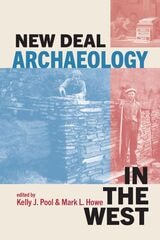
New Deal Archaeology in the West
Edited by Kelly J. Pool and Mark L. Howe
University of Utah Press, 2023
Descriptions of New Deal projects and their contributions to our understanding of the past, as well as the stories of those involved—archaeologists, avocationalists, and others—are woven together across the chapters. Also documented are lost or scattered artifacts, records, and ancestors’ remains; incomplete analyses; unpublished reports; inconsistent application of scientific methodology; and the loss of Native sacred sites and traditional lands and lifeways. Authors highlight characteristics that distinguished the American West from the East during the Depression and affected the nature of New Deal projects, including the extent of federal land available in the West, the reliance of sparsely populated areas upon tourism, the presence of large resident Native populations with deep histories, and the wide-ranging degree of existing archaeology infrastructure in each state. This volume demonstrates that despite regional differences, New Deal-funded archaeological and cultural heritage projects created a legacy of knowledge and practice across the nation.
New Perspectives on Mimbres Archaeology
Three Millennia of Human Occupation in the North American SouthwestEdited by Barbara J. Roth, Patricia A. Gilman, and Roger Anyon
University of Arizona Press, 2018
New Perspectives on Mimbres Archaeology brings together these experts in a single volume for the first time. The contributors discuss current knowledge of the people who lived in the Mimbres region of the southwestern United States and how our knowledge has changed since the Mimbres Foundation, directed by Steven A. LeBlanc, began the first modern archaeological investigations in the region. Many of these authors have spent decades conducting the fieldwork that has allowed for a broader understanding of Mimbres society.
Focusing on a variety of important research topics of interest to archaeologists—including the social contexts of people and communities, the role of ritual and ideology in Mimbres society, evidence of continuities and cultural change through time, and the varying impacts of external influences throughout the region—New Perspectives on Mimbres Archaeology presents recent data on and interpretations of the entire pre-Hispanic sequence of occupation. Additional contributions include a history of nonprofit archaeology by William H. Doelle and a concluding chapter by Steven A. LeBlanc reflecting on his decades-long work in Mimbres archaeology and outlining important areas for the next wave of research.
Newberry Crater
Anthropological Papers Number 121Thomas Connolly
University of Utah Press, 1999
The research in this volume derives from investigations conducted in connection with proposed widening and realignment of the Paulina-East Lake Highway, located within the caldera of Newberry Volcano. Formal evaluation of 13 localities and data recovers at four sites produced a wealth of information regarding human uses of the caldera and vicinity throughout the Holocene.
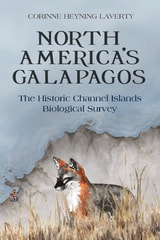
North America's Galapagos
The Historic Channel Islands Biological SurveyCorinne Heyning Laverty
University of Utah Press, 2019
This untold saga of adventure, discovery, and goals abandoned is juxtaposed against the fresh successes of a new generation of Channel Island scholars. Engagingly written, North America’s Galapagos illuminates the scientific process and reveals remarkable modern discoveries that are rewriting archaeological textbooks and unraveling the answer to the age-old question: how and when were the Americas populated?
Anyone interested in the work conducted behind closed museum doors will want to read this book—so will history buffs, environmentalists, scientists, and general readers curious about our world.
Visit the author's website: https://www.channelislandscalifornia.com/
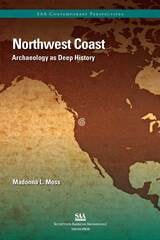
Northwest Coast
Archaeology as Deep HistoryMadonna L. Moss
University Press of Colorado, 2011
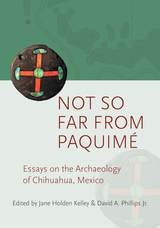
Not so Far from Paquimé
Essays on the Archaeology of Chihuahua, MexicoEdited by Jane Holden Kelley and David A. Phillips Jr.
University of Utah Press, 2017