Results by title
98 books match the query 'Existentialism' and 8 start with n
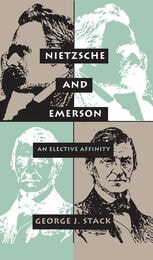
Nietzsche & Emerson
An Elective AffinityGeorge J. Stack
Ohio University Press, 1993
George J. Stack traces the sources of ideas and theories that have long been considered the exclusive province of Friedrich Nietzsche to the surprisingly radical writings of the American essayist and poet, Ralph Waldo Emerson.
Nietzsche and Emerson makes us see Emerson’s writings in a new, more intensified light and presents a new perspective on Nietzsche’s philosophy. Stack traces how the rich theoretical ideas and literary images of Emerson entered directly into the existential dimension of Nietzsche’s thought and hence into the stream of what has been considered a distinctively European intellectual movement.
Nietzsche Pursued
Toward a Philosophy for the FutureRichard Schacht
University of Chicago Press, 2024
Nietzsche advocated for a post-theistic “philosophy of the future”—a new approach to human reality that would bend Western thought away from nihilism in a life-affirming, value-creative direction. His early demise left this endeavor only just begun. In Nietzsche Pursued, Richard Schacht examines Nietzsche’s revisionist approach to familiar philosophical topics, exploring how some may be further pursued in Nietzschean ways.
Each chapter focuses on one topic that is central to Nietzsche's vision of what philosophy can and should be and do. Among them: his kind of naturalism, humanity, perspectivism, morality, and music. Building on his analysis in Nietzsche’s Kind of Philosophy, Schacht invites readers to see with new appreciation the ongoing significance of Nietzsche’s thought for philosophy’s future.

Nietzsche and Dostoevsky
Philosophy, Morality, TragedyEdited by Jeff Love and Jeffrey Metzger
Northwestern University Press, 2016
Nietzsche and Race
Marc de Launay
University of Chicago Press, 2023
The caricature of Friedrich Nietzsche as a proto-Nazi is still with us, having originated with his own Nazi sister, Elisabeth Förster, who curated Nietzsche’s disparate texts to suit her own purposes. In Nietzsche and Race, Marc de Launay deftly counters this persistent narrative in a series of concise and highly accessible reflections on the concept of race in Nietzsche’s publications, notebooks, and correspondence. Through a fresh reading of Nietzsche’s core philosophical project, de Launay articulates a new understanding of race in Nietzsche’s body of work free from the misunderstanding of his detractors.
Nietzsche and the Transcendental Tradition
Michael Steven Green
University of Illinois Press, 2002
In recent years, both analytic thinkers and postmodern theorists have looked at Friedrich Nietzsche's epistemology from the perspectives of their philosophical traditions. Michael Steven Green's penetrating study tries instead to do justice to Nietzsche's views on truth and knowledge by looking at them from the perspective of his contemporaries, particularly the Neo-Kantian philosopher Afrikan Spir, whose ideas exerted a tremendous influence on Nietzsche's thought.
Despite his generally naturalist outlook, Nietzsche was committed to an antinaturalist theory of cognition inherited from Kant and Spir. Green shows how this fundamental tension in Nietzsche's thought led him to present not only the antirealism that has commonly been attributed to him in the past, but two other epistemological positions. These are a denial of the possibility of human thought entirely, and an error theory–-the argument that all of our judgments are false–-that has strong parallels in Spir's thought and Kant's antinomies.
Viewing Nietzsche's error theory in light of Kantian transcendental idealism, Green makes sense of arguments that have previously confounded Nietzsche interpreters. Green also provides the first English translations of many passages from Spir's writings and Nietzsche's notebooks.
In examining Nietzsche's thought through the lens of the philosophical influences upon him–-the philosophers that Nietzsche himself read–-Green establishes a significant new foundation from which to assess Nietzsche's place in modern philosophy and culture.
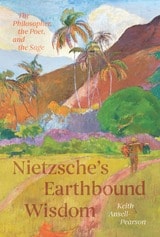
Nietzsche's Earthbound Wisdom
The Philosopher, the Poet, and the SageKeith Ansell-Pearson
University of Chicago Press, 2025
Today, Nietzsche is justly celebrated for his rich, philosophical naturalism, but Keith Ansell-Pearson warns that we must not overlook the visionary dimension of his thinking and his focus on the need to cultivate a new care of the self and care of life. In Nietzsche’s Earthbound Wisdom, Ansell-Pearson recovers Nietzsche’s love for a philosophy that guides us through our passions, one that opens us more fully to the possibilities of life and the joy of knowledge.
Ansell-Pearson offers close readings of Nietzsche’s texts in conversation with philosophical and literary figures including Augustine, Baudelaire, Carlyle, Dostoevsky, Emerson, Flaubert, Stendhal, and more. Throughout, Ansell-Pearson examines Nietzsche’s sophisticated critique of literary naturalism and his alternative conception of the poet as a seer who has a deep longing for a new earth.

Nineteenth-Century Philosophy
Revolutionary Responses to the Existing OrderEdited by Alan D. Schrift and Daniel Conway
University of Chicago Press, 2010
From Kant to Kierkegaard, from Hegel to Heidegger, continental philosophers have indelibly shaped the trajectory of Western thought since the eighteenth century. Although much has been written about these monumental thinkers, students and scholars lack a definitive guide to the entire scope of the continental tradition. The most comprehensive reference work to date, this eight-volume History of Continental Philosophy will both encapsulate the subject and reorient our understanding of it. Beginning with an overview of Kant’s philosophy and its initial reception, the History traces the evolution of continental philosophy through major figures as well as movements such as existentialism, phenomenology, hermeneutics, and poststructuralism. The final volume outlines the current state of the field, bringing the work of both historical and modern thinkers to bear on such contemporary topics as feminism, globalization, and the environment. Throughout, the volumes examine important philosophical figures and developments in their historical, political, and cultural contexts.
The first reference of its kind, A History of Continental Philosophy has been written and edited by internationally recognized experts with a commitment to explaining complex thinkers, texts, and movements in rigorous yet jargon-free essays suitable for both undergraduates and seasoned specialists. These volumes also elucidate ongoing debates about the nature of continental and analytic philosophy, surveying the distinctive, sometimes overlapping characteristics and approaches of each tradition. Featuring helpful overviews of major topics and plotting road maps to their underlying contexts, A History of Continental Philosophy is destined to be the resource of first and last resort for students and scholars alike.
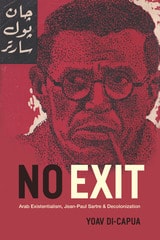
No Exit
Arab Existentialism, Jean-Paul Sartre, and DecolonizationYoav Di-Capua
University of Chicago Press, 2018
By closely following the remarkable career of Arab existentialism, Yoav Di-Capua reconstructs the cosmopolitan milieu of the generation that tried to articulate a political and philosophical vision for an egalitarian postcolonial world. He tells this story by touring a fascinating selection of Arabic and Hebrew archives, including unpublished diaries and interviews. Tragically, the warm and hopeful relationships forged between Arab intellectuals, Sartre, Simone de Beauvoir, and others ended when, on the eve of the 1967 war, Sartre failed to embrace the Palestinian cause. Today, when the prospect of global ethical engagement seems to be slipping ever farther out of reach, No Exit provides a timely, humanistic account of the intellectual hopes, struggles, and victories that shaped the Arab experience of decolonization and a delightfully wide-ranging excavation of existentialism’s non-Western history.