Results by title
56 books match the query 'Faculty' and 3 start with n
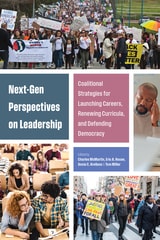
Next-Gen Perspectives on Leadership
Coalitional Strategies for Launching Careers, Renewing Curricula, and Defending DemocracyCharles McMartin
Utah State University Press, 2026
Next-Gen Perspectives on Leadership amplifies voices that have too often been excluded from traditional accounts of academic leadership. Centering the voices of early-career PhDs in writing studies and related fields, this book offers essential and practical leadership strategies at a pivotal moment in higher education shaped by the COVID-19 pandemic, the rise of new majority students, and the growing influence of authoritarian politics.
Next-gen faculty are leading now. Through coalition-building, care work, and equity-driven initiatives, they are transforming institutions from the ground up. From labor organizing and culturally responsive curriculum design to the care-work of academic parents and the leadership of writing program administrators, the contributors in this collection model the type of coalitional leadership needed in our institutions. Structured around intergenerational dialogues, the book brings together early-career scholars with mid-career leaders—Jennifer Sano-Franchini, Christina Cedillo, and Staci Perryman-Clark—who offer sharp, reflective responses to each section, and culminates in a powerful closing essay by Carmen Kynard. These voices trace a lineage of resistance and renewal, showing how the leadership strategies of today’s emerging scholars echo and evolve the activist traditions that have long shaped writing studies. Next-gen leaders are moving beyond individualistic models of success and embracing collective, justice-oriented leadership practices. This collection invites scholars to study and teach forms of leadership that help faculty and students step into the challenging opportunities they face.
For graduate students and early-career faculty, this book offers a model of leadership that creates meaningful change outside designated leadership roles or institutional metrics. For mid-career and senior faculty, it provides a framework for recognizing and supporting the ground-level leadership already happening in their contexts. This collection is for anyone committed to leading more inclusive and sustainable academic communities and encourages faculty across generations to reimagine how to mentor, collaborate, and lead in ways that reflect the values of equity, care, and coalition.
Contributors: Felicita Arzu-Carmichael, Amerdeep Bajwa, Christina Cedillo, Alexandra Chapa, Anicca Cox, Tom Do, Mena Hannakachl, Alice Hays, Charisse Iglesias, Brad Jacobson, Carmen Kynard, Adele Leon, Shaylyn Marks, Sean Moxley-Kelly, Abigail Oakley, Staci Perryman-Clark, Ana Milena Ribero, Jennifer Sano-Franchini
[more]
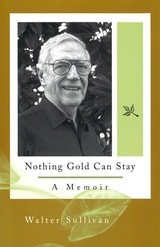
Nothing Gold Can Stay
A MemoirWalter Sullivan
University of Missouri Press, 2006
In his enduring fiction and criticism, Walter Sullivan has invited readers to share the thoughts of a penetrating, contemporary intellect. Now he turns his pen on his own life to forge a stirring memoir that fondly recounts the life of the mind.
From childhood in 1920s Nashville, where his father died three months after he was born, to the halls of Vanderbilt University, where he taught creative writing for more than fifty years, Sullivan recalls key episodes in his life—often pausing to ponder why some memories of seemingly trivial events persist while others, seemingly more important, have faded from view.
As witness to a series of social and cultural moments, Sullivan passes on his sharp observations about depression and war, southern renascence and civil rights. He also includes lively anecdotes and sharp character sketches, with personalities ranging from his grandmother “Chigger” and Sally Fudge—who had lived through the Civil War and was said to attend the funerals of people she didn’t know—to Mrs. Gertrude Vanderbilt, with whose eccentricities he sometimes had to contend.
Readers will discover a treasure trove of insights, as Sullivan’s views of academic life are complemented by remembrances of important writers: John Crowe Ransom, Robert Lowell, Eudora Welty, Robert Penn Warren, James Dickey, Flannery O’Connor, and a host of others, blending the formal and familiar in a style befitting a lingering southernness. He also recalls his shock at being branded a racist by Kingsley Amis and addresses issues of race in academia and southern culture. Throughout his career, he sees himself as a guardian of lost causes, continuing to teach an appreciation of literature in the face of encroaching post-structuralism and political correctness.
Laced with humor while maintaining a profound seriousness about what really matters in life, Nothing Gold Can Stay is a lively narrative of a life well lived that will charm any reader interested in American society during and after the Great Depression. Graced with emotional coherence achieved by an almost ironic tone that is sustained from first sentence to last, it is a book in which a distinguished writer considers his world—and his own mortality—and leaves us richer for it.
[more]
Nowhere Near the Line
Pain and Possibility in Teaching and WritingElizabeth H. Boquet
Utah State University Press, 2016
“When I was starting College Presidents for Gun Safety, one of the concerns I heard was the idea that there were just too many issues on which to articulate an opinion. Where would it stop? Where would we draw the line? . . . In light of this latest tragedy, on a college campus that could have been any of ours, I would say: ‘We are nowhere near the line yet.’” (Lawrence Schall, quoted in “Tragedy at Umpqua,” by Paul Fain, Inside Higher Ed, October 2, 2015)
In this short work, Elizabeth Boquet explores the line Lawrence Schall describes above, tracing the overlaps and intersections of a lifelong education around guns and violence, as a student, a teacher, a feminist, a daughter, a wife, a citizen and across the dislocations and relocations that are part of a life lived in and around school. Weaving narratives of family, the university classroom and administration, her husband’s work as a police officer, and her work with students and the Poetry for Peace effort that her writing center sponsors in the local schools, she recounts her efforts to respond to moments of violence with a pedagogy of peace. “Can we not acknowledge that our experiences with pain anywhere should render us more, not less, capable of responding to it everywhere?” she asks. “Compassion, it seems to me, is an infinitely renewable resource.”
In this short work, Elizabeth Boquet explores the line Lawrence Schall describes above, tracing the overlaps and intersections of a lifelong education around guns and violence, as a student, a teacher, a feminist, a daughter, a wife, a citizen and across the dislocations and relocations that are part of a life lived in and around school. Weaving narratives of family, the university classroom and administration, her husband’s work as a police officer, and her work with students and the Poetry for Peace effort that her writing center sponsors in the local schools, she recounts her efforts to respond to moments of violence with a pedagogy of peace. “Can we not acknowledge that our experiences with pain anywhere should render us more, not less, capable of responding to it everywhere?” she asks. “Compassion, it seems to me, is an infinitely renewable resource.”
[more]