Results by title
455 books match the query 'Feminism' and 9 start with n
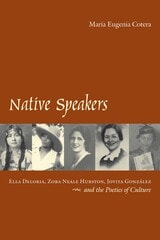
Native Speakers
Ella Deloria, Zora Neale Hurston, Jovita Gonzalez, and the Poetics of CultureBy María Eugenia Cotera
University of Texas Press, 2008
Gloria Anzaldua Book Prize, National Women's Studies Association, 2009
In the early twentieth century, three women of color helped shape a new world of ethnographic discovery. Ella Cara Deloria, a Sioux woman from South Dakota, Zora Neale Hurston, an African American woman from Florida, and Jovita González, a Mexican American woman from the Texas borderlands, achieved renown in the fields of folklore studies, anthropology, and ethnolinguistics during the 1920s and 1930s. While all three collaborated with leading male intellectuals in these disciplines to produce innovative ethnographic accounts of their own communities, they also turned away from ethnographic meaning making at key points in their careers and explored the realm of storytelling through vivid mixed-genre novels centered on the lives of women.
In this book, Cotera offers an intellectual history situated in the "borderlands" between conventional accounts of anthropology, women's history, and African American, Mexican American and Native American intellectual genealogies. At its core is also a meditation on what it means to draw three women—from disparate though nevertheless interconnected histories of marginalization—into conversation with one another. Can such a conversation reveal a shared history that has been erased due to institutional racism, sexism, and simple neglect? Is there a mode of comparative reading that can explore their points of connection even as it remains attentive to their differences? These are the questions at the core of this book, which offers not only a corrective history centered on the lives of women of color intellectuals, but also a methodology for comparative analysis shaped by their visions of the world.
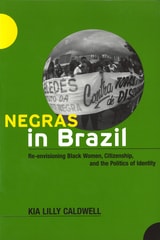
Negras in Brazil
Re-envisioning Black Women, Citizenship, and the Politics of IdentityCaldwell, Kia Lilly
Rutgers University Press, 2006
In Negras in Brazil, Kia Lilly Caldwell examines the life experiences of Afro-Brazilian women whose stories have until now been largely untold. This pathbreaking study analyzes the links between race and gender and broader processes of social, economic, and political exclusion. Drawing on ethnographic research with social movement organizations and thirty-five life history interviews, Caldwell explores the everyday struggles Afro-Brazilian women face in their efforts to achieve equal rights and full citizenship. She also shows how the black women's movement, which has emerged in recent decades, has sought to challenge racial and gender discrimination in Brazil. While proposing a broader view of citizenship that includes domains such as popular culture and the body, Negras in Brazil highlights the continuing relevance of identity politics for members of racially marginalized communities. Providing new insights into black women's social activism and a gendered perspective on Brazilian racial dynamics, this book will be of interest to students and scholars of Latin American Studies, African diaspora studies, women's studies, politics, and cultural anthropology.
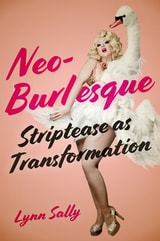
Neo-Burlesque
Striptease as TransformationLynn Sally
Rutgers University Press, 2022
Performance studies scholar and acclaimed burlesque artist Lynn Sally offers an inside look at the history, culture, and philosophy of New York’s neo-burlesque scene. Revealing how twenty-first century neo-burlesque is in constant dialogue with the classic burlesque of the nineteenth and twentieth centuries, she considers how today’s performers use camp to comment on preconceived notions of femininity. She also explores how the striptease performer directs the audience’s gaze, putting on layers of meaning while taking off layers of clothing.
Through detailed profiles of iconic neo-burlesque performers such as Dita Von Teese, Dirty Martini, Julie Atlas Muz, and World Famous *BOB*, this book makes the case for understanding neo-burlesque as a new sexual revolution. Yet it also examines the broader community of “Pro-Am” performers who use neo-burlesque as a liberating vehicle for self-expression. Raising important questions about what feminism looks like, Neo-Burlesque celebrates a revolutionary performing art and participatory culture whose acts have political reverberations, both onstage and off.
Next to the Color Line
Gender, Sexuality, and W. E. B. Du BoisSusan Gillman
University of Minnesota Press, 2007
No Less a Man
Masculist Art in a Feminist AgeDoug Robinson
University of Wisconsin Press, 1994

No Longer Patient
Feminist Ethics and Health CareSusan Sherwin
Temple University Press, 1992

No More Nice Girls
Countercultural EssaysEllen Willis
University of Minnesota Press, 2012
With characteristic intelligence, wit, and feminist insight, Ellen Willis addresses democracy as she sees it: “a commitment to individual freedom and egalitarian self-government in every area of social, economic, and cultural life.” Moving between scholarly and down-to-earth activist writing styles, Willis confronts the conservative backlash that has slowly eroded democratic ideals and advances of the 1960s as well as the internal debates that have frequently splintered the left.

No Permanent Waves
Recasting Histories of U.S. FeminismHewitt, Nancy A
Rutgers University Press, 2010
A respected group of contributors from diverse generations and backgrounds argue for new chronologies, more inclusive conceptualizations of feminist agendas and participants, and fuller engagements with contestations around particular issues and practices. Race, class, and sexuality are explored within histories of women's rights and feminism as well as the cultural and intellectual currents and social and political priorities that marked movements for women's advancement and liberation. These essays question whether the concept of waves surging and receding can fully capture the complexities of U.S. feminisms and suggest models for reimagining these histories from radio waves to hip-hop.
Notes on Nowhere
Feminism, Utopian Logic, and Social TransformationJennifer Burwell
University of Minnesota Press, 1997
Notes on Nowhere was first published in 1997. Minnesota Archive Editions uses digital technology to make long-unavailable books once again accessible, and are published unaltered from the original University of Minnesota Press editions.
The term utopia implies both "good place" and "nowhere." Since Sir Thomas More wrote Utopia in 1516, debates about utopian models of society have sought to understand the implications of these somewhat contradictory definitions. In Notes on Nowhere, author Jennifer Burwell uses a cross section of contemporary feminist science fiction to examine the political and literary meaning of utopian writing and utopian thought.
Burwell provides close readings of the science fiction novels of five feminist writers-Marge Piercy, Sally Gearhart, Joanna Russ, Octavia Butler, and Monique Wittig-and poses questions central to utopian writing: Do these texts promote a tradition in which narratives of the ideal society have been used to hide rather than reveal violence, oppression, and social divisions? Can a feminist critical utopia offer a departure from this tradition by using utopian narratives to expose contradiction and struggle as central aspects of the utopian impulse? What implications do these questions have for those who wish to retain the utopian impulse for emancipatory political uses?
As one way of answering these questions, Burwell compares two "figures" that inform utopian writing and social theory. The first is the traditional abstract "revolutionary" subject who contradicts existing conditions and who points us to the ideal body politic. The second, "resistant," subject is partial, concrete, and produced by conditions rather than operating outside of them. In analyzing contemporary changes in the subject's relationship to social space, Burwell draws from and revises "standpoint approaches" that tie visions of social transformation to a group's position within existing conditions.
By exploring the dilemmas, antagonisms, and resolutions within the critical literary feminist utopia, Burwell creates connections to a similar set of problems and resolutions characterizing "nonliterary" discourses of social transformation such as feminism, gay and lesbian studies, and Marxism. Notes on Nowhere makes an original, significant, and persuasive contribution to our understanding of the political and literary dimensions of the utopian impulse in literature and social theory.
Jennifer Burwell teaches in the Department of English at Wesleyan University in Connecticut.