Results by title
128 books match the query 'Feminism and literature' and 7 start with n
NEW WOMAN AND THE EMPIRE
Iveta Jusová
The Ohio State University Press, 2005
Negotiating Difference
Race, Gender, and the Politics of PositionalityMichael Awkward
University of Chicago Press, 1995
From Spike Lee's She's Gotta Have It to Michael Jackson's physical transmutations, from Toni Morrison's Song of Solomon to August Wilson's Fences, from male scholars' investments in feminism to white scholars' in black texts—Awkward explores cultural moments that challenge the exclusive critical authority of race and gender. In each instance he confronts the question: What do artists, scholars, and others concerned with representations of Afro-American life make of the view that gender, race, and sexuality circumscribe their own and others' lives and narratives? Throughout he demonstrates the perils and merits of the sort of "boundary crossing" this book ultimately makes: a black male feminism.
In pursuing a black male feminist criticism, Awkward's study acknowledges the complexities of interpretation in an age when a variety of powerful discourses have proliferated on the subject of racial, gendered, and sexual difference; at the same time, it identifies this proliferation as an opportunity to negotiate seemingly fixed cultural and critical positions.

New Black Feminist Criticism, 1985-2000
Barbara Christian. Edited by Gloria Bowles, M. Giulia Fabi, and Arlene Keizer
University of Illinois Press, 2007
New Latina Narrative
The Feminine Space of Postmodern EthnicityEllen McCracken
University of Arizona Press, 1999

New Women, New Novels
Ardis, Ann
Rutgers University Press, 1990
No More Separate Spheres!
A Next Wave American Studies ReaderCathy N. Davidson and Jessamyn Hatcher, eds.
Duke University Press, 2002
Using American literary studies as a way to talk about changing categories of analysis, these essays discuss the work of such major authors as Catharine Sedgwick, Herman Melville, Pauline E. Hopkins, Frederick Douglass, Catharine Beecher, Ralph Waldo Emerson, W. E. B. Du Bois, Sarah Orne Jewett, Nathaniel Hawthorne, María Ampara Ruiz de Burton, Ann Petry, Gwendolyn Brooks, Cynthia Kadohata, Chang Rae-Lee, and Samuel Delany. No More Separate Spheres! shows scholars and students different ways that gender can be approached and incorporated into literary interpretations. Feisty and provocative, it provides a forceful analysis of the limitations of any theory of gender that applies only to women, and urges suspicion of any argument that posits “woman” as a universal or uniform category.
By bringing together essays from the influential special issue of American Literature of the same name, a number of classic essays, and several new pieces commissioned for this volume, No More Separate Spheres! will be an ideal teaching tool, providing a key supplementary text in the American literature classroom.
Contributors. José F. Aranda, Lauren Berlant, Cathy N. Davidson, Judith Fetterley, Jessamyn Hatcher, Amy Kaplan, Dana D. Nelson, Christopher Newfield, You-me Park, Marjorie Pryse, Elizabeth Renker, Ryan Schneider, Melissa Solomon, Siobhan Somerville, Gayle Wald , Maurice Wallace
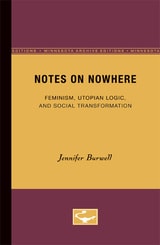
Notes on Nowhere
Feminism, Utopian Logic, and Social TransformationJennifer Burwell
University of Minnesota Press, 1997
Notes on Nowhere was first published in 1997. Minnesota Archive Editions uses digital technology to make long-unavailable books once again accessible, and are published unaltered from the original University of Minnesota Press editions.
The term utopia implies both "good place" and "nowhere." Since Sir Thomas More wrote Utopia in 1516, debates about utopian models of society have sought to understand the implications of these somewhat contradictory definitions. In Notes on Nowhere, author Jennifer Burwell uses a cross section of contemporary feminist science fiction to examine the political and literary meaning of utopian writing and utopian thought.
Burwell provides close readings of the science fiction novels of five feminist writers-Marge Piercy, Sally Gearhart, Joanna Russ, Octavia Butler, and Monique Wittig-and poses questions central to utopian writing: Do these texts promote a tradition in which narratives of the ideal society have been used to hide rather than reveal violence, oppression, and social divisions? Can a feminist critical utopia offer a departure from this tradition by using utopian narratives to expose contradiction and struggle as central aspects of the utopian impulse? What implications do these questions have for those who wish to retain the utopian impulse for emancipatory political uses?
As one way of answering these questions, Burwell compares two "figures" that inform utopian writing and social theory. The first is the traditional abstract "revolutionary" subject who contradicts existing conditions and who points us to the ideal body politic. The second, "resistant," subject is partial, concrete, and produced by conditions rather than operating outside of them. In analyzing contemporary changes in the subject's relationship to social space, Burwell draws from and revises "standpoint approaches" that tie visions of social transformation to a group's position within existing conditions.
By exploring the dilemmas, antagonisms, and resolutions within the critical literary feminist utopia, Burwell creates connections to a similar set of problems and resolutions characterizing "nonliterary" discourses of social transformation such as feminism, gay and lesbian studies, and Marxism. Notes on Nowhere makes an original, significant, and persuasive contribution to our understanding of the political and literary dimensions of the utopian impulse in literature and social theory.
Jennifer Burwell teaches in the Department of English at Wesleyan University in Connecticut.