Results by title
183 books match the query 'Feminist' and 3 start with n
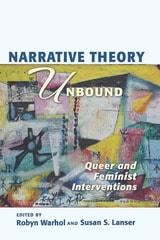
Narrative Theory Unbound
Queer and Feminist InterventionsEdited by Robyn Warhol and Susan S. Lanser
The Ohio State University Press, 2015
Under the bold banner of Narrative Theory Unbound: Queer and Feminist Interventions, editors Robyn Warhol and Susan S. Lanser gather a diverse spectrum of queer and feminist challenges to the theory and interpretation of narrative. The first edited collection to bring feminist, queer, and narrative theories into direct conversation with one another, this anthology places gender and sexuality at the center of contemporary theorizing about the production, reception, forms, and functions of narrative texts.
Through twenty-one essays prefaced by a cogent history of the field, Narrative Theory Unbound offers new perspectives on narrative discourse and its constituent elements; on intersectional approaches that recognize race, religion, and national culture as integral to understanding sexuality and gender; on queer temporalities; on cognitive research; and on lifewriting in graphic, print, and digital constellations. Exploring genres ranging from reality TV to fairy tales to classical fiction, contributors explore the thorny, contested relationships between feminist and queer theory, on the one hand, and between feminist/queer theory and contemporary narratologies, on the other. Rather than aiming for cohesiveness or conclusiveness, the collection stages open-ended debates designed to unbind the assumptions that have kept gender and sexuality on the periphery of narrative theory.
Through twenty-one essays prefaced by a cogent history of the field, Narrative Theory Unbound offers new perspectives on narrative discourse and its constituent elements; on intersectional approaches that recognize race, religion, and national culture as integral to understanding sexuality and gender; on queer temporalities; on cognitive research; and on lifewriting in graphic, print, and digital constellations. Exploring genres ranging from reality TV to fairy tales to classical fiction, contributors explore the thorny, contested relationships between feminist and queer theory, on the one hand, and between feminist/queer theory and contemporary narratologies, on the other. Rather than aiming for cohesiveness or conclusiveness, the collection stages open-ended debates designed to unbind the assumptions that have kept gender and sexuality on the periphery of narrative theory.
[more]
No More Separate Spheres, Volume 70
Cathy N. Davidson
Duke University Press, 0
Much criticism of nineteenth-century American literature written during the last quarter century has been structured by the concept of “separate spheres,” a construction that often is recreated in contemporary critical practice. The contributors to this special issue examine and contest the way the category of gender—male versus female, extending to include, for example, the oppositions between public and private, worldly and domestic—has organized critical discussion regarding the formulation of American literature. Challenging the separate spheres model, these essays ask how other categories complicate this paradigm, especially with regard to issues of race, sexuality, class, region, religion, and occupation.
In No More Separate Spheres! both established and new scholars look at the changing categories of analysis—from seventies feminism to nineties postcolonialism—that have shaped this discussion. In her introduction, Cathy N. Davidson assesses the state of criticism with regard to the separate spheres debate, and sets a constructive and often provocative tone for the rest of the volume. While one essay provides an overview of the multiple fronts on which the post-separate spheres model of criticism has been engaged, others offer perspectives that either support of directly confront and critique this model. Rather than seeking to establish yet another critical formula based on the opposition of binary terms, this special issue of American Literature will help move the debate to the next level.
In No More Separate Spheres! both established and new scholars look at the changing categories of analysis—from seventies feminism to nineties postcolonialism—that have shaped this discussion. In her introduction, Cathy N. Davidson assesses the state of criticism with regard to the separate spheres debate, and sets a constructive and often provocative tone for the rest of the volume. While one essay provides an overview of the multiple fronts on which the post-separate spheres model of criticism has been engaged, others offer perspectives that either support of directly confront and critique this model. Rather than seeking to establish yet another critical formula based on the opposition of binary terms, this special issue of American Literature will help move the debate to the next level.
Contributors. José F. Aranda, Lauren Berlant, Lawrence Buell, Judith Fetterley, Amy Kaplan, You-me Park, Marjorie Pryse, Gail Wald
[more]
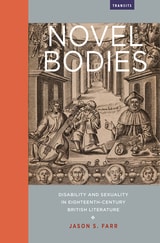
Novel Bodies
Disability and Sexuality in Eighteenth-Century British LiteratureJason S. Farr
Bucknell University Press, 2019
Novel Bodies examines how disability shapes the British literary history of sexuality. Jason Farr shows that various eighteenth-century novelists represent disability and sexuality in flexible ways to reconfigure the political and social landscapes of eighteenth-century Britain. In imagining the lived experience of disability as analogous to—and as informed by—queer genders and sexualities, the authors featured in Novel Bodies expose emerging ideas of able-bodiedness and heterosexuality as interconnected systems that sustain dominant models of courtship, reproduction, and degeneracy. Further, Farr argues that they use intersections of disability and queerness to stage an array of contemporaneous debates covering topics as wide-ranging as education, feminism, domesticity, medicine, and plantation life. In his close attention to the fiction of Eliza Haywood, Samuel Richardson, Sarah Scott, Maria Edgeworth, and Frances Burney, Farr demonstrates that disabled and queer characters inhabit strict social orders in unconventional ways, and thus opened up new avenues of expression for readers from the eighteenth century forward.
Published by Bucknell University Press. Distributed worldwide by Rutgers University Press.
Published by Bucknell University Press. Distributed worldwide by Rutgers University Press.
[more]