Results by title
279 books match the query 'Film & Video' and 8 start with n

Narrating the City
Mediated Representations of Architecture, Urban Forms and Social LifeEdited by Aysegül Akçay Kavakoglu, Türkan Nihan Haciömeroglu, and Lisa Landrum
Intellect Books, 2020
An analysis of the ways film and media create topographies of cities, architecture, and metropolitan experiences.
Narrating the City examines how film and related visual media offer insights and commentary on the city as both a constructed object and a lived social experience. It brings together filmmakers, architects, digital artists, designers, and media journalists who critically read, reinterpret, and create narratives of the city. Analyzing a variety of international films and placing them in dialogue with video art, photographic narratives, and emerging digital image-based technologies, the authors explore the expanding range of “mediated” narratives of contemporary architecture and urban culture from both a media and a sociological standpoint.
The authors explore how moving-image narratives can create cinematic topographies, presenting familiar cities and modes of seeing in unfamiliar ways. The authors then turn to the new age of digital image making and consumption, revealing new techniques of representation, mediation, and augmentation of sensorial reality for city dwellers. The book’s emphasis on narrative also offers insights into critical societal issues including cultural identity, diversity, memory, and spatial politics, as they are both informed by and represented in various media.
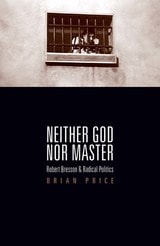
Neither God nor Master
Robert Bresson and Radical PoliticsBrian Price
University of Minnesota Press, 2010
Situating Bresson in radical and aesthetic political contexts, from surrealism to situationism, Neither God nor Master shows how his early style was a model for social resistance. We then see how, after May 1968, his films were in fact a series of reflections on the failure of revolution in France—especially as “failure” is understood in relation to Bresson’s chosen literary precursors, Dostoyevsky and Tolstoy, and Russian revolutionary culture of the nineteenth century.
Restoring Bresson to the radical political culture from which he emerged—and to which he remained faithful—Price offers a major revision of the reputation of one of the most celebrated figures in the history of French film. In doing so, he raises larger philosophical questions about the efficacy of revolutionary practices and questions about interpretation and metaphysical tendencies of film historical research that have, until now, gone largely untested.
New African Cinema
Orlando, Valérie K
Rutgers University Press, 2017
Orlando illuminates the diverse themes evident in the works of filmmakers such as Ousmane Sembène’s Ceddo (Senegal, 1977), Sarah Maldoror’s Sambizanga (Angola, 1972), Assia Djebar’s La Nouba des femmes de Mont Chenoua (The Circle of women of Mount Chenoua, Algeria, 1978), Zézé Gamboa’s The Hero (Angola, 2004) and Abderrahmane Sissako’s Timbuktu (Mauritania, 2014), among others. Orlando also considers the influence of major African film schools and their traditions, as well as European and American influences on the marketing and distribution of African film. For those familiar with the polemics of African film, or new to them, Orlando offers a cogent analytical approach that is engaging.
New Zealand Cinema
Interpreting the PastEdited by Alistair Fox, Barry Keith Grant, and Hilary Radner
Intellect Books, 2011
New Zealand has produced one of the world’s most vibrant film cultures, a reflection of the country’s evolving history and the energy and resourcefulness of its people. From early silent features like The Te Kooti Trail to recent films such as River Queen, this book examines the role of the cinema of New Zealand in building a shared sense of national identity. The works of key directors, including Peter Jackson, Jane Campion, and Vincent Ward, are here introduced in a new light, and select films are given in-depth coverage. Among the most informative accounts of New Zealand’s fascinating national cinema, this will be a must for film scholars around the globe.
New Zealand Film and Television
Institution, Industry and Cultural ChangeTrisha Dunleavy and Hester Joyce
Intellect Books, 2011
Despite challenges arising from a limited population and the difficulty of obtaining adequate funding, both the film and television industries of New Zealand have been the source of significant achievements and profound cultural influence. Charting their emergence and subsequent development through five decades, New Zealand Film and Television looks at these two increasingly vibrant cultural and creative industries. While there is a growing body of academic work on film and television in New Zealand, relatively little exists that examines the specific cultural concerns, local industries, institutions, and policies involved, which this book addresses in full.

Nigerian Video Films
Revised and Expanded EditionJonathan Haynes
Ohio University Press, 2000
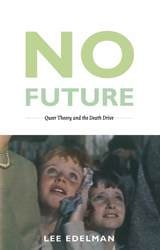
No Future
Queer Theory and the Death DriveLee Edelman
Duke University Press, 2004
Closely engaging with literary texts, Edelman makes a compelling case for imagining Scrooge without Tiny Tim and Silas Marner without little Eppie. Looking to Alfred Hitchcock’s films, he embraces two of the director’s most notorious creations: the sadistic Leonard of North by Northwest, who steps on the hand that holds the couple precariously above the abyss, and the terrifying title figures of The Birds, with their predilection for children. Edelman enlarges the reach of contemporary psychoanalytic theory as he brings it to bear not only on works of literature and film but also on such current political flashpoints as gay marriage and gay parenting. Throwing down the theoretical gauntlet, No Future reimagines queerness with a passion certain to spark an equally impassioned debate among its readers.
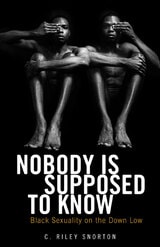
Nobody Is Supposed to Know
Black Sexuality on the Down LowC. Riley Snorton
University of Minnesota Press, 2014
Since the early 2000s, the phenomenon of the “down low”—black men who have sex with men as well as women and do not identify as gay, queer, or bisexual—has exploded in news media and popular culture, from the Oprah Winfrey Show to R & B singer R. Kelly’s hip hopera Trapped in the Closet. Most down-low stories are morality tales in which black men are either predators who risk infecting their unsuspecting female partners with HIV or victims of a pathological black culture that repudiates openly gay identities. In both cases, down-low narratives depict black men as sexually dangerous, duplicitous, promiscuous, and contaminated.
In Nobody Is Supposed to Know, C. Riley Snorton traces the emergence and circulation of the down low in contemporary media and popular culture to show how these portrayals reinforce troubling perceptions of black sexuality. Reworking Eve Sedgwick’s notion of the “glass closet,” Snorton advances a new theory of such representations in which black sexuality is marked by hypervisibility and confinement, spectacle and speculation. Through close readings of news, music, movies, television, and gossip blogs, Nobody Is Supposed to Know explores the contemporary genealogy, meaning, and functions of the down low.
Snorton examines how the down low links blackness and queerness in the popular imagination and how the down low is just one example of how media and popular culture surveil and police black sexuality. Looking at figures such as Ma Rainey, Bishop Eddie L. Long, J. L. King, and Will Smith, he ultimately contends that down-low narratives reveal the limits of current understandings of black sexuality.