Results by title
835 books match the query 'France' and 17 start with n

Nadia Boulanger and Her World
Edited by Jeanice Brooks
University of Chicago Press, 2020
Composer, performer, conductor, impresario, and charismatic and inspirational teacher, Boulanger engaged in a vast array of activities in a variety of media, from private composition lessons and lecture-recitals to radio broadcasts, recordings, and public performances. But how to define and account for Boulanger’s impact on the music world is still unclear. Nadia Boulanger and Her World takes us from a time in the late nineteenth century, when many careers in music were almost entirely closed to women, to the moment in the late twentieth century when those careers were becoming a reality. Contributors consider Boulanger’s work in the worlds of composition, musical analysis, and pedagogy and explore the geographies of transatlantic and international exchange and disruption within which her career unfolded. Ultimately, this volume takes its title as a topic for exploration—asking what worlds Boulanger belonged to, and in what sense we can consider any of them to be “hers.”

Nails in the Wall
Catholic Nuns in Reformation GermanyAmy Leonard
University of Chicago Press, 2005
Focusing primarily on a group of Dominican nuns in Strasbourg, Germany, Amy Leonard's Nails in the Wall outlines the century-long battle between these nuns and the Protestant city council. With savvy strategies that employed charm, wealth, and political and social connections, the nuns were able to sustain their Catholic practices. Leonard's in-depth archival research uncovers letters about and records of the nuns' struggle to maintain their religious beliefs and way of life in the face of Protestant reforms. She tells the story of how they worked privately to keep Catholicism alive-continuing to pray in Latin, smuggling in priests to celebrate Mass, and secretly professing scores of novices to ensure the continued survival of their convents. This fascinating and heartening study shows that, far from passively allowing the Protestants to dismantle their belief system, the women of the Strasbourg convents were active participants in the battle over their vocation and independence.
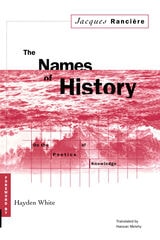
Names Of History
On the Poetics of KnowledgeJacques Ranciere
University of Minnesota Press, 1994

Napoleonic Friendship
Military Fraternity, Intimacy, and Sexuality in Nineteenth-Century FranceBrian Joseph Martin
University of New Hampshire Press, 2011
Winner of the Laurence Wylie Prize in French Cultural Studies
One of the first books on “Gays in the Military” published following the historic repeal of “Don't Ask Don't Tell” in 2011, Napoleonic Friendship examines the history of male intimacy in the French military, from Napoleon to the First World War. Echoing the historical record of gay soldiers in the United States, Napoleonic Friendship is the first book-length study on the origin of queer soldiers in modern France. Based on extensive archival research in France, the book traces the development of affectionate friendships in the French Army from 1789 to 1916.
Following the French Revolution, radical military reforms created conditions for new physical and emotional intimacy between soldiers, establishing a model of fraternal affection during the Revolutionary and Napoleonic Wars that would persist amid the ravages of the Franco-Prussian War and World War I. Through readings of Napoleonic military memoirs (and other non-fiction archival material) and French military fiction (from Hugo and Balzac to Zola and Proust), Martin examines a broad range of emotional and erotic relationships, from combat buddies to soldier lovers. He argues that the French Revolution's emphasis on military fraternity evolved into an unprecedented sense of camaraderie in the armies of Napoleon. For many soldiers, the hardships of combat led to intimate friendships. For some, the homosociality of military life inspired mutual affection, lifelong commitment, and homoerotic desire.

National History and the World of Nations
Capital, State, and the Rhetoric of History in Japan, France, and the United StatesChristopher L. Hill
Duke University Press, 2008
Delving into narrative histories, prose fiction, and social philosophy, Hill analyzes the rhetoric, narrative form, and intellectual genealogy of late-nineteenth-century texts that contributed to the creation of national history in each of the three countries. He discusses the global political economy of the era, the positions of the three countries in it, and the reasons that arguments about history loomed large in debates on political, economic, and social problems. Examining how the writing of national histories in the three countries addressed political transformations and the place of the nation in the world, Hill illuminates the ideological labor national history performed. Its production not only naturalized the division of the world by systems of states and markets, but also asserted the inevitability of the nationalization of human community; displaced dissent to pre-modern, pre-national pasts; and presented the subject’s acceptance of a national identity as an unavoidable part of the passage from youth to adulthood.
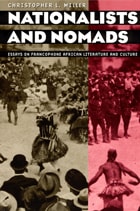
Nationalists and Nomads
Essays on Francophone African Literature and CultureChristopher L. Miller
University of Chicago Press, 1999
Miller ranges from the beginnings of francophone African literature—which he traces not to the 1930s Negritude movement but to the largely unknown, virulently radical writings of Africans in Paris in the 1920s—to the evolving relations between African literature and nationalism in the 1980s and 1990s. Throughout he aims to offset the contemporary emphasis on the postcolonial at the expense of the colonial, arguing that both are equally complex, with powerful ambiguities. Arguing against blanket advocacy of any one model (such as nationalism or hybridity) to explain these ambiguities, Miller instead seeks a form of thought that can read and recognize the realities of both identity and difference.
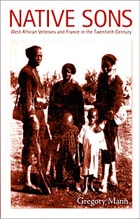
Native Sons
West African Veterans and France in the Twentieth CenturyGregory Mann
Duke University Press, 2006
Focusing on the period between World War I and 1968, Mann draws on archival research and extensive interviews with surviving Malian veterans of French wars to explore the experiences of the African soldiers. He describes the effects their long absences and infrequent homecomings had on these men and their communities, he considers the veterans’ status within contemporary Malian society, and he examines their efforts to claim recognition and pensions from France. Mann contends that Mali is as much a postslavery society as it is a postcolonial one, and that specific ideas about reciprocity, mutual obligation, and uneven exchange that had developed during the era of slavery remain influential today, informing Malians’ conviction that France owes them a “blood debt” for the military service of African soldiers in French wars.

Natives against Nativism
Antiracism and Indigenous Critique in Postcolonial FranceOlivia C. Harrison
University of Minnesota Press, 2023
Examining the intersection of Palestine solidarity movements and antiracist activism in France from the 1970s to the present
For the pasty fifty years, the Palestinian question has served as a rallying cry in the struggle for migrant rights in postcolonial France, from the immigrant labor associations of the 1970s and Beur movements of the 1980s to the militant decolonial groups of the 2000s. In Natives against Nativism, Olivia C. Harrison explores the intersection of anticolonial solidarity and antiracist activism from the 1970s to the present.
Natives against Nativism analyzes a wide range of texts—novels, memoirs, plays, films, and militant archives—that mobilize the twin figures of the Palestinian and the American Indian in a crossed critique of Eurocolonial modernity. Harrison argues that anticolonial solidarity with Palestinians and Indigenous Americans has been instrumental in developing a sophisticated critique of racism across imperial formations—in this case, France, the United States, and Israel.
Serving as the first relational study of antiracism in France, Natives against Nativism observes how claims to indigeneity have been deployed in multiple directions, both in the ongoing struggle for migrant rights and racial justice, and in white nativist claims in France today.

Neandertal Lithic Industries at La Quina
Arthur J. Jelinek
University of Arizona Press, 2013
This study of the significance of changes through time revealed by an analysis of the chipped stone at La Quina reports on the excavations of the Cooperative American–French Excavation Project from 1985 to 1994. It moves beyond the largely descriptive and subjective approaches that have traditionally been applied to this kind of evidence and applies several important quantitative analytical techniques. These new approaches incorporate the history of previous excavations at the site, the results of the work of the Cooperative Project, and the most recent scientific understanding of relevant climatic changes.
This is a major contribution to our understanding of Neandertal behavior and industry. It adds new dimensions and perspectives based on innovative techniques of analysis. The analytic methods applied to lithic artifacts that form the heart of the book are the product of considerations about how to best interpret a sequence of multiple contextual samples. The author concludes the book with an extraordinarily useful chapter that places his findings into the larger context of our contemporary knowledge of Neandertal life in the region.
The book comes with a compact disc, which includes coded observations used in the analysis in as many as 47 data fields for the more than 11,500 artifacts that will allow professionals and students to further explore the collection of lithic artifacts.
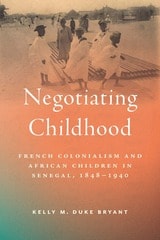
Negotiating Childhood
French Colonialism and African Children in Senegal, 1848–1940Kelly M. Duke Bryant
University of Massachusetts Press, 2026
A groundbreaking study of the meaning of childhood in French colonial Senegal
Negotiating Childhood explores how colonial child protection policies and African children’s responses to them produced new ways of defining, measuring, documenting, and experiencing childhood in the French colony of Senegal from 1848 to 1940. In this groundbreaking book, Kelly M. Duke Bryant takes the scholarship in new directions, offering to a literature dominated by studies of British colonies in the twentieth century a study of childhood in a French colony from the immediate post-emancipation period through the 1930s. This focus allows her to complicate the generally accepted timeline of child protection in colonial Africa and question other assumptions about children’s history on the continent.
This deeply researched work uses a wide range of sources to examine children’s experiences in spaces where they encountered French discipline and surveillance, such as wardship courts, public streets, schools, juvenile reformatories, and vaccine clinics. The book shows not only how these spaces re-ordered African childhood, but also how children themselves shaped and limited French efforts to impose order, especially when the state depended on African children’s cooperation to make good on rhetoric about child “protection.” It also charts the rise of documentation in children’s lives, as colonial representatives recorded names, ages, and other details about the African children with whom they interacted. Tracing the “documented” child back to the early colonial period, Negotiating Childhood historicizes the emergence of identity documentation—so crucial to our contemporary world—and questions the naturalness of the very idea of the “child.”

Never Say I
Sexuality and the First Person in Colette, Gide, and ProustMichael Lucey
Duke University Press, 2006
Considering novels along with journalism, theatrical performances, correspondences, and face-to-face encounters, Lucey focuses on the interlocking social and formal dimensions of using the first person. He argues for understanding the first person not just as a grammatical category but also as a collectively produced social artifact, demonstrating that Proust’s, Gide’s, and Colette’s use of the first person involved a social process of assuming the authority to speak about certain issues, or on behalf of certain people. Lucey reveals these three writers as both practitioners and theorists of the first person; he traces how, when they figured themselves or other first persons in certain statements regarding same-sex identity, they self-consciously called attention to the creative effort involved in doing so.
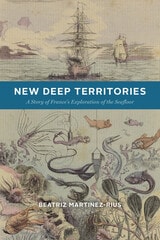
New Deep Territories
A Story of France’s Exploration of the SeafloorBeatriz Martinez-Rius
University of Chicago Press, 2026
Beneath the surface of the seas and oceans lies a territory as important for human societies as the exposed land and the airspace above them: the seafloor. Our daily life is inextricably linked to the seafloor and its resources, from global telecommunications infrastructure to offshore oil and gas extraction to strategic mineral mining.
By focusing on France, a country with an underwater territory seventeen times larger than its emerged lands, New Deep Territories explains how the seafloor emerged as a territory during the second half of the twentieth century. Beatriz Martinez-Rius traces the evolution of the country’s seafloor exploration and the motivations that fueled it from the aftermath of World War I to the late 1970s. In the early 1960s, the seafloor, instead of colonial territories, came to be seen as a source of natural resources. The French government, corporations such as oil companies, and scientists all imagined future uses of the seafloor, and these ever-evolving aspirations drove the development of technologies, techniques, and scientific fields that built up the submerged territory. Government officers and industrial stakeholders massively invested in technoscientific development to prepare for a future reliant on seafloor resources, including oil, gas, and minerals, well before it was technologically possible, economically feasible, and legally acceptable to extract them. The future they envisioned did not arrive, but their investment resulted in an unprecedented understanding of the ocean’s crust. Today, once again, national governments, international organizations, and private stakeholders are turning their attention to the seafloor.

New Negro Artists in Paris
African American Painters and Sculptors in the City of Light, 1922-1934Leininger-Miller, Theresa
Rutgers University Press, 2001
These artists exhibited the works they created in Paris at prestigious salons in France and in the United States, winning fellowships, grants, and awards. Leininger-Miller argues that it was study abroad that won these artists critical acclaim, establishing their reputations as some of the most significant leaders of the New Negro movement in the visual arts. She begins her study with a history of the debut of African American artists in Paris, 1830–1914, then provides readers with rarely seen profiles of each of the six artists from their birth through the end of their time abroad. Finally, Leininger-Miller examines patterns and differences in these individuals’ backgrounds and development, their patronage in the United States and France, their shared experiences abroad, and the impact their study in Paris had on the rest of their careers.

No Gifts from Chance
A Biography of Edith WhartonBy Shari Benstock
University of Texas Press, 2004
The first new biography of America's foremost woman of letters in twenty years, No Gifts from Chance presents an Edith Wharton for our times. Far from the emotionally withdrawn and neurasthenic victim of earlier portraits, she is revealed here as an ambitious, disciplined, and self-determined woman who fashioned life to her own desires. Drawing on government records, legal and medical documents, and recently opened collections of Wharton's letters, Shari Benstock's biography offers new information on what have been called the key mysteries of her life: the question of her paternity, her troubled relations with her mother and older brothers, her marriage to manic-depressive Teddy Wharton, and her extramarital affair with Morton Fullerton.
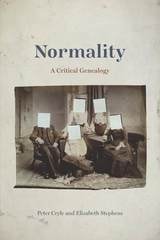
Normality
A Critical GenealogyPeter Cryle and Elizabeth Stephens
University of Chicago Press, 2017
In Normality, Peter Cryle and Elizabeth Stephens offer an intellectual and cultural history of what it means to be normal. They explore the history of how communities settle on any one definition of the norm, along the way analyzing a fascinating series of case studies in fields as remote as anatomy, statistics, criminal anthropology, sociology, and eugenics. Cryle and Stephens argue that since the idea of normality is so central to contemporary disability, gender, race, and sexuality studies, scholars in these fields must first have a better understanding of the context for normality. This pioneering book moves beyond binaries to explore for the first time what it does—and doesn’t—mean to be normal.

Not the Germans Alone
A Son's Search for the Truth of VichyIsaac Levendel
Northwestern University Press, 2000
On the eve of D-Day, Isaac Levendel's mother left her hiding place on a farm in southern France and never returned. After 40 years of silence and torment, he returned to France in 1990 determined to find out what had happened. This is the story of how, with perseverance, luck, and official help, he gained access to secret wartime documents laying bare the details of French collaboration-and the truth about his mother's fate.

Novel Gazing
Queer Readings in FictionEve Kosofsky Sedgwick, ed.
Duke University Press, 1997
Through discussions of a diverse array of British, French, and American novels—including major canonical novels, best-sellers, children’s fiction, and science fiction—these essays explore queer worlds of taste, texture, joy, and ennui, focusing on such subjects as flogging, wizardry, exorcism, dance, Zionist desire, and Internet sexuality. Interpreting the works of authors as diverse as Benjamin Constant, Toni Morrison, T. H. White, and William Gibson, along with canonical queer modernists such as James, Proust, Woolf, and Cather, contributors reveal the wealth of ways in which selves and communities succeed in extracting sustenance from the objects of a culture whose avowed desire has often been not to sustain them. The dramatic reframing that these essays perform will make the significance of Novel Gazing extend beyond the scope of queer studies to literary criticism in general.
Contributors. Stephen Barber, Renu Bora, Anne Chandler, James Creech, Tyler Curtain, Jonathan Goldberg, Joseph Litvak, Michael Lucey, Jeff Nunokawa, Cindy Patton, Jacob Press, Robert F. Reid-Pharr, Eve Kosofsky Sedgwick, Melissa Solomon, Kathryn Bond Stockton, John Vincent, Maurice Wallace, Barry Weller