Results by title
377 books match the query 'French' and 9 start with n

Napoleonic Friendship
Military Fraternity, Intimacy, and Sexuality in Nineteenth-Century FranceBrian Joseph Martin
University of New Hampshire Press, 2011
Winner of the Laurence Wylie Prize in French Cultural Studies
One of the first books on “Gays in the Military” published following the historic repeal of “Don't Ask Don't Tell” in 2011, Napoleonic Friendship examines the history of male intimacy in the French military, from Napoleon to the First World War. Echoing the historical record of gay soldiers in the United States, Napoleonic Friendship is the first book-length study on the origin of queer soldiers in modern France. Based on extensive archival research in France, the book traces the development of affectionate friendships in the French Army from 1789 to 1916.
Following the French Revolution, radical military reforms created conditions for new physical and emotional intimacy between soldiers, establishing a model of fraternal affection during the Revolutionary and Napoleonic Wars that would persist amid the ravages of the Franco-Prussian War and World War I. Through readings of Napoleonic military memoirs (and other non-fiction archival material) and French military fiction (from Hugo and Balzac to Zola and Proust), Martin examines a broad range of emotional and erotic relationships, from combat buddies to soldier lovers. He argues that the French Revolution's emphasis on military fraternity evolved into an unprecedented sense of camaraderie in the armies of Napoleon. For many soldiers, the hardships of combat led to intimate friendships. For some, the homosociality of military life inspired mutual affection, lifelong commitment, and homoerotic desire.
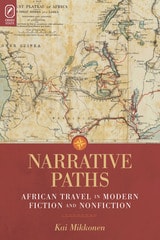
Narrative Paths
African Travel in Modern Fiction and NonfictionKai Mikkonen
The Ohio State University Press, 2015
Narrative Paths contributes to debates in narratology and rhetorical narrative theory about the fiction–nonfiction distinction. With chapters on a wide range of modernist authors—from Pierre Loti, André Gide, Michel Leiris, and Georges Simenon to Blaise Cendrars, Louis-Ferdinand Céline, Joseph Conrad, Graham Greene, Evelyn Waugh, and Isak Dinesen (Karen Blixen)—Mikkonen’s study also contributes to postcolonial approaches to these authors, examining issues of representation, narrative voice, and authority in narratives about colonial Africa.
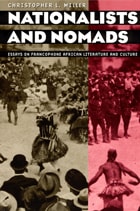
Nationalists and Nomads
Essays on Francophone African Literature and CultureChristopher L. Miller
University of Chicago Press, 1999
Miller ranges from the beginnings of francophone African literature—which he traces not to the 1930s Negritude movement but to the largely unknown, virulently radical writings of Africans in Paris in the 1920s—to the evolving relations between African literature and nationalism in the 1980s and 1990s. Throughout he aims to offset the contemporary emphasis on the postcolonial at the expense of the colonial, arguing that both are equally complex, with powerful ambiguities. Arguing against blanket advocacy of any one model (such as nationalism or hybridity) to explain these ambiguities, Miller instead seeks a form of thought that can read and recognize the realities of both identity and difference.
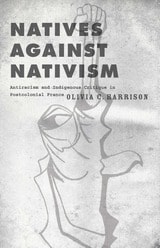
Natives against Nativism
Antiracism and Indigenous Critique in Postcolonial FranceOlivia C. Harrison
University of Minnesota Press, 2023
Examining the intersection of Palestine solidarity movements and antiracist activism in France from the 1970s to the present
For the pasty fifty years, the Palestinian question has served as a rallying cry in the struggle for migrant rights in postcolonial France, from the immigrant labor associations of the 1970s and Beur movements of the 1980s to the militant decolonial groups of the 2000s. In Natives against Nativism, Olivia C. Harrison explores the intersection of anticolonial solidarity and antiracist activism from the 1970s to the present.
Natives against Nativism analyzes a wide range of texts—novels, memoirs, plays, films, and militant archives—that mobilize the twin figures of the Palestinian and the American Indian in a crossed critique of Eurocolonial modernity. Harrison argues that anticolonial solidarity with Palestinians and Indigenous Americans has been instrumental in developing a sophisticated critique of racism across imperial formations—in this case, France, the United States, and Israel.
Serving as the first relational study of antiracism in France, Natives against Nativism observes how claims to indigeneity have been deployed in multiple directions, both in the ongoing struggle for migrant rights and racial justice, and in white nativist claims in France today.
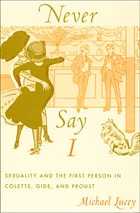
Never Say I
Sexuality and the First Person in Colette, Gide, and ProustMichael Lucey
Duke University Press, 2006
Considering novels along with journalism, theatrical performances, correspondences, and face-to-face encounters, Lucey focuses on the interlocking social and formal dimensions of using the first person. He argues for understanding the first person not just as a grammatical category but also as a collectively produced social artifact, demonstrating that Proust’s, Gide’s, and Colette’s use of the first person involved a social process of assuming the authority to speak about certain issues, or on behalf of certain people. Lucey reveals these three writers as both practitioners and theorists of the first person; he traces how, when they figured themselves or other first persons in certain statements regarding same-sex identity, they self-consciously called attention to the creative effort involved in doing so.
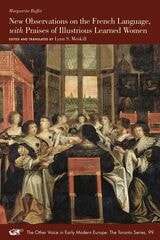
New Observations on the French Language, with Praises of Illustrious Learned Women
Marguerite Buffet
Iter Press, 2023
According to the few historical records that mention Marguerite Buffet, she lived her entire life in seventeenth-century Paris where she taught French to aristocratic women. Buffet’s vivid example of proper language use in New Observations on the French Language offers a rare glimpse into the life, habits, and culture of seventeenth-century France. She describes common errors in contemporary language use and gives examples of correct expressions for speaking and writing all the while encouraging women to aspire to higher levels of intellectual achievement.
In addition, her Praises of Illustrious Learned Women, a catalog of biographies of women who displayed exemplary intellect, wit, and conversation, includes a number of the author’s contemporaries such as Anna Maria van Schurman and Madeleine de Scudéry. Buffet’s collected praises of these women, many of whom were connected to the court of Louis XIV, show her unique position as both a participant in and historian of the intellectual and social world of the French salon.
This volume presents Buffet’s work in its near entirety for the first time in English, bringing to light Buffet’s unique contribution to the centuries-long debate concerning the status of women known as the querelle des femmes.

New York-Paris
Whitman, Baudelaire, and the Hybrid CityLaure Katsaros
University of Michigan Press, 2012
As New York and Paris began to modernize, new modes of entertainment, such as panoramas, dioramas, and photography, seemed poised to take the place of the more complex forms of literary expression. Dioramas and photography were invented in Paris but soon spread to America, forming part of an increasingly universal idiom of the spectacle. This brave new world of technologically advanced but crudely mimetic spectacles haunts both Whitman's vision of New York and Baudelaire's view of Paris. In New York-Paris, Katsaros explores the images of the mid-nineteenth-century city in the poetry of both Whitman and Baudelaire and seeks to demonstrate that, by projecting an image of the other's city onto his own, each poet tried to resist the apparently irresistible forward momentum of modernity rather than create a paradigmatically happy mixture of "high" and "low" culture.
Nomadic Voices of Exile
Feminine Identity in the Francophone Literature of the MaghrebValérie K. Orlando
Ohio University Press, 1999
Contemporary French writing on the Maghreb—that part of Africa above the Sahara—is truly postmodern in scope, the rich product of multifaceted histories promoting the blending of two worlds, two identities, two cultures, and two languages.
Nomadic Voices of Exile demonstrates how that postmodern sentiment has altered perceptions concerning Maghrebian feminine identity since the end of the French-colonial era. The authors discussed here, both those who reside in the Maghreb and those who have had to seek asylum in France, find themselves at the intersection of French and North African viewpoints, exposing a complicated world that must be negotiated and redefined.
In looking at the authors whose writings extend beyond a gender-based dialogue to include such issues as race, politics, religion, and history, Valérie Orlando explores the rich and changing landscape of the literature and the culture, addresses the stereotypes that have defined the past, and navigates the space of the exiled, a space previously at the peripheries of Western discourse.
Nomadic Voices of Exile will be useful to a variety of classrooms—women’s studies, Middle East studies, Francophone literature, Third World women writers—and to anyone interested in postcolonial and postmodern theory and philosophy and the history of the Maghreb through literature.

Novelization
From Film to NovelJan Baetens
The Ohio State University Press, 2018
Novelization offers a historical overview of the genre, focusing on the various formats that have been adopted since the first decades of the twentieth century until today: daily and weekly novelizations, cheap brochures, pocket books, and trade editions. It studies the specific features of the genre from various points of view: narrative style, illustrations, authorship, and marketing. By studying novelization from a broad historical perspective, Baetens reframes our understanding of adaptation and the relationship between cinema and literature. Rather than assume that cinematic adaptations either cannibalize or rejuvenate literature, Novelization ultimately offers the opportunity to rethink the adaptation paradigm of film and literary studies.