130 books match the query 'Gender identity' and 2 start with n
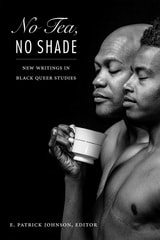
cover of No Tea, No Shade: New Writings in Black Queer Studies

No Tea, No Shade

New Writings in Black Queer Studies

E. Patrick Johnson, editor

Duke University Press, 2016
The follow-up to the groundbreaking Black Queer Studies, the edited collection No Tea, No Shade brings together nineteen essays from the next generation of scholars, activists, and community leaders doing work on black gender and sexuality. Building on the foundations laid by the earlier volume, this collection's contributors speak new truths about the black queer experience while exemplifying the codification of black queer studies as a rigorous and important field of study. Topics include "raw" sex, pornography, the carceral state, gentrification, gender nonconformity, social media, the relationship between black feminist studies and black trans studies, the black queer experience throughout the black diaspora, and queer music, film, dance, and theater. The contributors both disprove naysayers who believed black queer studies to be a passing trend and respond to critiques of the field's early U.S. bias. Deferring to the past while pointing to the future, No Tea, No Shade pushes black queer studies in new and exciting directions.

Contributors. Jafari S. Allen, Marlon M. Bailey, Zachary Shane Kalish Blair, La Marr Jurelle Bruce, Cathy J. Cohen, Jennifer DeClue, Treva Ellison, Lyndon K. Gill, Kai M. Green, Alexis Pauline Gumbs, Kwame Holmes, E. Patrick Johnson, Shaka McGlotten, Amber Jamilla Musser, Alison Reed, Ramón H. Rivera-Servera, Tanya Saunders, C. Riley Snorton, Kaila Story, Omise'eke Natasha Tinsley, Julia Roxanne Wallace, Kortney Ziegler
 

[more]
cover of Nonbinary Jane Austen

Nonbinary Jane Austen

Chris Washington

University of Minnesota Press, 2025

A bold and provocative analysis of Jane Austen as an early gender abolitionist

Chris Washington reads Jane Austen differently than we have classically understood her: rather than the doyen of the cisheteronormative marriage plot, the author theorizes how Austen envisions a nonbinary future that traverses the two-sex model of gender that we can supposedly see solidifying in the eighteenth century. Instead, Washington argues, Austen leverages the generic restraints of the novel to write a disguised autofiction in which Austen imagines herself as transgender and works to abolish gender exclusivity altogether. In doing so, she establishes a politics that ushers in a future beyond the cisheteronormative binary, one built on plurality and possibility.

[more]