Results by title
97 books match the query 'Geopolitics' and 3 start with n
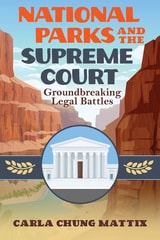
National Parks and the Supreme Court
Groundbreaking Legal BattlesCarla Chung Mattix
University of Nevada Press, 2026
Many Americans revere their national parks as places of natural beauty and cultural significance—but few realize how often these landscapes have been shaped by the courtroom as much as by conservation policy. With more than 3,500 lawsuits involving the National Park Service, litigation has defined, defended, and sometimes even threatened the character of the parks. Without these legal fights, the Gettysburg battlefield might be covered with strip malls and the Grand Canyon reduced to a mining site.
This book examines five landmark Supreme Court cases involving national parks—Gettysburg, Yellowstone, Grand Canyon, Death Valley, and the National Mall. Each chapter blends legal analysis with historical context, tracing the origins of the parks and the disputes that brought them before the nation’s highest court. Spanning nearly a century, these cases reveal how the Court has shaped park policy, land use, Native American rights, water law, and free speech.
Through these pivotal decisions, National Parks and the Supreme Court offers a new lens on the contested terrain of the national parks, where legal, environmental, and cultural values collide. By exploring the courts’ influence on public lands, it deepens our understanding of the complexities of managing America’s most cherished landscapes.
[more]
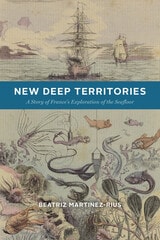
New Deep Territories
A Story of France’s Exploration of the SeafloorBeatriz Martinez-Rius
University of Chicago Press, 2026
How France integrated the seafloor into its national territory through an interplay of science, technology, and geopolitical ambition during the Cold War.
Beneath the surface of the seas and oceans lies a territory as important for human societies as the exposed land and the airspace above them: the seafloor. Our daily life is inextricably linked to the seafloor and its resources, from global telecommunications infrastructure to offshore oil and gas extraction to strategic mineral mining.
By focusing on France, a country with an underwater territory seventeen times larger than its emerged lands, New Deep Territories explains how the seafloor emerged as a territory during the second half of the twentieth century. Beatriz Martinez-Rius traces the evolution of the country’s seafloor exploration and the motivations that fueled it from the aftermath of World War I to the late 1970s. In the early 1960s, the seafloor, instead of colonial territories, came to be seen as a source of natural resources. The French government, corporations such as oil companies, and scientists all imagined future uses of the seafloor, and these ever-evolving aspirations drove the development of technologies, techniques, and scientific fields that built up the submerged territory. Government officers and industrial stakeholders massively invested in technoscientific development to prepare for a future reliant on seafloor resources, including oil, gas, and minerals, well before it was technologically possible, economically feasible, and legally acceptable to extract them. The future they envisioned did not arrive, but their investment resulted in an unprecedented understanding of the ocean’s crust. Today, once again, national governments, international organizations, and private stakeholders are turning their attention to the seafloor.
[more]

New World Orderings
China and the Global SouthLisa Rofel and Carlos Rojas, editors
Duke University Press, 2022
The contributors to New World Orderings demonstrate that China’s twenty-first-century rise occurs not only through economics and state politics but equally through the mutual entanglements of overlapping social, economic, and cultural worlds in Southeast Asia, Africa, and Latin America. They show how the Chinese state has sought to reconfigure the nation’s position in the world and the centrality of trade, labor, religion, migration, gender, race, and literature to this reconfiguration. Among other topics, the contributors examine China’s post-Bandung cultural diplomacy with African nations, how West African “pastor-entrepreneurs” in China interpreted and preached the prosperity doctrine, the diversity of Chinese-Argentine social relations in the soy supply chain, and the ties between China and India within the complex history of inter-Asian exchange and Chinese migration to Southeast Asia. By examining China’s long historical relationship with the Global South, this volume presents a non-state-centric history of China that foregrounds the importance of transnational communicative and imaginative worldmaking processes and interactions.
Contributors. Andrea Bachner, Luciano Damián Bolinaga, Nellie Chu, Rachel Cypher, Mingwei Huang, T. Tu Huynh, Yu-lin Lee, Ng Kim Chew, Lisa Rofel, Carlos Rojas, Shuang Shen, Derek Sheridan, Nicolai Volland
Contributors. Andrea Bachner, Luciano Damián Bolinaga, Nellie Chu, Rachel Cypher, Mingwei Huang, T. Tu Huynh, Yu-lin Lee, Ng Kim Chew, Lisa Rofel, Carlos Rojas, Shuang Shen, Derek Sheridan, Nicolai Volland
[more]