Results by title
212 books match the query 'German' and 3 start with n
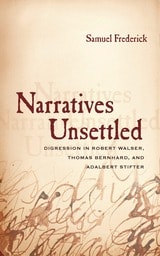
Narratives Unsettled
Digression in Robert Walser, Thomas Bernhard, and Adalbert StifterSamuel Frederick
Northwestern University Press, 2012
Frederick's readings of the narrative experiments, utopian moments, and obsessions with the trivial in works by Walser, Bernhard, and Stifter point to new ways of approaching the ostensibly antinarrative as a productive element of narrativity. As a work that explores the often neglected crossroads of German studies and postclassical narratology, Narratives Unsettled will be of great interest to scholars in both of these fields, as well as to those working on literature and theory in general.

Nothing Happened
Charlotte Salomon and an Archive of SuicideDarcy C. Buerkle
University of Michigan Press, 2013
Charlotte Salomon's (1917-43) fantastical autobiography, Life? or Theater?, consists of 769 sequenced gouache paintings, through which the artist imagined the circumstances of the eight suicides in her family, all but one of them women. But Salomon's focus on suicide was not merely a familial idiosyncrasy. Nothing Happened argues that the social history of early-twentieth-century Germany has elided an important cultural and social phenomenon by not including the story of German Jewish women and suicide. This absence in social history mirrors an even larger gap in the intellectual history of deeply gendered suicide studies that have reproduced the notion of women's suicide as a rarity in history. Nothing Happened is a historiographic intervention that operates in conversation and in tension with contemporary theory about trauma and the reconstruction of emotion in history.

Novalis, Spinoza, and the Limits of Romantic Materialism
Siarhei Biareishyk
Northwestern University Press, 2026
Offering an innovative and illuminating new reading of Spinoza and Novalis
This rigorously researched study reframes our understanding of the intellectual currents in Germany around 1800 through a careful reinterpretation of its key thinker, Novalis, in conversation with Spinoza’s philosophy. Siarhei Biareishyk presents an alternative to the standard narrative that resolutely links emergent modernity and secularization to philosophical “idealism” by showing how Spinozan materialism informs the scientific experiments, metaphysical inquiries, and political debates of Novalis and his contemporaries. Shifting our focus away from the historical interpretation of Novalis as a mystic and theorist of subjectivity, Biareishyk elaborates on the Spinozan materialist strain in Novalis in three key domains: ontology and the conception of nature, theories of singularity and individuation, and the concept of the political. He brings current romanticist scholarship into conversation with contemporary discussions of Spinoza in continental philosophy, in the Marxist tradition particularly, demonstrating that the Spinoza–Novalis encounter provides a viable alternative—in its articulation of causality, dialectics, and the political—to the dominant conceptual apparatuses of both Kant and Hegel.