383 books match the query 'Globalization' and 7 start with n
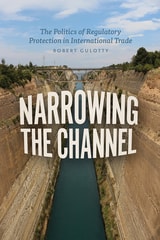
cover of Narrowing the Channel: The Politics of Regulatory Protection in International Trade

Narrowing the Channel

The Politics of Regulatory Protection in International Trade

Robert Gulotty

University of Chicago Press, 2020

While large, multinational corporations have supported the removal of tariffs, behind the scenes these firms have fought for protection in the form of product regulations, including testing, labeling, and registration requirements. Unlike tariffs, these regulations can raise fixed costs, excluding smaller firms from the market and shifting profits toward global giants.

Narrowing the Channel demonstrates that globalization and globalized firms can paradoxically hinder rather than foster economic cooperation as larger firms seek to protect their markets through often unnecessarily strict product regulations. To illustrate the problem of regulatory protectionism, Robert Gulotty offers an in-depth analysis of contemporary rulemaking in the United States and the European Union in the areas of health, safety, and environmental standards. He shows how large firms seek regulatory schemes that disproportionately disadvantage small firms. When multinationals are embedded in the local economy, governments too have an incentive to use these regulations to shift profits back home. Today, the key challenge to governing global trade is not how much trade occurs but who is allowed to participate, and this book shows that new rules will be needed to allow governments to widen the benefits of global commerce and avoid further inequality and market concentration.

 
[more]
cover of National Consciousness and Literary Cosmopolitics: Postcolonial Literature in a Global Moment

National Consciousness and Literary Cosmopolitics

Postcolonial Literature in a Global Moment

Weihsin Gui

The Ohio State University Press, 2013
National Consciousness and Literary Cosmopolitics: Postcolonial Literature in a Global Moment by Weihsin Gui argues that postcolonial literature written within a framework of globalization still takes nationalism seriously rather than dismissing it as obsolete. Authors and texts often regarded as cosmopolitan, diasporic, or migrant actually challenge globalization’s tendency to treat nations as absolute and homogenous sociocultural entities.
While social scientific theories of globalization after 1945 represent nationalism as antithetical to transnational economic and cultural flows, National Consciousness and Literary Cosmopolitics contends that postcolonial literature represents nationalism as a form of cosmopolitical engagement with what lies beyond the nation’s borders. Postcolonial literature never gave up on anticolonial nationalism but rather revised its meaning, extending the idea of the nation beyond an identity position into an interrogation of globalization and the neocolonial state through political consciousness and cultural critique.
The literary cosmopolitics evident in the works of Kazuo Ishiguro, Derek Walcott, Shirley Geok-lin Lim, Preeta Samarasan, and Twan Eng Tan distinguish between an instrumental national identity and a critical nationality that negates the subordination of nationalism by neocolonial regimes and global capitalism. Through their formal innovations, these writers represent nationalism not as a monolithic or essentialized identity or body of people but as a cosmopolitcal constellation of political, social, and cultural forces.
[more]
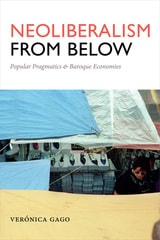
cover of Neoliberalism from Below: Popular Pragmatics and Baroque Economies

Neoliberalism from Below

Popular Pragmatics and Baroque Economies

Verónica Gago

Duke University Press, 2017
In Neoliberalism from Below—first published in Argentina in 2014—Verónica Gago examines how Latin American neoliberalism is propelled not just from above by international finance, corporations, and government, but also by the activities of migrant workers, vendors, sweatshop workers, and other marginalized groups. Using the massive illegal market La Salada in Buenos Aires as a point of departure, Gago shows how alternative economic practices, such as the sale of counterfeit goods produced in illegal textile factories, resist neoliberalism while simultaneously succumbing to its models of exploitative labor and production. Gago demonstrates how La Salada's economic dynamics mirror those found throughout urban Latin America. In so doing, she provides a new theory of neoliberalism and a nuanced view of the tense mix of calculation and freedom, obedience and resistance, individualism and community, and legality and illegality that fuels the increasingly powerful popular economies of the global South's large cities.
[more]
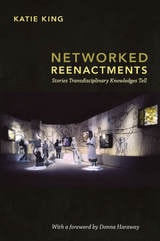
cover of Networked Reenactments: Stories Transdisciplinary Knowledges Tell

Networked Reenactments

Stories Transdisciplinary Knowledges Tell

Katie King with a foreword by Donna Haraway

Duke University Press, 2012
Since the 1990s, the knowledge, culture, and entertainment industries have found themselves experimenting, not altogether voluntarily, with communicating complex information across multiple media platforms. Against a backdrop of competing national priorities, changing technologies, globalization, and academic capitalism, these industries have sought to reach increasingly differentiated local audiences, even as distributed production practices have made the lack of authorial control increasingly obvious. As Katie King describes in Networked Reenactments, science-styled television—such as the Secrets of Lost Empires series shown on the PBS program Nova—demonstrates how new technical and collaborative skills are honed by television producers, curators, hobbyists, fans, and even scholars. Examining how transmedia storytelling is produced across platforms such as television and the web, she analyzes what this all means for the humanities. What sort of knowledge projects take up these skills, attending to grain of detail, evoking affective intensities, and zooming in and out, representing multiple scales, as well as many different perspectives? And what might this mean for feminist transdisciplinary work, or something sometimes called the posthumanities?
[more]
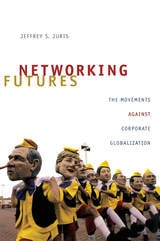
cover of Networking Futures: The Movements against Corporate Globalization

Networking Futures

The Movements against Corporate Globalization

Jeffrey S. Juris

Duke University Press, 2008

Since the first worldwide protests inspired by Peoples’ Global Action (PGA)—including the mobilization against the November 1999 World Trade Organization meetings in Seattle—anti–corporate globalization activists have staged direct action protests against multilateral institutions in cities such as Prague, Barcelona, Genoa, and Cancun. Barcelona is a critical node, as Catalan activists have played key roles in the more radical PGA network and the broader World Social Forum process. In 2001 and 2002, the anthropologist Jeffrey S. Juris participated in the Barcelona-based Movement for Global Resistance, one of the most influential anti–corporate globalization networks in Europe. Combining ethnographic research and activist political engagement, Juris took part in hundreds of meetings, gatherings, protests, and online discussions. Those experiences form the basis of Networking Futures, an innovative ethnography of transnational activist networking within the movements against corporate globalization.

In an account full of activist voices and on-the-ground detail, Juris provides a history of anti–corporate globalization movements, an examination of their connections to local dynamics in Barcelona, and an analysis of movement-related politics, organizational forms, and decision-making. Depicting spectacular direct action protests in Barcelona and other cities, he describes how far-flung activist networks are embodied and how networking politics are performed. He further explores how activists have used e-mail lists, Web pages, and free software to organize actions, share information, coordinate at a distance, and stage “electronic civil disobedience.” Based on a powerful cultural logic, anti–corporate globalization networks have become models of and for emerging forms of radical, directly democratic politics. Activists are not only responding to growing poverty, inequality, and environmental devastation; they are also building social laboratories for the production of alternative values, discourses, and practices.

[more]
cover of Neutral Accent: How Language, Labor, and Life Become Global

Neutral Accent

How Language, Labor, and Life Become Global

A. Aneesh

Duke University Press, 2015

In Neutral Accent, A. Aneesh employs India's call centers as useful sites for studying global change. The horizon of global economic shift, the consequences of global integration, and the ways in which call center work "neutralizes" racial, ethnic, and national identities become visible from the confines of their cubicles. In his interviews with call service workers and in his own work in a call center in the high tech metropolis of Gurgoan, India, Aneesh observed the difficulties these workers face in bridging cultures, laws, and economies: having to speak in an accent that does not betray their ethnicity, location, or social background; learning foreign social norms; and working graveyard shifts to accommodate international customers. Call center work is cast as independent of place, space, and time, and its neutrality—which Aneesh defines as indifference to difference—has become normal business practice in a global economy. The work of call center employees in the globally integrated marketplace comes at a cost, however, as they become disconnected from the local interactions and personal relationships that make their lives anything but neutral.
[more]
cover of New Imaginaries, Volume 14

New Imaginaries, Volume 14

Dilip Parameshwar Gaonkar and Benjamin Lee, eds.

Duke University Press, 0

How do ordinary people identify themselves as part of a group? By what means do they express a largely unspoken understanding of themselves in society? This special issue on new social imaginaries examines the emergent forms of solidarity and collective identity in a global context. The essays explore how local cultural forms and global social movements contribute to the making and unmaking of imagined collective identities.

Contributors to this collection include major voices in the fields of philosophy, critical literature, sociology, anthropology, and communication studies. The articles consider how people conceive of and categorize themselves as part of a cohesive group under the multiple rubrics of the public and counterpublic, nation, ethnos, civilization, genealogy, democracy, and the market. Many of the essays are situated in specific national and cultural sites such as Africa, Australia, eighteenth-century England, the European Union, India, and Turkey. Others examine the intersections of global financial markets and democratic institutions.

As a whole, New Imaginaries suggests a new way of synthesizing economic, political, and cultural approaches to social life.

Contributors. Arjun Appadurai, Craig Calhoun, Dilip Parameshwar Gaonkar, Nilüfer Göle, Benjamin Lee, Edward LiPuma, Achille Mbembe, Mary Poovey, Elizabeth A. Povinelli, Charles Taylor, Michael Warner

[more]