62 books match the query 'Hawaii' and 3 start with n
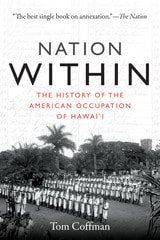
cover of Nation Within: The History of the American Occupation of Hawai'i

Nation Within

The History of the American Occupation of Hawai'i

Tom Coffman

Duke University Press, 2009
In 1893 a small group of white planters and missionary descendants backed by the United States overthrew the Kingdom of Hawai‘i and established a government modeled on the Jim Crow South. In Nation Within Tom Coffman tells the complex history of the unsuccessful efforts of deposed Hawaiian queen Lili‘uokalani and her subjects to resist annexation, which eventually came in 1898. Coffman describes native Hawaiian political activism, the queen's visits to Washington, D.C., to lobby for independence, and her imprisonment, along with hundreds of others, after their aborted armed insurrection. Exposing the myths that fueled the narrative that native Hawaiians willingly relinquished their nation, Coffman shows how Americans such as Theodore Roosevelt conspired to extinguish Hawai‘i's sovereignty in the service of expanding the United States' growing empire.
[more]
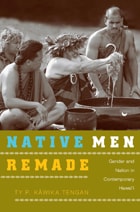
cover of Native Men Remade: Gender and Nation in Contemporary Hawai'i

Native Men Remade

Gender and Nation in Contemporary Hawai'i

Ty P. Kawika Tengan

Duke University Press, 2008

Many indigenous Hawaiian men have felt profoundly disempowered by the legacies of colonization and by the tourist industry, which, in addition to occupying a great deal of land, promotes a feminized image of Native Hawaiians (evident in the ubiquitous figure of the dancing hula girl). In the 1990s a group of Native men on the island of Maui responded by refashioning and reasserting their masculine identities in a group called the Hale Mua (the “Men’s House”). As a member and an ethnographer, Ty P. Kāwika Tengan analyzes how the group’s mostly middle-aged, middle-class, and mixed-race members assert a warrior masculinity through practices including martial arts, woodcarving, and cultural ceremonies. Some of their practices are heavily influenced by or borrowed from other indigenous Polynesian traditions, including those of the Māori. The men of the Hale Mua enact their refashioned identities as they participate in temple rites, protest marches, public lectures, and cultural fairs.

The sharing of personal stories is an integral part of Hale Mua fellowship, and Tengan’s account is filled with members’ first-person narratives. At the same time, Tengan explains how Hale Mua rituals and practices connect to broader projects of cultural revitalization and Hawaiian nationalism. He brings to light the tensions that mark the group’s efforts to reclaim indigenous masculinity as they arise in debates over nineteenth-century historical source materials and during political and cultural gatherings held in spaces designated as tourist sites. He explores class status anxieties expressed through the sharing of individual life stories, critiques of the Hale Mua registered by Hawaiian women, and challenges the group received in dialogues with other indigenous Polynesians. Native Men Remade is the fascinating story of how gender, culture, class, and personality intersect as a group of indigenous Hawaiian men work to overcome the dislocations of colonial history.

[more]
cover of No Sword To Bury: Japanese Americans In Hawaii

No Sword To Bury

Japanese Americans In Hawaii

Franklin S. Odo

Temple University Press, 2004

When bombs rained down on Pearl Harbor in 1941, Japanese American college students were among the many young men enrolled in ROTC and immediately called upon to defend the Hawaiian islands against invasion. In a few weeks, however, the military government questioned their loyalty and disarmed them. In No Sword to Bury, Franklin Odo places the largely untold story of the wartime experience of these young men in the context of the community created by their immigrant families and its relationship to the larger, white-dominated society. At the heart of the book are vivid oral histories that recall their service on the home front in the Varsity Victory Volunteers, a non-military group dedicated to public works, as well as in the segregated 442nd Regimental Combat Team. Illuminating a critical moment in ethnic identity formation among this first generation of Americans of Japanese descent (the nisei), Odo shows how the war-time service and the post-war success of these men contributed to the simplistic view of Japanese Americans as a model minority in Hawai`i.
[more]