Results by title
438 books match the query 'Hispanic & Latino' and 13 start with n
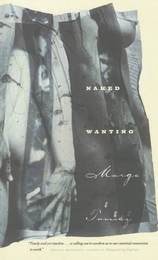
Naked Wanting
Margo Tamez
University of Arizona Press, 2003
Margo Tamez’s voice is that of the cicada and the cricket, the raven and the crane. In this volume of poetry, she shows us that the earth is an erotic current linking all beings, a vibrant network of birth, death, and rebirth. A sacred intertwining from which we as humans have become disconnected. Tamez shares the perspective of other creatures in images that remind us of Nature's beauty and fragility. An invocation of birds: “Sudden hum / wings touching / wings in swift turn / hush / a fast red out of the flux.” An appreciation for the delicacy of insects, for spiderwebs “like a hundred needle-thin tubes of blown glass.”
Here too are reflections on childbirth and children—and on miscarriage, when damage inflicted on the environment by herbicides comes back to haunt all of us in our skin and bones, our very wombs. Warning of “the chemical cocktail seeping into the air ducts,” she brings the voice of someone who has experienced firsthand what happens when our land and water are compromised. For Tamez, earth, food, and family are the essentials of life, and we ignore them at our own peril. “If a person / does not admit the peril . . . that becomes a dangerous / form of existence.”
Written with the wisdom of one who knows and loves the land, her lyrical meditations speak to the naked wanting in us all.
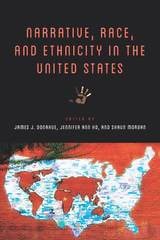
Narrative, Race, and Ethnicity in the United States
Edited by James J. Donahue, Jennifer Ann Ho, and Shaun Morgan
The Ohio State University Press, 2017
Recognizing that racial/ethnic issues and tensions are often contextualized geographically, this volume focuses on narratives associated with various racial and ethnic communities in the United States. By engaging with new developments in narrative theory and critical race studies, this volume demonstrates the vitality of using the tools of narratology and critical race theory together to understand how race influences narrative and how narratology illuminates a reading of race in ethnic American literature.
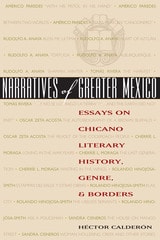
Narratives of Greater Mexico
Essays on Chicano Literary History, Genre, and BordersBy Héctor Calderón
University of Texas Press, 2005
Once relegated to the borders of literature—neither Mexican nor truly American—Chicana/o writers have always been in the vanguard of change, articulating the multicultural ethnicities, shifting identities, border realities, and even postmodern anxieties and hostilities that already characterize the twenty-first century. Indeed, it is Chicana/o writers' very in-between-ness that makes them authentic spokespersons for an America that is becoming increasingly Mexican/Latin American and for a Mexico that is ever more Americanized.
In this pioneering study, Héctor Calderón looks at seven Chicana and Chicano writers whose narratives constitute what he terms an American Mexican literature. Drawing on the concept of "Greater Mexican" culture first articulated by Américo Paredes, Calderón explores how the works of Paredes, Rudolfo Anaya, Tomás Rivera, Oscar Zeta Acosta, Cherríe Moraga, Rolando Hinojosa, and Sandra Cisneros derive from Mexican literary traditions and genres that reach all the way back to the colonial era. His readings cover a wide span of time (1892-2001), from the invention of the Spanish Southwest in the nineteenth century to the América Mexicana that is currently emerging on both sides of the border. In addition to his own readings of the works, Calderón also includes the writers' perspectives on their place in American/Mexican literature through excerpts from their personal papers and interviews, correspondence, and e-mail exchanges he conducted with most of them.

Natural Consequences
A NovelElia Barceló
Vanderbilt University Press, 2021
Author Elia Barceló's setup is funny and feminist, and it raises questions of what it means to be "male" or "female"—prescient, considering this novel was first published twenty-five years ago. The anniversary is being celebrated now with the first English-language edition, translated by veteran sci-fi translators Yolanda Molina-Gavilán and Andrea Bell, who also provide a critical introduction.
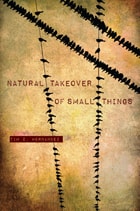
Natural Takeover of Small Things
Tim Z. Hernandez
University of Arizona Press, 2013
The book opens with an image of Fresno as “the inexhaustible nerve/in the twitching leg of a dog/three hours after being smashed/beneath the retread wheel/of a tomato truck en route to/a packing house that was raided/by the feds just days before the harvest.” It ends with “Adios, Fresno,” an astringent farewell to the city: “You can keep your fields,/the sun will follow me./I won’t reconsider./I’ve overstayed my welcome/by three generations.” By then, we have toured the breadth of the San Joaquin Valley, have tasted Fuyu persimmons and lengua, have witnessed a home crumbling to foreclosure, and listened to the last words of a dying campesino. We’re made aware that this is an atmosphere scented by an entirely organic stew—a melding of culture, objects, and forms. This is a place where rubble mirrors the refuse of lives. But garbage is also compost. And if we squint, we can see through the wreckage a few small patches where love could be taking root and hope might actually be sprouting.
New Latina Narrative
The Feminine Space of Postmodern EthnicityEllen McCracken
University of Arizona Press, 1999
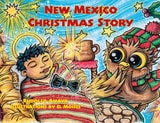
New Mexico Christmas Story
Owl in a Straw Hat 3Rudolfo Anaya
Museum of New Mexico Press, 2020
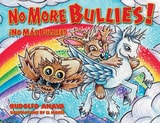
No More Bullies!/¡No Más Bullies
Owl in a Straw Hat 2Rudolfo Anaya
Museum of New Mexico Press, 2019
No Short Journeys
The Interplay of Cultures in the History and Literature of the BorderlandsCecil Robinson
University of Arizona Press, 1992
"In graceful prose, the longtime English professor leads readers on a leisurely stroll through the literary landscape of the Southwest."—Journal of Arizona History
"Does more for reconstructing American literature than any of the contemporary American literature anthologies that are on the market today. . . . Strongly recommended."—Choice
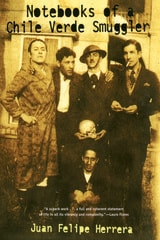
Notebooks of a Chile Verde Smuggler
Juan Felipe Herrera
University of Arizona Press, 2002
Notebooks of a Chile Verde Smuggler is a river of faces and phrases, jottings and reflections—a personal pilgrimage and collective parade of love, mock-prophecy, and chiste. Tuning in voices from numerous time zones, languages, and minds, Herrera recalls his childhood and coming of age, his participation in the Chicano Movement, and the surreal aspects of postmodern America. He uses broad strokes to paint a historical, social, and familial portrait that moves from the twilight of the nineteenth century to the dawn of the twenty-first, then takes up a finer brush to etch the eternal tension between desire and frustration, hope and disillusionment, violence and tenderness.
Here are transamerican sutras spanning metrocenters from Mexico City to San Francisco, or slinking across the border from Juárez to El Paso. Outrageous, rhythmic lists—"Foodstuffs They Never Told Us About," "Things Religion Makes Me Do"—that fire the imagination. Celebrations of his Plutomobile that "runs on ham hawks & bird grease," and of Chicano inventions such as cilantro aftershave and "the art of eating Vicks VapoRub with your dedos."
Pushing forms to the edge of possibility while forcing readers to rethink reality as well as language, Herrera invokes childhoods and neighborhoods, stand-up clowns and Movimiento gypsies, grandmothers of the buñuelo kitchen and tragicomic soliloquies of dizzy-headed outcasts of paradise. Notebooks of a Chile Verde Smuggler is a crucible of flavorful language meant to be rolled lazily on the mind's tongue—and then swallowed whole to let its hot and savory sweetness fill your soul.
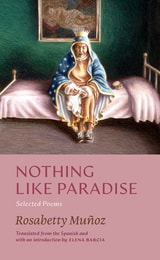
Nothing Like Paradise
Selected PoemsRosabetty Muñoz, Elena Barcia
Northwestern University Press, 2027
The first English-language translation of Rosabetty Muñoz’s vital and innovative poetry from across her extraordinary body of work
Rosabetty Muñoz is one of Chile’s most acclaimed and innovative contemporary poets. Her poems highlight the lives of girls and women on the islands of the Chilean archipelago, portraying the hardships they encounter in this often-overlooked region of the world. In this meticulous and compelling translation from Elena Barcia, Nothing Like Paradise offers a collection of selected works from across Muñoz’s oeuvre, offering a close look into the breadth and emotional intensity of her poetry.
These poems depict the wounds inflicted by the Pinochet dictatorship, foreign invasions, sexual exploitation, the incursions of global capitalism, and political exile. Renowned for her powerful use of multiple voices and striking images, Muñoz channels the thoughts and emotions of the islands’ female inhabitants, bringing immediacy and drama to their stories and transforming readers into their witnesses and confidants. Her poems invite us to confront pain and injustice with empathy and to turn understanding into a collective act of compassion and resistance.
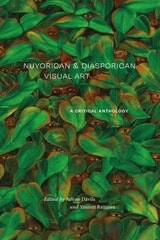
Nuyorican and Diasporican Visual Art
A Critical AnthologyArlene Dávila and Yasmin Ramirez, editors
Duke University Press, 2025
With: Néstor David Pastor, Gabriel Magraner, and Nikki Myers
Contributors. Joseph Anthony Cáceres, Taína Caragol, Arnaldo M. Cruz-Malavé, Deborah Cullen-Morales, Arlene Dávila, Kerry Doran, Elizabeth Ferrer, Yomaira C. Figueroa-Vásquez, Al Hoyos-Twomey, Teréz Iacovino, Johnny Irizarry, Johana Londoño, Urayoán Noel, Néstor David Pastor, Yasmin Ramirez, Melissa M. Ramos Borges, Raquel Reichard, Rojo Robles, Abdiel D. Segarra Ríos, Wilson Valentín-Escobar
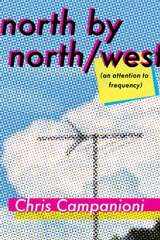
north by north/west
(an attention to frequency)Chris Campanioni
West Virginia University Press, 2025
2025 Foreword Indies Finalist, Nonfiction (Multicultural)
north by north/west is a hybrid work of creative nonfiction assembled as several iterative sequences—a discontinuous itinerary—of exile. Harnessing both montage and collage to represent the incohesive experience of being between cultures, categories, and language, this book is a personal, critical, and autoethnographic exploration of diasporic identity formation and creative expression amidst the cultural and political impacts of Cold War colonialism and fragmentation. As the narrator begins work on a rough translation of the 1959 film North by Northwest, focal points surface through textual correspondences with distant coordinates, shifting between close readings of Whitney Houston’s early music videos, current events reportage, illness journals, eighties spy movies, the most recent solar eclipse, Alfred Hitchcock’s unproduced films, Cold War “stay-behind operations,” an ill-fated party at the Festival de Cannes, and family accounts of migration. These meticulously arranged narrative threads—harnessing elements of a novel alongside poetry, photographs, and field notes—attempt to discompose the epistemology of the West/Global North in order to conceptualize a genre of work by the children of exiles who have been called “the post-dictatorship generation.”