Results by title
260 books match the query 'Human ecology' and 9 start with n
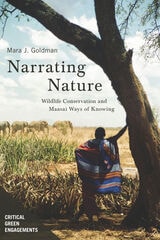
Narrating Nature
Wildlife Conservation and Maasai Ways of KnowingMara J. Goldman
University of Arizona Press, 2020
This book employs different storytelling practices, including a traditional Maasai oral meeting—the enkiguena—to decenter conventional scientific ways of communicating about, knowing, and managing nature. Author Mara J. Goldman draws on more than two decades of deep ethnographic and ecological engagements in the semi-arid rangelands of East Africa—in landscapes inhabited by pastoral and agropastoral Maasai people and heavily utilized by wildlife. These iconic landscapes have continuously been subjected to boundary drawing practices by outsiders, separating out places for people (villages) from places for nature (protected areas). Narrating Nature follows the resulting boundary crossings that regularly occur—of people, wildlife, and knowledge—to expose them not as transgressions but as opportunities to complicate the categories themselves and create ontological openings for knowing and being with nature otherwise.
Narrating Nature opens up dialogue that counters traditional conservation narratives by providing space for local Maasai inhabitants to share their ways of knowing and being with nature. It moves beyond standard community conservation narratives that see local people as beneficiaries or contributors to conservation, to demonstrate how they are essential knowledgeable members of the conservation landscape itself.
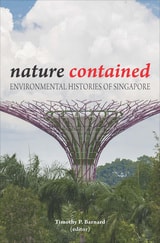
Nature Contained
Environmental Histories of SingaporeTimothy P. Barnard
National University of Singapore Press, 2014
Nature Inc.
Environmental Conservation in the Neoliberal AgeEdited by Bram Büscher, Wolfram Dressler, and Robert Fletcher
University of Arizona Press, 2014
As public funding for conservation efforts grows ever scarcer and the private sector is brimming with ideas about how its role—along with its profits— can grow, market forces have found their way into environmental management to a degree unimaginable only a few years ago. Ecotourism, payment for environmental services (PES), and new conservation finance instruments such as species banking, carbon trading, and biodiversity derivatives are only some of the market mechanisms that have sprung into being. This is “Nature™ Inc.”: a fast-growing frontier of networks, activities, knowledge, and regulations that are rapidly changing the relations between people and nature on both global and local scales.
Nature™ Inc. brings together cutting-edge research by respected scholars from around the world to analyze how “neoliberal conservation” is reshaping human–nature relations that have been fashioned over two centuries of capitalist development. Contributors synthesize and add to a growing body of academic literature that cuts across the disciplinary boundaries of geography, sociology, anthropology, political science, and development studies to critically interrogate the increasing emphasis on neoliberal market-based mechanisms in environmental conservation. They all grapple with one overriding question: can capitalist market mechanisms resolve the environmental problems they have helped create?
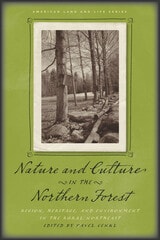
Nature and Culture in the Northern Forest
Region, Heritage, and Environment in the Rural NortheastPavel Cenkl
University of Iowa Press, 2010
Nearly 30 million acres of the Northern Forest stretch across New York, Vermont, New Hampshire, and Maine. Within this broad area live roughly a million residents whose lives are intimately associated with the forest ecosystem and whose individual stories are closely linked to the region’s cultural and environmental history. The fourteen engaging essays in Nature and Culture in the Northern Forest effectively explore the relationships among place, work, and community in this complex landscape. Together they serve as a stimulating introduction to the interdisciplinary study of this unique region.
Each of the four sections views through a different lens the interconnections between place and people. The essayists in “Encounters” have their hiking boots on as they focus on personal encounters with flora and fauna of the region. The energizing accounts in “Teaching and Learning” question our assumptions about education and scholarship by proposing invigorating collaborations between teachers and students in ways determined by the land itself, not by the abstractions of pedagogy. With the freshness of Thoreau’s irreverence, the authors in “Rethinking Place” look at key figures in the forest’s literary and cultural development to help us think about the affiliations between place and citizenship. In “Nature as Commodity,” three essayists consider the ways that writers from the nineteenth and early twentieth centuries thought about nature as a product and, thus, how their conclusions bear on the contemporary retailing of place.
The writers in Nature and Culture in the Northern Forest reveal the rich affinities between a specific place and the literature, thought, and other cultural expressions it has nurtured. Their insightful and stimulating connections exemplify adventurous bioregional thinking that encompasses both natural and cultural realities while staying rooted in the particular landscape of some of the Northeast’s wildest forests and oldest settlements.
Nature and History in Modern Italy
Marco Armiero
Ohio University Press, 2010
Is Italy il bel paese—the beautiful country—where tourists spend their vacations looking for art, history, and scenery? Or is it a land whose beauty has been cursed by humanity’s greed and nature’s cruelty? The answer is largely a matter of narrative and the narrator’s vision of Italy. The fifteen essays in Nature and History in Modern Italy investigate that nation’s long experience in managing domesxadtixadcated rather than wild natures and offer insight into these conflicting visions. Italians shaped their land in the most literal sense, producing the landscape, sculpting its heritage, embedding memory in nature, and rendering the two different visions inseparxadable. The interplay of Italy’s rich human history and its dramatic natural diversity is a subject with broad appeal to a wide range of readers.
Nature in Common?
Environmental Ethics and the Contested Foundations of Environmental PolicyBen A. Minteer
Temple University Press, 2009
This important book brings together leading environmental thinkers to debate a central conflict within environmental philosophy: Should we appreciate nature mainly for its ability to advance our interests or should we respect it as having a good of its own, apart from any contribution to human well being? Specifically, the fourteen essays collected here discuss the "convergence hypothesis" put forth by Bryan Norton—a controversial thesis in environmental ethics about the policy implications of moral arguments for environmental protection. Historically influential essays are joined with newly commissioned essays to provide the first sustained attempt to reconcile two long-opposed positions. Norton himself offers the book's closing essay.
This seminal volume contains contributions from some of the most respected scholars in the field, including Donald Brown, J. Baird Callicott, Andrew Light, Holmes Rolston III, Laura Westra, and many others. Although Nature in Common? will be especially useful for students and professionals studying environmental ethics and philosophy, it will engage any reader who is concerned about the philosophies underlying contemporary environmental policies.

Nature's Keeper
Peter S. Wenz
Temple University Press, 1996
In the West, humans tend to separate themselves from nature, valuing nature only as a means of meeting their own needs and happiness. This domination of nature often fosters human oppression instead of freedom and progress, as those who ignore abuses of nature tend to disregard human injustice as well. Peter S. Wenz argues that this oppression involves such destructive forces as sexism, ethnic strife, and political repression, including repression of the nuclear power industry's victims. Catastrophes like the Holocaust and the Gulf War are the result.
In contrast to the destructive "separate from nature" attitude, Wenz looks to various indigenous peoples as an example of societies where human beings revere nature for itself--societies where human beings flourish as individuals, in families, and in communities. Unlike societies dependent on commerce and industry, many indigenous peoples consider themselves part of a circle of life, reaping benefits far greater than the technological advances of the West. Wenz considers how to adopt the perspective of some indigenous cultures and how to make it work in our fast-food world. Additionally, he uses a trip to the World Uranium Hearings in Salzburg as a vehicle for understanding complex philosophical issues from consumerism to anthropocentrism.
In the series Ethics and Action, edited by Tom Regan.
Nevada's Changing Wildlife Habitat
An Ecological HistoryGeorge E. Gruell
University of Nevada Press, 2013
For millennia the ecology of the Great Basin has evolved because of climate change and the impacts of human presence. Nevada’s Changing Wildlife Habitat is the first book to explain the transformations in the plants and animals of this region over time and how they came about. Using data gleaned from archaeological and anthropological studies, numerous historical documents, repeat photography, and several natural sciences, the authors examine changes in vegetation and their impact on wildlife species and the general health of the environment. They also outline the choices that current users and managers of rangelands face in being good stewards of this harsh but fragile environment and its wildlife.
No Place Like Home
Notes from a Western LifeLinda M. Hasselstrom
University of Nevada Press, 2010
In No Place Like Home, Linda Hasselstrom ponders the changing nature of community in the modern West, where old family ranches are being turned into subdivisions and historic towns are evolving into mean, congested cities. Her scrutiny, like her life, moves back and forth between her ranch on the South Dakota prairie and her house in an old neighborhood at the edge of downtown Cheyenne, Wyoming. The vignettes that form the foundation of her consideration are drawn from the communities she has known during her life in the West, reflecting on how they have grown, thrived, failed, and changed, and highlighting the people and decisions that shaped them. Hasselstrom’s ruminations are both intensely personal and universal. She laments the disappearance of the old prairie ranches and the rural sense of community and mutual responsibility that sustained them, but she also discovers that a spirit of community can be found in unlikely places and among unlikely people. The book defines her idea of how a true community should work, and the kind of place she wants to live in. Her voice is unique and honest, both compassionate and cranky, full of love for the harsh, hauntingly beautiful short-grass prairie that is her home, and rich in understanding of the intricacies of the natural world around her and the infinite potentials of human commitment, hope, and greed. For anyone curious about the state of the contemporary West, Hasselstrom offers a report from the front, where nature and human aspirations are often at odds, and where the concepts of community and mutual responsibility are being redefined.