Results by title
101 books match the query 'Identity (Psychology)' and 4 start with n
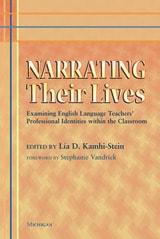
Narrating Their Lives
Examining English Language Teachers' Professional Identities within the ClassroomEdited by Lia Kamhi-Stein
University of Michigan Press, 2013
“…a groundbreaking book that will…engage, inform, and connect with present and future teachers and teacher educators.”
---Stephanie Vandrick, Foreword to Narrating Their Lives
The field of TESOL has called attention to the ways that the issues of race and ethnicity, language status and power, and cultural background affect second language learners’ identities and, to some degree, those of teachers. In Narrating Their Lives, Kamhi-Stein examines the process of identity construction of classroom teachers so as to make connections between their personal and professional identities and their instructional practices. To do that, she has selected six autobiographical narratives from teachers who were once part of her TESL 570 (Educational Sociolinguistics) class in the MA TESOL program at California State University, Los Angeles. These six narratives cover a surprisingly wide range of identity issues but also touch on broader instructional themes that are part of teacher education programs.
Because of the reflective nature of the narratives—with the teachers using their stories to better understand how their experiences shape what they do in the classroom—this volume includes provocative chapter-opening and reflective chapter-closing questions. An informative discussion of the autobiographical narrative assignment and the TESL 570 course (including supplemental course readings and assessment criteria) is also included.
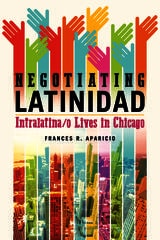
Negotiating Latinidad
Intralatina/o Lives in ChicagoFrances R. Aparicio
University of Illinois Press, 2019
Negotiating the Past in the Past
Identity, Memory, and Landscape in Archaeological ResearchNorman Yoffee
University of Arizona Press, 2008
Despite our keen eye for discerning historical spin doctors operating today, it has been only in recent years that archaeologists have begun exploring in detail how the past was used in the past itself. This volume of ten original works brings critical insight to this frequently overlooked dimension of earlier societies. Drawing on the concepts of identity, memory, and landscape, the contributors show how these points of entry can lead to substantially new accounts of how people understood their lives and why things changed as they did.
Chapters include the archaeologies of the eastern Mediterranean, including Mesopotamia, Iran, Greece, and Rome; prehistoric Greece; Achaemenid and Hellenistic Armenia; Athens in the Roman period; Nubia and Egypt; medieval South India; and northern Maya Quintana Roo. The contributors show how and why, in each society, certain versions of the past were promoted while others were aggressively forgotten for the purpose of promoting innovation, gaining political advantage, or creating a new group identity.
Commentaries by leading scholars Lynn Meskell and Jack Davis blend with newer voices to create a unique set of essays that is diverse but interrelated, exceptionally researched, and novel in its perspectives.
CONTENTS
1. Peering into the Palimpsest: An Introduction to the Volume
Norman Yoffee
2. Collecting, Defacing, Reinscribing (and Otherwise Performing) Memory in the Ancient World
Catherine Lyon Crawford
3. Unforgettable Landscapes: Attachments to the Past in Hellenistic Armenia
Lori Khatchadourian
4. Mortuary Studies, Memory, and the Mycenaean Polity
Seth Button
5. Identity under Construction in Roman Athens
Sanjaya Thakur
6. Inscribing the Napatan Landscape: Architecture and Royal Identity
Lindsay Ambridge
7. Negotiated Pasts and the Memorialized Present in Ancient India: Chalukyas of Vatapi
Hemanth Kadambi
8. Creating, Transforming, Rejecting, and Reinterpreting Ancient Maya Urban Landscapes: Insights from Lagartera and Margarita
Laura P. Villamil
9. Back to the Future: From the Past in the Present to the Past in the Past
Lynn Meskell
10. Memory Groups and the State: Erasing the Past and Inscribing the Present in the Landscapes of the Mediterranean and Near East
Jack L. Davis
About the Editor
About the Contributors
Index
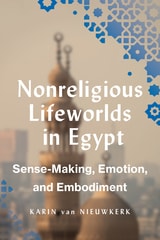
Nonreligious Lifeworlds in Egypt
Sense-Making, Emotion, and EmbodimentKarin van Nieuwkerk
University of Texas Press, 2026
An analysis of the growing visibility of nonreligion in Egypt.
Egypt's 2011 Uprising, while often perceived as a failed revolution, nonetheless nonetheless had durable social effects. Among these has been a rise in expressing atheism and agnosticism, especially among educated and affluent youth—the country’s future leaders.
An intimate ethnography, Nonreligious Lifeworlds in Egypt explores the intellectual and emotional transformations of atheists and agnostics inspired by the aspirational freedom-seeking of the Arab Spring. Rejecting both of Egypt’s dominant religious traditions, Islam and Coptic Christianity, nonreligious people are widely viewed as agents of moral outrage. Amid media-driven panics, their sanity is often questioned by their own families as they experiment with new ways of living and relating. Drawing from in-depth fieldwork, interviews, and social media analysis, Karin van Nieuwkerk reveals her interlocutors’ changing perspectives on sex and gender, eating and drinking, and life and death. Above all, she emphasizes the affective experiences of renouncing religion, marked by anxiety and regret—but also liberation and relief. With rigor and compassion, Van Nieuwkerk opens our minds to the arduous process of exchanging established norms for self-determination.