Results by title
155 books match the query 'Indians of South America' and 3 start with n
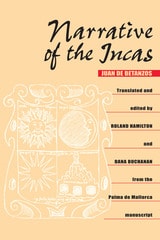
Narrative of the Incas
By Juan de Betanzos
University of Texas Press, 1996
One of the earliest chronicles of the Inca empire was written in the 1550s by Juan de Betanzos. Although scholars have long known of this work, only eighteen chapters were actually available until the 1980s when the remaining sixty-four chapters were discovered in the collection of the Fundación Bartolomé March in Palma de Mallorca, Spain.
Narrative of the Incas presents the first complete English translation of the original manuscript of this key document. Although written by a Spaniard, it presents an authentic Inca worldview, drawn from the personal experiences and oral traditions told to Betanzos by his Inca wife, Doña Angelina, and other members of her aristocratic family who lived during the reigns of the last Inca rulers, Huayna Capac Huascar and Atahualpa. Betanzos wrote a history of the Inca empire that focuses on the major rulers and the contributions each one made to the growth of the empire and of Inca culture.
Filled with new insights into Inca politics, marriage, laws, the calendar, warfare, and other matters, Narrative of the Incas is essential reading for everyone interested in this ancient civilization.
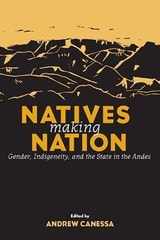
Natives Making Nation
Gender, Indigeneity, and the State in the AndesAndrew Canessa
University of Arizona Press, 2005
This volume looks at how metropolitan ideas of nation employed by politicians, the media and education are produced, reproduced, and contested by people of the rural Andes—people who have long been regarded as ethnically and racially distinct from more culturally European urban citizens. Yet these peripheral “natives” are shown to be actively engaged with the idea of the nation in their own communities, forcing us to re-think the ways in which indigeneity is defined by its marginality.
The contributors examine the ways in which numerous identities—racial, generational, ethnic, regional, national, gender, and sexual—are both mutually informing and contradictory among subaltern Andean people who are more likely now to claim an allegiance to a nation than ever before. Although indians are less often confronted with crude assimilationist policies, they continue to face racism and discrimination as they struggle to assert an identity that is more than a mere refraction of the dominant culture. Yet despite the language of multiculturalism employed even in constitutional reform, any assertion of indian identity is likely to be resisted. By exploring topics as varied as nation-building in the 1930s or the chuqila dance, these authors expose a paradox in the relation between indians and the nation: that the nation can be claimed as a source of power and distinct identity while simultaneously making some types of national imaginings unattainable.
Whether dancing together or simply talking to one another, the people described in these essays are shown creating identity through processes that are inherently social and interactive. To sing, to eat, to weave . . . In the performance of these simple acts, bodies move in particular spaces and contexts and do so within certain understandings of gender, race and nation. Through its presentation of this rich variety of ethnographic and historical contexts, Natives Making Nation provides a finely nuanced view of contemporary Andean life.
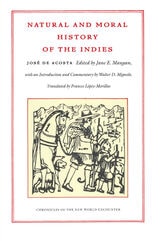
Natural and Moral History of the Indies
José de Acosta
Duke University Press, 2002
A significant contribution to Renaissance Europe's thinking about the New World, Acosta's Natural and Moral History of the Indies reveals an effort to incorporate new information into a Christian, Renaissance worldview. He attempted to confirm for his European readers that a "new" continent did indeed exist and that human beings could and did live in equatorial climates. A keen observer and prescient thinker, Acosta hypothesized that Latin America's indigenous peoples migrated to the region from Asia, an idea put forth more than a century before Europeans learned of the Bering Strait. Acosta's work established a hierarchical classification of Amerindian peoples and thus contributed to what today is understood as the colonial difference in Renaissance European thinking.