Results by title
748 books match the query 'Influence' and 15 start with n
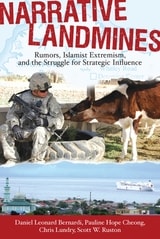
Narrative Landmines
Rumors, Islamist Extremism, and the Struggle for Strategic InfluenceBernardi, Daniel Leonard
Rutgers University Press, 2012
Islamic extremism is the dominant security concern of many contemporary governments, spanning the industrialized West to the developing world. Narrative Landmines explores how rumors fit into and extend narrative systems and ideologies, particularly in the context of terrorism, counter-terrorism, and extremist insurgencies. Its concern is to foster a more sophisticated understanding of how oral and digital cultures work alongside economic, diplomatic, and cultural factors that influence the struggles between states and non-state actors in the proverbial battle of hearts and minds. Beyond face-to-face communication, the authors also address the role of new and social media in the creation and spread of rumors.
As narrative forms, rumors are suitable to a wide range of political expression, from citizens, insurgents, and governments alike, and in places as distinct as Singapore, Iraq, and Indonesia—the case studies presented for analysis. The authors make a compelling argument for understanding rumors in these contexts as “narrative IEDs,” low-cost, low-tech weapons that can successfully counter such elaborate and expansive government initiatives as outreach campaigns or strategic communication efforts. While not exactly the same as the advanced technological systems or Improvised Explosive Devices to which they are metaphorically related, narrative IEDs nevertheless operate as weapons that can aid the extremist cause.
Nation and World, Church and God
The Legacy of Garry WillsEdited by Kenneth L. Vaux and Melanie Baffes
Northwestern University Press, 2014
Garry Wills is the polymathic public intellectual bemoaned as missing from American letters. A professor emeritus at Northwestern University, he has built upon his early studies in classics and patristics, while bringing his considerable intellect to bear on American culture, politics, and religion, notably through provocative articles and books on wars, past and present presidents, and the Catholic Church Wills has distinguished himself in the crowded field of Civil War history; fearlessly taken on the legacies of Richard Nixon and Ronald Reagan, among other presidents; and offered a critical voice in many fraught ethical discussions, especially in the areas of war and peace.
Nation and World, Church and God gathers original critical reflections by leading writers and scholars on Garry Wills’s life work. Organized around the themes of “Classics,” “Civil War,” “War and Peace,” and “Theology, Church, and the Arts,” the book reflects the cultural acumen, fine-grained political analysis, ethical candor, and theological wisdom of one of America’s most prolific writers.
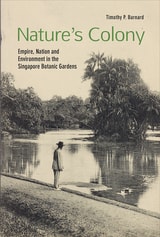
Nature's Colony
Empire, Nation and Environment in the Singapore Botanic GardensTimothy P. Barnard
National University of Singapore Press, 2017
Initially conceived to exploit nature for the benefit of empire, the Gardens were part of a symbolic struggle by administrators, scientists, and gardeners to assert dominance within Southeast Asia’s tropical landscape, reflecting shifting understandings of power, science, and nature among local administrators and distant mentors in Britain. Consequently, as an outpost of imperial science, the Gardens were instrumental in the development of plantation crops, such as rubber and oil palm, which went on to shape landscapes across the globe. Since the independence of Singapore, the Gardens have played a role in the “greening” of the country and have been named as Singapore’s first World Heritage Site. Setting the Gardens alongside the Royal Botanic Gardens, Kew, and botanic gardens in India, Ceylon, Mauritius, and the West Indies, Nature’s Colony provide the first in-depth look at the history of this influential institution.
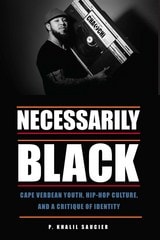
Necessarily Black
Cape Verdean Youth, Hip-Hop Culture, and a Critique of IdentityP. Khalil Saucier
Michigan State University Press, 2015
Negro Thought in America, 1880-1915
Racial Ideologies in the Age of Booker T. WashingtonAugust Meier
University of Michigan Press, 1963
Networked Poetics
The Digital Turn in Southern African PoetrySusanna L. Sacks
University of Massachusetts Press, 2024
Winner of the 2025 MLA Scaglione Prize for African Studies
Simultaneously transnational and local, poetry in the twenty-first century is produced across digital networks, shaped through local communities, and evaluated on a global scale. It might start on social media, where a video of a poet circulates and goes viral, gaining international attention without ever going through traditional modes of publication. In Networked Poetics, Susanna L. Sacks introduces readers to the southern African poetry scene in Malawi, Zimbabwe, and South Africa, illustrating how contemporary poetry is shaped, from inception to canonization, by the influence of digital media publication.
Interweaving ethnographic observation and extensive literary analysis, Sacks demonstrates that, as more artists in Africa reach wider audiences through online publication, poetic form has shifted to reflect social media’s aesthetic norms of urgency, immediacy, and populism. These changes have, in turn, challenged elite processes of valuation, forcing literary institutions like prizes, festivals, and curricula to accommodate the digital turn.
New Deal Modernism
American Literature and the Invention of the Welfare StateMichael Szalay
Duke University Press, 2000
Szalay situates his study within a liberal culture bent on security, a culture galvanized by its imagined need for private and public insurance.
Taking up prominent exponents of social and economic security—such as Franklin Delano Roosevelt, John Maynard Keynes, and John Dewey—Szalay demonstrates how the New Deal’s revision of free-market culture required rethinking the political function of aesthetics. Focusing in particular on the modernist fascination with the relation between form and audience, Szalay offers innovative accounts of Busby Berkeley, Jack London, James M. Cain, Robert Frost, Ayn Rand, Betty Smith, and Gertrude Stein, as well as extended analyses of the works of Ernest Hemingway, John Steinbeck, and Richard Wright.
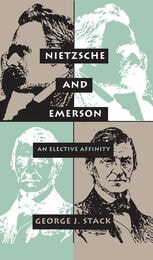
Nietzsche & Emerson
An Elective AffinityGeorge J. Stack
Ohio University Press, 1993
George J. Stack traces the sources of ideas and theories that have long been considered the exclusive province of Friedrich Nietzsche to the surprisingly radical writings of the American essayist and poet, Ralph Waldo Emerson.
Nietzsche and Emerson makes us see Emerson’s writings in a new, more intensified light and presents a new perspective on Nietzsche’s philosophy. Stack traces how the rich theoretical ideas and literary images of Emerson entered directly into the existential dimension of Nietzsche’s thought and hence into the stream of what has been considered a distinctively European intellectual movement.
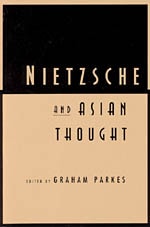
Nietzsche and Asian Thought
Edited by Graham Parkes
University of Chicago Press, 1991
The contributors are Roger T. Ames, Johann Figl, Chen Guying, Michel Hulin, Arifuku Kogaku, David A. Kelly, Glen T. Martin, Sonoda Muneto, Graham Parkes, okochi Ryogi, Eberhard Scheiffele, Mervyn Sprung, and Joan Stambaugh.
"Exemplary. Its comparative approach is incisive yet accessible. I consider it a 'must read'"—Kathleen Marie Higgins, Philosophy East and West
"An excellent introduction to the broad ranging reception of Nietzsche among Asian thinkers."—James R. Watson, Canadian Philosophical Review
"The essays in this welcome collection are invariably thought-provoking and genuinely cross-disciplinary."—Kenneth Surin, Religious Studies Review
"A worthy and undogmatic introduction to several fascinating questions concerning the relations between Nietzschean thought and certain traditions of thought in India, China, and Japan."—Don Miller, Asian Studies Review
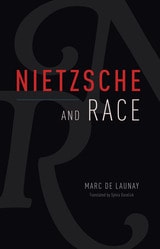
Nietzsche and Race
Marc de Launay
University of Chicago Press, 2023
The caricature of Friedrich Nietzsche as a proto-Nazi is still with us, having originated with his own Nazi sister, Elisabeth Förster, who curated Nietzsche’s disparate texts to suit her own purposes. In Nietzsche and Race, Marc de Launay deftly counters this persistent narrative in a series of concise and highly accessible reflections on the concept of race in Nietzsche’s publications, notebooks, and correspondence. Through a fresh reading of Nietzsche’s core philosophical project, de Launay articulates a new understanding of race in Nietzsche’s body of work free from the misunderstanding of his detractors.

Nietzsche's Corps/e
Aesthetics, Politics, Prophecy, or, the Spectacular Technoculture of Everyday LifeGeoff Waite
Duke University Press, 1996
Waite advances his argument by bringing Marxist—especially Gramscian and Althusserian—theories to bear on the concept of Nietzsche/anism. But he also goes beyond ideological convictions to explore the vast Nietzschean influence that proliferates throughout the marketplace of contemporary philosophy, political and literary theory, and cultural and technocultural criticism. In light of a philological reconstruction of Nietzsche’s published and unpublished texts, Nietzsche’s Corps/e shuttles between philosophy and everyday popular culture and shows them to be equally significant in their having been influenced by Nietzsche—in however distorted a form and in a way that compromises all of our best interests.
Controversial in its “decelebration” of Nietzsche, this remarkable study asks whether the postcontemporary age already upon us will continue to be dominated and oriented by the haunting spectre of Nietzsche’s corps/e. Philosophers, intellectual historians, literary theorists, and those interested in western Marxism, popular culture, Friedrich Nietzsche, and the intersection of French and German thought will find this book both appealing and challenging.
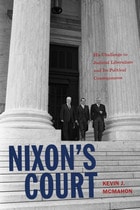
Nixon's Court
His Challenge to Judicial Liberalism and Its Political ConsequencesKevin J. McMahon
University of Chicago Press, 2011
Most analysts have deemed Richard Nixon’s challenge to the judicial liberalism of the Warren Supreme Court a failure—“a counterrevolution that wasn’t.” Nixon’s Court offers an alternative assessment. Kevin J. McMahon reveals a Nixon whose public rhetoric was more conservative than his administration’s actions and whose policy towards the Court was more subtle than previously recognized. Viewing Nixon’s judicial strategy as part political and part legal, McMahon argues that Nixon succeeded substantially on both counts.
Many of the issues dear to social conservatives, such as abortion and school prayer, were not nearly as important to Nixon. Consequently, his nominations for the Supreme Court were chosen primarily to advance his “law and order” and school desegregation agendas—agendas the Court eventually endorsed. But there were also political motivations to Nixon’s approach: he wanted his judicial policy to be conservative enough to attract white southerners and northern white ethnics disgruntled with the Democratic party but not so conservative as to drive away moderates in his own party. In essence, then, he used his criticisms of the Court to speak to members of his “Silent Majority” in hopes of disrupting the long-dominant New Deal Democratic coalition.
For McMahon, Nixon’s judicial strategy succeeded not only in shaping the course of constitutional law in the areas he most desired but also in laying the foundation of an electoral alliance that would dominate presidential politics for a generation.
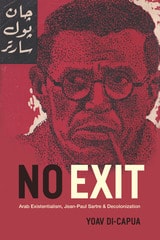
No Exit
Arab Existentialism, Jean-Paul Sartre, and DecolonizationYoav Di-Capua
University of Chicago Press, 2018
By closely following the remarkable career of Arab existentialism, Yoav Di-Capua reconstructs the cosmopolitan milieu of the generation that tried to articulate a political and philosophical vision for an egalitarian postcolonial world. He tells this story by touring a fascinating selection of Arabic and Hebrew archives, including unpublished diaries and interviews. Tragically, the warm and hopeful relationships forged between Arab intellectuals, Sartre, Simone de Beauvoir, and others ended when, on the eve of the 1967 war, Sartre failed to embrace the Palestinian cause. Today, when the prospect of global ethical engagement seems to be slipping ever farther out of reach, No Exit provides a timely, humanistic account of the intellectual hopes, struggles, and victories that shaped the Arab experience of decolonization and a delightfully wide-ranging excavation of existentialism’s non-Western history.
Nonfiction, the Teaching of Writing, and the Influence of Richard Lloyd-Jones
Doug Hesse
University Press of Colorado, 2023
Nonhuman Witnessing
War, Data, and Ecology after the End of the WorldMichael Richardson
Duke University Press, 2024