477 books match the query 'Italy' and 11 start with n
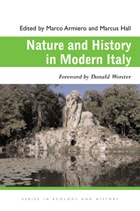
cover of Nature and History in Modern Italy

Nature and History in Modern Italy

Marco Armiero

Ohio University Press, 2010

Is Italy il bel paese—the beautiful country—where tourists spend their vacations looking for art, history, and scenery? Or is it a land whose beauty has been cursed by humanity’s greed and nature’s cruelty? The answer is largely a matter of narrative and the narrator’s vision of Italy. The fifteen essays in Nature and History in Modern Italy investigate that nation’s long experience in managing domesxadtixadcated rather than wild natures and offer insight into these conflicting visions. Italians shaped their land in the most literal sense, producing the landscape, sculpting its heritage, embedding memory in nature, and rendering the two different visions inseparxadable. The interplay of Italy’s rich human history and its dramatic natural diversity is a subject with broad appeal to a wide range of readers.

[more]
cover of Navigating the African Diaspora: The Anthropology of Invisibility

Navigating the African Diaspora

The Anthropology of Invisibility

Donald Martin Carter

University of Minnesota Press, 2010

Investigating how the fraught political economy of migration impacts people around the world, Donald Martin Carter raises important issues about contemporary African diasporic movements. Developing the notion of the anthropology of invisibility, he explores the trope of navigation in social theory intent on understanding the lived experiences of transnational migrants.
 
Carter examines invisibility in its various forms, from social rejection and residential segregation to war memorials and the inability of some groups to represent themselves through popular culture, scholarship, or art. The pervasiveness of invisibility is not limited to symbolic actions, Carter shows, but may have dramatic and at times catastrophic consequences for people subjected to its force. The geographic span of his analysis is global, encompassing Senegalese Muslims in Italy and the United States and concluding with practical questions about the future of European societies. Carter also considers both contemporary and historical constellations of displacement, from Darfurian refugees to French West African colonial soldiers.
 
Whether focusing on historical photographs, television, print media, and graffiti scrawled across urban walls or identifying the critique of colonialism implicit in African films and literature, Carter reveals a protean and peopled world in motion.
[more]
cover of Neodomestic American Fiction

Neodomestic American Fiction

Kristin J. Jacobson

The Ohio State University Press, 2010
In American literature, domestic fictions—that is, novels focused on the home and homemaking—are linked with white, middle-class women’s fiction and culture. Employing a spatial lens, Neodomestic American Fiction joins and extends other studies in redefining domestic fiction’s literary history and definition. Unlike previous redefinitions and reevaluations, Neodomestic American Fiction reads domestic novels alongside feminist geography and architectural history to map the links and disjunctions among a range of authors writing during the same period as well as across centuries and cultures. Kristin Jacobson’s attention to domestic geographies reveals a new space and subgenre emerge in the 1980s: neodomestic fiction.
 
In this innovative study, Kristin Jacobson identifies over thirty novels that renovate traditional forms, therefore challenging model domesticity’s conservative gender, racial, and sexual politics. Rather than produce stable single-family homes, neodomestic fictions advance a politics of instability characterized by mobility, renovation and redesign, and relational space. These “alternative” domesticities—when read in the context of neodomestic fiction—are not marginal but rather central to domesticity’s configurations. Such resistance, as Iris Marion Young argues, “is integral to modern political theory and is not an alternative to it.”
 
Thus, this spatial analysis of post-1980 domestic novels does not indicate a post-feminist or post-gender world. Rather, neodomestic fiction’s heterogeneous, unstable spaces offer opportunities to examine contemporary hierarchies and experiment with more egalitarian homemaking. These fictions include Toni Morrison’s Paradise, Barbara Kingsolver’s The Poisonwood Bible, Leslie Marmon Silko’s Gardens in the Dunes, and Chang-rae Lee’s A Gesture Life.
[more]
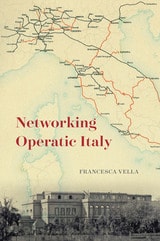
cover of Networking Operatic Italy

Networking Operatic Italy

Francesca Vella

University of Chicago Press, 2022

A study of the networks of opera production and critical discourse that shaped Italian cultural identity during and after Unification.

Opera’s role in shaping Italian identity has long fascinated both critics and scholars. Whereas the romance of the Risorgimento once spurred analyses of how individual works and styles grew out of and fostered specifically “Italian” sensibilities and modes of address, more recently scholars have discovered the ways in which opera has animated Italians’ social and cultural life in myriad different local contexts.

In Networking Operatic Italy, Francesca Vella reexamines this much-debated topic by exploring how, where, and why opera traveled on the mid-nineteenth-century peninsula, and what this mobility meant for opera, Italian cities, and Italy alike. Focusing on the 1850s to the 1870s, Vella attends to opera’s encounters with new technologies of transportation and communication, as well as its continued dissemination through newspapers, wind bands, and singing human bodies. Ultimately, this book sheds light on the vibrancy and complexity of nineteenth-century Italian operatic cultures, challenging many of our assumptions about an often exoticized country.
[more]
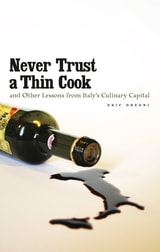
cover of Never Trust a Thin Cook and Other Lessons from Italy’s Culinary Capital

Never Trust a Thin Cook and Other Lessons from Italy’s Culinary Capital

Eric Dregni

University of Minnesota Press, 2024

The food-obsessed chronicle of an American’s three years in Italy—now available in paperback


I simply want to live in the place with the best food in the world. This dream led Eric Dregni to Italy, first to Milan and eventually to a small, fog-covered town to the north: Modena, the birthplace of balsamic vinegar, Ferrari, and Luciano Pavarotti. Never Trust a Thin Cook is a classic American abroad tale, brimming with adventures both expected and unexpected, awkward social moments, and most important, very good food.


Parmesan thieves. Tortellini based on the shape of Venus’s navel. Infiltrating the secret world of the balsamic vinegar elite. Life in Modena is a long way from the Leaning Tower of Pizza (the south Minneapolis pizzeria where Eric and his girlfriend and fellow traveler Katy first met), and while some Italians are impressed that “Minnesota” sounds like “minestrone,” they are soon learning what it means to live in a country where the word “safe” doesn’t actually exist—only “less dangerous.” Thankfully, another meal is always waiting, and Dregni revels in uncorking the secrets of Italian cuisine, such as how to guzzle espresso “corrected” with grappa and learning that mold really does make a good salami great.


What begins as a gastronomical quest soon becomes a revealing, authentic portrait of how Italians live and a hilarious demonstration of how American and Italian cultures differ. In Never Trust a Thin Cook, Eric Dregni dishes up the sometimes wild experiences of living abroad alongside the simple pleasures of Italian culture in perfect, complementary portions.
[more]
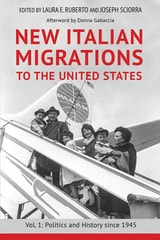
cover of New Italian Migrations to the United States: Vol. 1: Politics and History since 1945

New Italian Migrations to the United States

Vol. 1: Politics and History since 1945

Edited by Laura E. Ruberto and Joseph Sciorra: Afterword by Donna Gabaccia

University of Illinois Press, 2017

Italian immigration from 1945 to the present is an American phenomenon too little explored in our historical studies. Until now. In this new collection, Laura E. Ruberto and Joseph Sciorra edit essays by an elite roster of scholars in Italian American studies. These interdisciplinary works focus on leading edge topics that range from politics of the McCarren-Walter Act and its effects on women to the ways Italian Americans mobilized against immigration restrictions. Other essays unwrap the inner workings of multi-ethnic power brokers in a Queens community, portray the complex transformation of identity in Boston’s North End, and trace the development of Italian American youth culture and how new arrivals fit into it. Finally, Donna Gabaccia pens an afterword on the importance of this seventy-year period in U.S. migration history.

Contributors: Ottorino Cappelli, Donna Gabaccia, Stefano Luconi, Maddalena Marinari, James S. Pasto, Rodrigo Praino, Laura E. Ruberto, Joseph Sciorra, Donald Tricarico, and Elizabeth Zanoni.
[more]
cover of New Italian Migrations to the United States: Vol. 2: Art and Culture since 1945

New Italian Migrations to the United States

Vol. 2: Art and Culture since 1945

Laura Ruberto, Joseph Sciorra

University of Illinois Press, 2017

This second volume of <i>New Italian Migrations to the United States</i> explores the evolution of art and cultural expressions created by and about Italian immigrants and their descendants since 1945. The essays range from an Italian-language radio program that broadcast intimate messages from family members in Italy to the role of immigrant cookbook writers in crafting a fashionable Italian food culture. Other works look at how exoticized actresses like Sophia Loren and Pier Angeli helped shape a glamorous Italian style out of images of desperate postwar poverty; overlooked forms of brain drain; the connections between countries old and new in the works of Michigan self-taught artist Silvio Barile; and folk revival performer Alessandra Belloni's reinterpretation of tarantella dance and music for Italian American women. In the afterword, Anthony Julian Tamburri discusses the nomenclature ascribed to Italian American creative writers living in Italy and the United States.

Contributors: John Allan Cicala, Simone Cinotto, Teresa Fiore, Incoronata (Nadia) Inserra, Laura E. Ruberto, Joseph Sciorra, and Anthony Julian Tamburri.
[more]
cover of Nietzsche's Journey to Sorrento: Genesis of the Philosophy of the Free Spirit

Nietzsche's Journey to Sorrento

Genesis of the Philosophy of the Free Spirit

Paolo D'Iorio

University of Chicago Press, 2016

“When for the first time I saw the evening rise with its red and gray softened in the Naples sky,” Nietzsche wrote, “it was like a shiver, as though pitying myself for starting my life by being old, and the tears came to me and the feeling of having been saved at the very last second.” Few would guess it from the author of such cheery works as The Birth of Tragedy, but as Paolo D’Iorio vividly recounts in this book, Nietzsche was enraptured by the warmth and sun of southern Europe. It was in Sorrento that Nietzsche finally matured as a thinker.

Nietzsche first voyaged to the south in the autumn of 1876, upon the invitation of his friend, Malwida von Meysenbug. The trip was an immediate success, reviving Nietzsche’s joyful and trusting sociability and fertilizing his creative spirit. Walking up and down the winding pathways of Sorrento and drawing on Nietzsche’s personal notebooks, D’Iorio tells the compelling story of Nietzsche’s metamorphosis beneath the Italian skies. It was here, D’Iorio shows, that Nietzsche broke intellectually with Wagner, where he decided to leave his post at Bâle, and where he drafted his first work of aphorisms, Human, All Too Human, which ushered in his mature era. A sun-soaked account of a philosopher with a notoriously overcast disposition, this book is a surprising travelogue through southern Italy and the history of philosophy alike.
 
[more]
cover of Nocturne and Five Tales of Love and Death

Nocturne and Five Tales of Love and Death

Gabrielle D'Aunnunzio

Northwestern University Press, 1988
Nocturne and Five Tales of Love and Death is a book of prose by Gabrielle D’Annunzio translated from Italian to English by Raymond Rosenthal.
[more]
cover of Not without Madness: Perspectives on Opera

Not without Madness

Perspectives on Opera

Fabrizio Della Seta

University of Chicago Press, 2012
Opera often seems to arouse either irrational enthusiasm or visceral dislike. Such madness, as Goethe wrote, is indispensable in all theater, and yet in practice, sentiment and passion must be balanced by sense and reason. Exploring this tension between madness and reason, Not without Madness presents new analytical approaches to thinking about eighteenth- and nineteenth-century opera through the lenses of its historical and cultural contexts.
 
In these twelve essays, Fabrizio Della Seta explores the concept of opera as a dramatic event and an essential moment in the history of theater. Examining the meaning of opera and the devices that produce and transmit this meaning, he looks at the complex verbal, musical, and scenic mechanisms in parts of La sonnambula, Ernani, Aida, Le nozze di Figaro, Macbeth, and Il trovatore. He argues that approaches to the study of opera must address performance, interpretation, composition, reception, and cultural ramifications. Purely musical analysis does not make sense unless we take into account music’s dramatic function. Containing many essays available for the first time in English, Not without Madness bridges recent divisions in opera studies and will attract musicologists, musicians, and opera lovers alike.
[more]
cover of Nuns Behaving Badly: Tales of Music, Magic, Art, and Arson in the Convents of Italy

Nuns Behaving Badly

Tales of Music, Magic, Art, and Arson in the Convents of Italy

Craig A. Monson

University of Chicago Press, 2010

Witchcraft. Arson. Going AWOL. Some nuns in sixteenth- and seventeenth-century Italy strayed far from the paradigms of monastic life. Cloistered in convents, subjected to stifling hierarchy, repressed, and occasionally persecuted by their male superiors, these women circumvented authority in sometimes extraordinary ways. But tales of their transgressions have long been buried in the Vatican Secret Archive. That is, until now.

In Nuns Behaving Badly, Craig A. Monson resurrects forgotten tales and restores to life the long-silent voices of these cloistered heroines. Here we meet nuns who dared speak out about physical assault and sexual impropriety (some real, some imagined). Others were only guilty of misjudgment or defacing valuable artwork that offended their sensibilities. But what unites the women and their stories is the challenges they faced: these were women trying to find their way within the Catholicism of their day and through the strict limits it imposed on them. Monson introduces us to women who were occasionally desperate to flee cloistered life, as when an entire community conspired to torch their convent and be set free. But more often, he shows us nuns just trying to live their lives. When they were crossed—by powerful priests who claimed to know what was best for them—bad behavior could escalate from mere troublemaking to open confrontation.

In resurrecting these long-forgotten tales and trials, Monson also draws attention to the predicament of modern religious women, whose “misbehavior”—seeking ordination as priests or refusing to give up their endowments to pay for priestly wrongdoing in their own archdioceses—continues even today. The nuns of early modern Italy, Monson shows, set the standard for religious transgression in their own age—and beyond.

[more]