Results by title
104 books match the query 'Japanese' and 2 start with n

Nakagami, Japan
Buraku and the Writing of EthnicityAnne McKnight
University of Minnesota Press, 2010
How do you write yourself into a literature that doesn’t know you exist? This was the conundrum confronted by Nakagami Kenji (1946–1992), who counted himself among the buraku-min, Japan’s largest minority. His answer brought the histories and rhetorical traditions of buraku writing into the high culture of Japanese literature for the first time and helped establish him as the most canonical writer born in postwar Japan.
In Nakagami, Japan, Anne McKnight shows how the writer’s exploration of buraku led to a unique blend of fiction and ethnography—which amounted to nothing less than a reimagining of modern Japanese literature. McKnight develops a parallax view of Nakagami’s achievement, allowing us to see him much as he saw himself, as a writer whose accomplishments traversed both buraku literary arts and high literary culture in Japan.
As she considers the ways in which Nakagami and other twentieth-century writers used ethnography to shape Japanese literature, McKnight reveals how ideas about language also imagined a transfigured relation to mainstream culture and politics. Her analysis of the resulting “rhetorical activism” lays bare Nakagami’s unique blending of literature and ethnography within the context of twentieth-century ideas about race, ethnicity, and citizenship—in Japan, but also on an international scale.
[more]
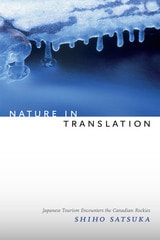
Nature in Translation
Japanese Tourism Encounters the Canadian RockiesShiho Satsuka
Duke University Press, 2015
Nature in Translation is an ethnographic exploration in the cultural politics of the translation of knowledge about nature. Shiho Satsuka follows the Japanese tour guides who lead hikes, nature walks, and sightseeing bus tours for Japanese tourists in Canada's Banff National Park and illustrates how they aspired to become local "nature interpreters" by learning the ecological knowledge authorized by the National Park. The guides assumed the universal appeal of Canada’s magnificent nature, but their struggle in translating nature reveals that our understanding of nature—including scientific knowledge—is always shaped by the specific socio-cultural concerns of the particular historical context. These include the changing meanings of work in a neoliberal economy, as well as culturally-specific dreams of finding freedom and self-actualization in Canada's vast nature. Drawing on nearly two years of fieldwork in Banff and a decade of conversations with the guides, Satsuka argues that knowing nature is an unending process of cultural translation, full of tensions, contradictions, and frictions. Ultimately, the translation of nature concerns what counts as human, what kind of society is envisioned, and who is included and excluded in the society as a legitimate subject.
[more]