Results by title
496 books match the query 'Jewish' and 7 start with n
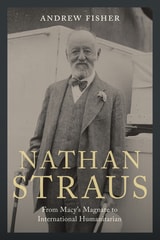
Nathan Straus
From Macy's Magnate to International HumanitarianAndrew Fisher
Rutgers University Press, 2026
Nathan Straus (1848–1931) encompassed worlds. He rose from his Jewish German immigrant family’s ruin in Civil War Georgia to become co-owner of Macy’s and Abraham & Straus department stores. He helped build American Zionism and cofounded the American Jewish Congress movement. His public service led to a nomination for New York City mayor.
This, the first comprehensive biography of Straus, details each of these lives but argues that his most historic achievements lay elsewhere—in philanthropy. Inspired by both his Jewish values and no-nonsense pragmatism, Straus designed, funded, and oversaw four Progressive philanthropic initiatives. The greatest—his demonstration and advocacy campaigns for milk pasteurization—saved the lives of countless thousands of infants in New York City and, ultimately, across much of America and western Europe. Straus also founded America’s first TB preventorium for at-risk children: a model for the forty-five more that followed. Partnering with Hadassah, he brought American public health innovations to Mandate Palestine. He provided vast relief for New York City’s jobless in the severe 1890s depression. In all, Straus’s humanitarianism won the acclaim of American presidents and world leaders and the gratitude of millions. We can learn from him today.
Nazi-Looted Jewish Archives in Moscow
A Guide to Jewish Historical and Cultural Collections in the Russian State Military ArchiveEdited by David E. Fishman, Mark Kupovetsky, and Vladimir Kuzelenkov
University of Scranton Press, 2010

Never Again? Never Gone!
Old and New Anti-SemitismMichael Wolffsohn
St. Augustine's Press, 2026
Michael Wolffsohn charges head-on the varying reactions to the Hamas "murder orgy" of 7 October 2023. Political leaders proclaim that anti-Semitism has no place in Germany, but Wolffsohn identifies a dangerous resurgence in the wake of these atrocities. On the 85th Anniversary of the November pogrom of 1938, Wolffsohn delivered a passionate speech before the Berlin House of Representatives. Two versions of this speech exist--one written prior the Hamas attacks and another written after the event. The variances highlight the depth of rupture that the responses to the attacks provoked. Both speeches are contained in this book, and they give evidence to the reality that antisemitism was never eradicated, it is simply "old or new." Interwoven with deeply personal reflections, Wolffsohn offers a scathing critique of attempts to cover antisemitism in Europe and questions the authenticity of the vow to eliminate it. This German bestselling account of the cyclical reoccurrence of anti-Semitic campaigns reveals repeated and worsening political and social consequences globally, but especially in Germany where the presumption is that historical memory condemns such thinking.
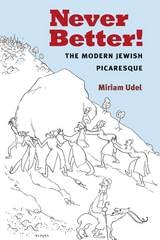
Never Better!
The Modern Jewish PicaresqueMiriam Udel
University of Michigan Press, 2016
The characters defined by this dual consciousness constitute a new kind of protagonist: a distinctively Jewish scapegrace whom Udel denominates the polit or refugee. Cousin to the Golden Age Spanish pícaro, the polit is a socially marginal figure who narrates his own story in discrete episodes, as if stringing beads on a narrative necklace. A deeply unsettled figure, the polit is allergic to sentimentality and even routine domesticity. His sequential misadventures point the way toward the heart of the picaresque, which Jewish authors refashion as a vehicle for modernism—not only in Yiddish, but also in German, Russian, English and Hebrew. Udel draws out the contours of the new Jewish picaresque by contrasting it against the nineteenth-century genre of progress epitomized by the Bildungsroman.
While this book is grounded in modern Jewish literature, its implications stretch toward genre studies in connection with modernist fiction more generally. Udel lays out for a diverse readership concepts in the history and theory of the novel while also explicating the relevant particularities of Jewish literary culture. In addressing the literary stylistics of a “minor” modernism, this study illuminates how the adoption of a picaresque sensibility allowed minority authors to write simultaneously within and against the literary traditions of Europe.
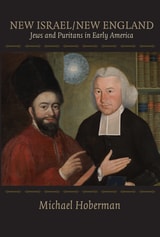
New Israel / New England
Jews and Puritans in Early AmericaMichael Hoberman
University of Massachusetts Press, 2011
More often than not, Michael Hoberman shows, Puritans thought and wrote about Jews in order to resolve their own theological and cultural dilemmas. A number of prominent New Englanders, including Roger Williams, Increase Mather, Samuel Sewall, Benjamin Colman, Cotton Mather, Jonathan Edwards, and Ezra Stiles, wrote extensively about post-biblical Jews, in some cases drawing on their own personal acquaintance with Jewish contemporaries.
Among the intriguing episodes that Hoberman investigates is the recruitment and conversion of Harvard's first permanent instructor of Hebrew, the Jewish-born Judah Monis. Later chapters describe the ecumenical friendship between Newport minister Ezra Stiles and Haim Carigal, an itinerant rabbi from Palestine, as well as the life and career of Moses Michael Hays, the prominent freemason who was Boston's first permanently established Jewish businessman, a founder of its insurance industry, an early sponsor of the Bank of Massachusetts, and a personal friend of Paul Revere.
New Perspectives in American Jewish History
A Documentary Tribute to Jonathan D. SarnaEdited by Mark A. Raider and Gary Phillip Zola
Brandeis University Press, 2021
Widely regarded as today’s foremost American Jewish historian, Jonathan D. Sarna had a huge impact on the academy. Sarna’s influence is perhaps nowhere more apparent than among his former doctoral students—a veritable “Sarna diaspora” of over three dozen active scholars around the world. Both a tribute to Sarna and an important collection in its own right, New Perspectives in American Jewish History was compiled by Sarna’s former students and presents previously unpublished, neglected, or rarely seen historical documents and images that illuminate the breadth, diversity, and dynamism of the American Jewish experience. Beginning with the earliest known Jewish divorce in circum-Atlantic history (1774) and concluding with a Black Lives Matter Haggadah supplement (2019), the collection travels across time and space to shed light on intriguing and generative moments that span the varieties of Jewish experience in the American setting from the colonial era to the present. The materials underscore the interrelationship of myriad themes including ritual observance, Jewish-Christian relations, civil rights, Zionism and Israel, and immigration. While not intended as a comprehensive treatment of American Jewish history, the collection offers a chronological road map of American Jewry’s evolving self-understanding and encounter with America over the course of four centuries. A brief prefatory note sets up the analytic context of each document and helps to unpack and explore its significance. The capacious and multifaceted quality of the American Jewish experience is further amplified here by a sampling of artistic texts such as photographs, advertisements, cartoons, and more.
Nothing Vast
A NovelMoshe Zvi Marvit
Acre Books, 2024
Spanning from 1932 to 1973, Nothing Vast delves deeply into the circumstances and concerns of Jews in cities across the globe—in Poland, France, Morocco, and the United States—as well as in Israel. Giving voice to characters male and female, young and old, Moshe Zvi Marvit braids together stories of migration and struggle, of custom and superstition, of long-held secrets and lies. This beautifully crafted novel follows a survivor of sexual assault, a member of the French resistance, a dream interpreter, a petty criminal, and a venerated rabbi.
Based on the experiences and traditions of the author’s own half-Arab Jewish family, the book is rife with historical and cultural detail and with the intricacies of faith and identity, both personal and national. At the center of the novel is Israel itself—a place existing first in the collective imagination, then in reality as Marvit slips into nonfiction to document the establishment of the country and the reactions to its birth. The characters’ experiences upon arrival in their new nation are vastly different: one family is given a large orange grove upon which to establish a Yeshiva, while the other, not accorded the same privileges, lives beneath notice. The story takes yet another twist when, years later, a grandchild of one of the founding rabbis, seeking answers, discovers the origin of his family’s land.
Visceral, intellectual, and searching, Nothing Vast is nothing short of a virtuosic debut.