Results by title
593 books match the query 'Jews' and 11 start with n
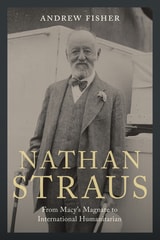
Nathan Straus
From Macy's Magnate to International HumanitarianAndrew Fisher
Rutgers University Press, 2026
Nathan Straus (1848–1931) encompassed worlds. He rose from his Jewish German immigrant family’s ruin in Civil War Georgia to become co-owner of Macy’s and Abraham & Straus department stores. He helped build American Zionism and cofounded the American Jewish Congress movement. His public service led to a nomination for New York City mayor.
This, the first comprehensive biography of Straus, details each of these lives but argues that his most historic achievements lay elsewhere—in philanthropy. Inspired by both his Jewish values and no-nonsense pragmatism, Straus designed, funded, and oversaw four Progressive philanthropic initiatives. The greatest—his demonstration and advocacy campaigns for milk pasteurization—saved the lives of countless thousands of infants in New York City and, ultimately, across much of America and western Europe. Straus also founded America’s first TB preventorium for at-risk children: a model for the forty-five more that followed. Partnering with Hadassah, he brought American public health innovations to Mandate Palestine. He provided vast relief for New York City’s jobless in the severe 1890s depression. In all, Straus’s humanitarianism won the acclaim of American presidents and world leaders and the gratitude of millions. We can learn from him today.
Nationalizing a Borderland
War, Ethnicity, and Anti-Jewish Violence in East Galicia, 1914–1920Alexander Victor Prusin
University of Alabama Press, 2005
Nationalizing a Borderland enriches understanding of ethnic conflict by examining the factors in the Austro-Hungarian province of Galicia between 1914 and 1920 that led to the rise of xenophobic nationalism and to the ethnocide of World War II. From Russian, Polish, Ukrainian, and Austrian archival sources, Prusin argues that while the violence inflicted upon Jews during that period may at first seem irrational and indiscriminate, a closer examination reveals that it was generated by traditional antisemitism and by the security concerns of the Russian and Polish militaries in the front zone. This violence, Prusin contends, served as a means of reshaping the socio-economic and political space of the province by diminishing Jewish cultural and economic influence.
Nazi-Looted Jewish Archives in Moscow
A Guide to Jewish Historical and Cultural Collections in the Russian State Military ArchiveEdited by David E. Fishman, Mark Kupovetsky, and Vladimir Kuzelenkov
University of Scranton Press, 2010
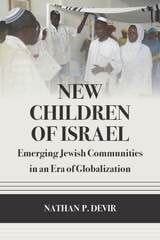
New Children of Israel
Emerging Jewish Communities in an Era of GlobalizationNathan P. Devir
University of Utah Press, 2017
This comparative ethnographic study, the first of its kind, presents in-depth analyses of the backgrounds, motivations, and sociohistorical contexts of emerging Jewish communities in Cameroon, Ghana, India, and other postcolonial locales. It investigates the ramifications of these new movements for the larger Judeo-Christian world, particularly with regard to issues of multiculturalism, immigration, race relations, and messianic expectations concerning the prophecy of Isaiah 11:12, according to which God will “assemble the dispersed of Israel, and gather together the scattered of Judah from the four corners of the earth.”
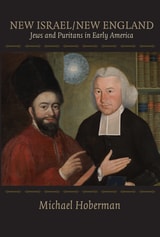
New Israel / New England
Jews and Puritans in Early AmericaMichael Hoberman
University of Massachusetts Press, 2011
More often than not, Michael Hoberman shows, Puritans thought and wrote about Jews in order to resolve their own theological and cultural dilemmas. A number of prominent New Englanders, including Roger Williams, Increase Mather, Samuel Sewall, Benjamin Colman, Cotton Mather, Jonathan Edwards, and Ezra Stiles, wrote extensively about post-biblical Jews, in some cases drawing on their own personal acquaintance with Jewish contemporaries.
Among the intriguing episodes that Hoberman investigates is the recruitment and conversion of Harvard's first permanent instructor of Hebrew, the Jewish-born Judah Monis. Later chapters describe the ecumenical friendship between Newport minister Ezra Stiles and Haim Carigal, an itinerant rabbi from Palestine, as well as the life and career of Moses Michael Hays, the prominent freemason who was Boston's first permanently established Jewish businessman, a founder of its insurance industry, an early sponsor of the Bank of Massachusetts, and a personal friend of Paul Revere.
New Jewish Identities
András Kovács
Central European University Press, 2003
New Perspectives in American Jewish History
A Documentary Tribute to Jonathan D. SarnaEdited by Mark A. Raider and Gary Phillip Zola
Brandeis University Press, 2021
Widely regarded as today’s foremost American Jewish historian, Jonathan D. Sarna had a huge impact on the academy. Sarna’s influence is perhaps nowhere more apparent than among his former doctoral students—a veritable “Sarna diaspora” of over three dozen active scholars around the world. Both a tribute to Sarna and an important collection in its own right, New Perspectives in American Jewish History was compiled by Sarna’s former students and presents previously unpublished, neglected, or rarely seen historical documents and images that illuminate the breadth, diversity, and dynamism of the American Jewish experience. Beginning with the earliest known Jewish divorce in circum-Atlantic history (1774) and concluding with a Black Lives Matter Haggadah supplement (2019), the collection travels across time and space to shed light on intriguing and generative moments that span the varieties of Jewish experience in the American setting from the colonial era to the present. The materials underscore the interrelationship of myriad themes including ritual observance, Jewish-Christian relations, civil rights, Zionism and Israel, and immigration. While not intended as a comprehensive treatment of American Jewish history, the collection offers a chronological road map of American Jewry’s evolving self-understanding and encounter with America over the course of four centuries. A brief prefatory note sets up the analytic context of each document and helps to unpack and explore its significance. The capacious and multifaceted quality of the American Jewish experience is further amplified here by a sampling of artistic texts such as photographs, advertisements, cartoons, and more.
News from the New American Diaspora
and Other Tales of ExileBy Jay Neugeboren
University of Texas Press, 2005
Prize-winning novelist Jay Neugeboren's third collection of short stories focuses on Jews in various states of exile and expatriation—strangers in strange lands, far from home. These dozen tales, by an author whose stories have been selected for more than fifty anthologies, including Best American Short Stories and O. Henry Prize Stories, span the twentieth century and vividly capture brief moments in the lives of their characters: a rabbi in a small town in New England struggling to tend to his congregation and himself, retirees who live in Florida but dream of Brooklyn, a boy at a summer camp in upstate New York learning about the Holocaust for the first time, Russians living in Massachusetts with the family who helped them immigrate. In "The Other End of the World," an American soldier who has survived life in a Japanese prisoner of war camp grieves for members of his family murdered in a Nazi death camp, and in "Poppa's Books" a young boy learns to share his father's passion for the rare books that represent the Old World. "This Third Life" tells of a divorced woman who travels across Germany searching for new meaning in her life after her children leave home, while both "His Violin" and "The Golden Years" explore the plight of elderly Jews, displaced from New York City to retirement communities in Florida, who struggle with memory, madness, and mortality.
Set in various times and places, these poignant stories are all tales of personal exile that also illuminate that greater diaspora—geographical, emotional, or spiritual—in which many of us, whether Jews or non-Jews, live.
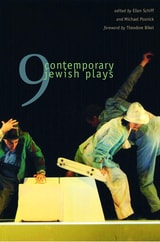
Nine Contemporary Jewish Plays
Edited by Ellen Schiff and Michael Posnick
University of Texas Press, 2005
Jewish theatre—plays about and usually by Jews—enters the twenty-first century with a long and distinguished history. To keep this vibrant tradition alive, the National Foundation for Jewish Culture established the New Play Commissions in Jewish Theatre in 1994. The commissions are awarded in an annual competition. Their goal is to help emerging and established dramatists develop new works in collaboration with a wide variety of theatres. Since its inception, the New Play Commissions has contributed support to more than seventy-five professional productions, staged readings, and workshops.
This anthology brings together nine commissioned plays that have gone on to full production. Ellen Schiff and Michael Posnick have selected works that reflect many of the historical and social forces that have shaped contemporary Jewish experience and defined Jewish identity—among them, surviving the Holocaust, the Israeli-Palestinian conflict, and the lives of newcomers in America, Israel, and Argentina. Following a foreword by Theodore Bikel, the editors provide introductory explanations of the New Play Commissions and an overview of Jewish theatre. The playwrights comment on the genesis of their work and its production history.
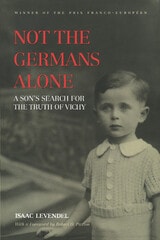
Not the Germans Alone
A Son's Search for the Truth of VichyIsaac Levendel
Northwestern University Press, 2000
On the eve of D-Day, Isaac Levendel's mother left her hiding place on a farm in southern France and never returned. After 40 years of silence and torment, he returned to France in 1990 determined to find out what had happened. This is the story of how, with perseverance, luck, and official help, he gained access to secret wartime documents laying bare the details of French collaboration-and the truth about his mother's fate.
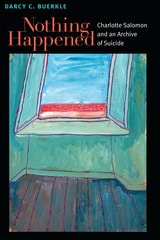
Nothing Happened
Charlotte Salomon and an Archive of SuicideDarcy C. Buerkle
University of Michigan Press, 2013
Charlotte Salomon's (1917-43) fantastical autobiography, Life? or Theater?, consists of 769 sequenced gouache paintings, through which the artist imagined the circumstances of the eight suicides in her family, all but one of them women. But Salomon's focus on suicide was not merely a familial idiosyncrasy. Nothing Happened argues that the social history of early-twentieth-century Germany has elided an important cultural and social phenomenon by not including the story of German Jewish women and suicide. This absence in social history mirrors an even larger gap in the intellectual history of deeply gendered suicide studies that have reproduced the notion of women's suicide as a rarity in history. Nothing Happened is a historiographic intervention that operates in conversation and in tension with contemporary theory about trauma and the reconstruction of emotion in history.