Results by title
403 books match the query 'Journalism' and 12 start with n

NEWSPEAK in the 21st Century
David Cromwell and David Edwards
Pluto Press, 2009
Since 2001, Media Lens has encouraged thousands of readers to challenge the filtered and distorted version of the world provided by major newspapers and broadcasters. The media responses, collected in Newspeak, are an exposé of the arrogance and servility to power of our leading journalists and editors, starring Andrew Marr, Alan Rusbridger, Roger Alton, Jon Snow, Jeremy Bowen and even George Monbiot.
Picking up where the highly acclaimed and successful Guardians of Power (2006) left off, Newspeak is packed with forensic media analysis, revealing the lethal bias in "balanced" reporting. Even the "best" UK media -- the Guardian, the Independent, Channel 4 News and the BBC -- turn out to be cheerleaders for government, business and war.
Alongside an A-Z of BBC propaganda and chapters on Iraq and climate change, Newspeak focuses on the demonisation of Iran and Venezuela, the Israel-Palestine conflict, the myth of impartial reporting and the dark art of smearing dissidents.
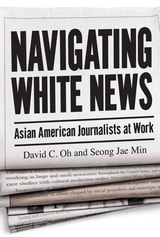
Navigating White News
Asian American Journalists at WorkDavid C Oh
Rutgers University Press, 2023
Combining critical race studies with cultural production studies, Navigating White News: Asian American Journalists at Work is the only academic book to examine the ways that racial identification and activation matters in their understanding of news. This adds to the existing literature on race and the sociology of news by examining intra-racial differences in the ways they navigate and understand White newsrooms. Employing in-depth interviews with twenty Asian American journalists who are actively working in large and small newsrooms across the United States, Navigating White News: Asian American Journalists at Work argues that Asian American reporters for whom racial identities are important questioned what counted as news, questioned the implicitly White perspective of objectivity, and actively worked toward providing more complex, substantive coverage of Asian American communities. For Asian American reporters for whom racial identity was not meaningful, they were more invested in existing professional norms. Regardless, all journalists understood that news is a predominantly and culturally White institution.
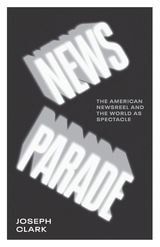
News Parade
The American Newsreel and the World as SpectacleJoseph Clark
University of Minnesota Press, 2020
A fascinating look at the United States’ conflicted relationship with news and the media, through the lens of the newsreel
When weekly newsreels launched in the early twentieth century, they offered the U.S. public the first weekly record of events that symbolized “indisputable evidence” of the news. In News Parade, Joseph Clark examines the history of the newsreel and how it changed the way Americans saw the world. He combines an examination of the newsreel’s methods of production, distribution, and reception with an analysis of its representational strategies to understand the newsreel’s place in the history of twentieth-century American culture and film history.
Clark focuses on the sound newsreel of the 1930s and 1940s, arguing that it represents a crucial moment in the development of a spectacular society where media representations of reality became more fully integrated into commodity culture. Using several case studies, including the newsreel’s coverage of Charles Lindbergh’s transatlantic flight and the Sino–Japanese War, News Parade shows how news film transformed the relationship between its audience and current events, as well as the social and political consequences of these changes. It pays particular attention to how discourses of race and gender worked together with the rhetoric of speed, mobility, and authority to establish the power and privilege of newsreel spectatorship.
In the age of fake news and the profound changes to journalism brought on by the internet, News Parade demonstrates how new technologies and media reshaped the American public’s relationship with the news in the 1930s—a history that can help us to better understand the transformations happening today.
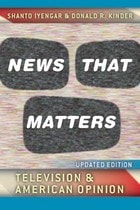
News That Matters
Television and American Opinion, Updated EditionShanto Iyengar and Donald R. Kinder
University of Chicago Press, 2010
Almost twenty-five years ago, Shanto Iyengar and Donald R. Kinder first documented a series of sophisticated and innovative experiments that unobtrusively altered the order and emphasis of news stories in selected television broadcasts. Their resulting book News That Matters, now hailed as a classic by scholars of political science and public opinion alike, is here updated for the twenty-first century, with a new preface and epilogue by the authors. Backed by careful analysis of public opinion surveys, the authors show how, despite changing American politics, those issues that receive extended coverage in the national news become more important to viewers, while those that are ignored lose credibility. Moreover, those issues that are prominent in the news stream continue to loom more heavily as criteria for evaluating the president and for choosing between political candidates.
“News That Matters does matter, because it demonstrates conclusively that television newscasts powerfully affect opinion. . . . All that follows, whether it supports, modifies, or challenges their conclusions, will have to begin here.”—The Public Interest
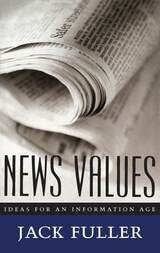
News Values
Ideas for an Information AgeJack Fuller
University of Chicago Press, 1996
"Every talk show host should read this book. So should every newsroom cynic. . . . 'Pursuit of truth is not a license to be a jerk.' In all too many newsrooms, that statement would resound like a three-bell bulletin."—Martin F. Nolan, New York Times Book Review
"[News Values] ought to be required reading not just for those who work for newspapers, but for all those who read and care about them. . . . [This book] seems destined to become one of those slim but important volumes people read for a long time to come."—Richard J. Tofel, Wall Street Journal
"Fuller stays above the fray [of the many books on the media]: His is a deeply intellectual approach, one that provides serious context to the highly complicated issue of how the news 'works.'"—Duncan McDonald, Chicago Tribune Books
"News Values has the touch and feel of knowledgeable, authentic caring about the kind of journalism than can help make society more cohesive, even human." —"Monitor's Pick," Christian Science Monitor
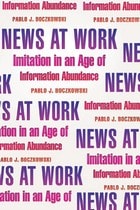
News at Work
Imitation in an Age of Information AbundancePablo J. Boczkowski
University of Chicago Press, 2010
Before news organizations began putting their content online, people got the news in print or on TV and almost always outside of the workplace. But nowadays, most of us keep an eye on the headlines from our desks at work, and we have become accustomed to instant access to a growing supply of constantly updated stories on the Web. This change in the amount of news available as well as how we consume it has been coupled with an unexpected development in editorial labor: rival news organizations can now keep tabs on the competition and imitate them, resulting in a decrease in the diversity of the news. Peeking inside the newsrooms where journalists create stories and the work settings where the public reads them, Pablo J. Boczkowski reveals why journalists contribute to the growing similarity of news—even though they dislike it—and why consumers acquiesce to a media system they find increasingly dissatisfying.
Comparing and contrasting two newspapers in Buenos Aires with similar developments in the United States, News at Work offers an enlightening perspective on living in a world with more information but less news.
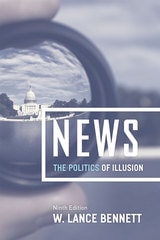
News
The Politics of Illusion, Ninth EditionW. Lance Bennett
University of Chicago Press, 2011

News
The Politics of Illusion, Tenth EditionW. Lance Bennett
University of Chicago Press, 2016
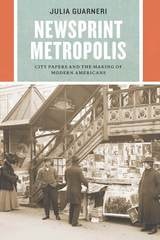
Newsprint Metropolis
City Papers and the Making of Modern AmericansJulia Guarneri
University of Chicago Press, 2017
At the turn of the twentieth century, ambitious publishers like Joseph Pulitzer, William Randolph Hearst, and Robert McCormick produced the most spectacular newspapers Americans had ever read. Alongside current events and classified ads, publishers began running comic strips, sports sections, women’s pages, and Sunday magazines. Newspapers’ lavish illustrations, colorful dialogue, and sensational stories seemed to reproduce city life on the page.
Yet as Julia Guarneri reveals, newspapers did not simply report on cities; they also helped to build them. Metropolitan sections and civic campaigns crafted cohesive identities for sprawling metropolises. Real estate sections boosted the suburbs, expanding metropolitan areas while maintaining cities’ roles as economic and information hubs. Advice columns and advertisements helped assimilate migrants and immigrants to a class-conscious, consumerist, and cosmopolitan urban culture.
Newsprint Metropolis offers a tour of American newspapers in their most creative and vital decades. It traces newspapers’ evolution into highly commercial, mass-produced media, and assesses what was gained and lost as national syndicates began providing more of Americans’ news. Case studies of Philadelphia, New York, Chicago, and Milwaukee illuminate the intertwined histories of newspapers and the cities they served. In an era when the American press is under attack, Newsprint Metropolis reminds us how papers once hosted public conversations and nurtured collective identities in cities across America.
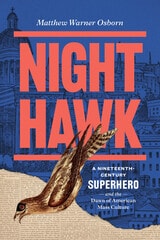
Night Hawk
A Nineteenth-Century Superhero and the Dawn of American Mass CultureMatthew Warner Osborn
University of Chicago Press, 2026
Unmasks the long-forgotten story of how a flying, superhuman vigilante played a pivotal role in the founding of the American labor movement.
On July 5, 1828, more than a century before Superman arrived on Earth, a superhero took flight in Philadelphia’s night sky. Buried on page three of a small local newspaper, the announcement of his arrival appeared under the title “The Night-Hawk, No. 1” with a cryptic epigraph from Romeo and Juliet: “I’ll be a candleholder and look on.” Who and what was the Night Hawk? As Matthew Warner Osborn reveals, this was the sobriquet of a mysterious columnist for the weekly Mechanics’ Free Press, the first radical socialist newspaper in America. Dressed in a mysterious cloak, the Night Hawk soared over Philadelphia, revealing the evil crimes of prominent gentlemen, fighting murderous criminals, and calling out fraudulent moral authorities.
The Night Hawk was the ingenious invention of an impoverished actor, Cornelius A. Logan, who created the character as a public champion of Philadelphia’s Working Men’s movement, the first successful American labor party. The Night Hawk’s nocturnal adventures transformed their socialist ideology into an entertaining fantasy that dramatized the struggle against industrial exploitation and the degradation of working people. The success of the character made Logan into a celebrity, and he went on to become a popular and innovative comedian on the antebellum stage.
A harbinger of the superheroes we know today, the Night Hawk promises to illuminate dark secrets from the past, but he can also shed light on our present. He ignites our need to see corrupt elites unmasked and held accountable for their actions, all while protecting the innocent and oppressed. Americans have always loved to fantasize about powerful superheroes who hide behind masks while chasing bad guys, and Osborn shows in this entertaining history how the Night Hawk was perhaps the first standard bearer for that enduring mystique.
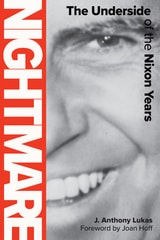
Nightmare
The Underside of the Nixon YearsJ. Anthony Lukas
Ohio University Press, 1999
In July 1973, for the first time in its history, the New York Times Magazine devoted a full issue to a single article: Pulitzer Prize–winning journalist J. Anthony Lukas’s account of the Watergate story to date. Six months later, a second installment ran in another full issue. Later the Times asked him to write a third issue, on the impeachment, which never appeared because of Nixon’s intervening resignation. But all of Lukas’s painstaking reporting on Nixon’s last months in office appears here, along with added information on every aspect of Watergate.
Widely acclaimed as a major text of the Watergate saga, J. Anthony Lukas’s Nightmare is a masterwork of investigation, highlighted by in-depth character sketches of the key players. For students of history coming to these events for the first time, this book reveals in depth the particular trauma of a nation in turmoil; for those who remember, the upheaval and what was at stake are once more brought to life.
Normative Theories of the Media
Journalism in Democratic SocietiesClifford G. Christians, Theodore Glasser, Denis McQuail, Kaarle Nordenstreng, Ro
University of Illinois Press, 2008