Results by title
122 books match the query 'Journalists' and 2 start with n
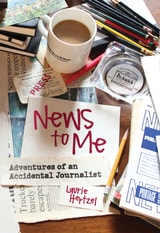
News to Me
Adventures of an Accidental JournalistLaurie Hertzel
University of Minnesota Press, 2010
The story of a journalist’s coming of age in Duluth during the boom days of print
Laurie Hertzel wasn't yet a teenager in Duluth, Minnesota, when she started her first newspaper, which she appropriately christened Newspaper. Complete with the most sensational headlines of the day-MARGO FLUEGEL HAS ANOTHER BIRTHDAY!-and with healthy competition from her little brothers and their rival publication, Magapaper (a magazine and a newspaper), this venture would become Hertzel's first step toward realizing what her heart was already set on: journalism as her future.
News to Me is the adventurous story of Hertzel's journey into the bustling world of print journalism in the mid-1970s, a time when copy was still banged out on typewriters by chain-smoking men in fedoras and everybody read the paper. A coming-of-age tale in more ways than one, Hertzel's eighteen-year career at the Duluth News Tribune began when journalism was a predominantly male profession. And while the newspaper trade was booming, Duluth had fallen on difficult times as factories closed and more and more people moved away. Hertzel describes her climb up the ranks of the paper against the backdrop of a Midwestern city during a time of extraordinary change. She was there during major events like the Congdon murders, the establishment of the BWCA, and the rise of Indian treaty rights, and eventually follows the biggest story of her life to Soviet Russia-and completely blows her deadline.
Written with the insight and humor of someone who makes a living telling stories, News to Me is the chronicle of a small-city newspaper on the cusp of transformation, an affectionate portrait of Duluth and its people, and the account of a talented, persistent journalist who witnessed it all and was changing right along with it-whether she wanted to or not.
(Oh, Newspaper doggedly outlasted the full-color Magapaper).
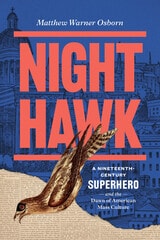
Night Hawk
A Nineteenth-Century Superhero and the Dawn of American Mass CultureMatthew Warner Osborn
University of Chicago Press, 2026
Unmasks the long-forgotten story of how a flying, superhuman vigilante played a pivotal role in the founding of the American labor movement.
On July 5, 1828, more than a century before Superman arrived on Earth, a superhero took flight in Philadelphia’s night sky. Buried on page three of a small local newspaper, the announcement of his arrival appeared under the title “The Night-Hawk, No. 1” with a cryptic epigraph from Romeo and Juliet: “I’ll be a candleholder and look on.” Who and what was the Night Hawk? As Matthew Warner Osborn reveals, this was the sobriquet of a mysterious columnist for the weekly Mechanics’ Free Press, the first radical socialist newspaper in America. Dressed in a mysterious cloak, the Night Hawk soared over Philadelphia, revealing the evil crimes of prominent gentlemen, fighting murderous criminals, and calling out fraudulent moral authorities.
The Night Hawk was the ingenious invention of an impoverished actor, Cornelius A. Logan, who created the character as a public champion of Philadelphia’s Working Men’s movement, the first successful American labor party. The Night Hawk’s nocturnal adventures transformed their socialist ideology into an entertaining fantasy that dramatized the struggle against industrial exploitation and the degradation of working people. The success of the character made Logan into a celebrity, and he went on to become a popular and innovative comedian on the antebellum stage.
A harbinger of the superheroes we know today, the Night Hawk promises to illuminate dark secrets from the past, but he can also shed light on our present. He ignites our need to see corrupt elites unmasked and held accountable for their actions, all while protecting the innocent and oppressed. Americans have always loved to fantasize about powerful superheroes who hide behind masks while chasing bad guys, and Osborn shows in this entertaining history how the Night Hawk was perhaps the first standard bearer for that enduring mystique.