Results by title
187 books match the query 'Justice' and 4 start with n

Narrative, Violence, and the Law
The Essays of Robert CoverMartha Minow, Michael Ryan, and Austin Sarat, Editors
University of Michigan Press, 1993
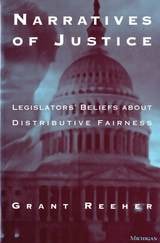
Narratives of Justice
Legislators' Beliefs about Distributive FairnessGrant Reeher
University of Michigan Press, 1996
Narratives of Justice offers a provocative, contemporary look at the timeless questions of justice and fairness. Using face-to-face interviews, Grant Reeher plumbs the minds of legislators for their beliefs about distributive justice and attempts to discover the ways in which those beliefs influence their behavior. The book calls into question many notions of American political ideology and, in particular, the idea of an "American exceptionalism" regarding views from the political left, and the dominance in the United States of a "liberal tradition."
Political philosophers have amassed a large body of work on justice and fairness from a theoretical perspective, but there is comparatively little empirical work on the subject. The work that does exist concentrates on the beliefs of the public. We know very little concerning the beliefs about justice held by political elites. This work offers a window into the beliefs of legislators, a group for which such an inquiry is rarely undertaken.
The book is based on a set of extended, in-depth interviews with the members of the Connecticut State Senate as well as a year of close observation of the Senate in action. The interviews averaged four hours in length and covered a variety of topics related to fairness. Through this material, Reeher employs a narrative-based framework to understand the patterns in the senators' interview responses, and develops a typology of the senator's narratives. These narratives vary in both content and form, and as a whole present a surprising range of views.
Narratives of Justice will be of interest to those concerned with justice, political ideologies, and political beliefs, as well as state and local politics and, more generally, American politics. Its wide research and thorough documentation make it a useful guide to the literature within and beyond political science concerning beliefs, ideologies, legislative behavior, and qualitative research methods.
Grant Reeher is Assistant Professor, Maxwell School of Citizenship and Public Affairs, Department of Political Science, Syracuse University, and currently a Robert Wood Johnson Foundation Scholar in Health Policy Research, University of Michigan.

Natchiq Grows Up
The Story of an Alaska Ringed Seal Pup and Her Changing HomeDonna D.W. Hauser
University of Alaska Press, 2023
Beginning in the 1980s, scientists started traveling to northwest Alaska to research the lives of ringed seals, bringing Labrador retrievers who could sniff out seals and their snow cave homes (called lairs) on the sea ice. Decades later, scientists partnered with the Iñupiaq people of
Qikiktaġruk (Kotzebue) to learn more about ringed seals. They relied on a combination of Indigenous Knowledge and scientific techniques to capture and apply tags to understand the movements and behavior of ringed seals.
But the Arctic homes of ringed seals are changing, and the long history of ringed seal science in the Kotzebue Sound proved to be just the beginning of long and cooperative relationships melding science and Indigenous knowledge. During 2018 and 2019, with unprecedented sea ice conditions, Qikiktagrumiut Elders and scientists returned to the ice to measure changes in the habitat available for ringed seal pups in the region.

National Deconstruction
Violence, Identity, and Justice in BosniaDavid Campbell
University of Minnesota Press, 1998
What our response to the Bosnian crisis can tell us about multiculturalism in the United States and beyond.
How did Bosnia, once a polity of intersecting and overlapping identities, come to be understood as an intractable ethnic problem? David Campbell pursues this question-and its implications for the politics of community, democracy, justice, and multiculturalism-through readings of media and academic representations of the conflict in Bosnia. National Deconstruction is a rethinking of the meaning of “ethnic/nationalist” violence and a critique of the impoverished discourse of identity politics that crippled the international response to the Bosnian crisis.
Rather than assuming the preexistence of an entity called Bosnia, Campbell considers the complex array of historical, statistical, cartographic, and other practices through which the definitions of Bosnia have come to be. These practices traverse a continuum of political spaces, from the bodies of individuals and the corporate body of the former Yugoslavia to the international bodies of the world community. Among the book’s many original disclosures, arrived at through a critical reading of international diplomacy, is the shared identity politics of the peacemakers and paramilitaries. Equally significant is Campbell’s conclusion that the international response to the Bosnian war was hamstrung by the poverty of Western thought on the politics of heterogeneous communities. Indeed, he contends that Europe and the United States intervened in Bosnia not to save the ideal of multiculturalism abroad but rather to shore up the nationalist imaginary so as to contain the ideal of multiculturalism at home.By bringing to the fore the concern with ethics, politics, and responsibility contained in more traditional accounts of the Bosnian war, this book is a major statement on the inherently ethical and political assumptions of deconstructive thought-and the reworkings of the politics of community it enables.Awarded “Book of the Year 1999” by the International Forum Bosnia (Sarajevo) and the Human Rights Review (USA).ISBN 0-8166-2936-6 Cloth $62.95xxISBN 0-8166-2937-4 Paper $24.95x382 pages 5 7/8 x 9 SeptemberTranslation inquiries: University of Minnesota Press