486 books match the query 'LGBTQ+' and 11 start with n
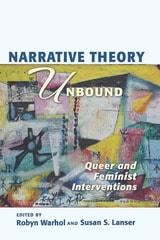
cover of Narrative Theory Unbound: Queer and Feminist Interventions

Narrative Theory Unbound

Queer and Feminist Interventions

Edited by Robyn Warhol and Susan S. Lanser

The Ohio State University Press, 2015

Under the bold banner of Narrative Theory Unbound: Queer and Feminist Interventions, editors Robyn Warhol and Susan S. Lanser gather a diverse spectrum of queer and feminist challenges to the theory and interpretation of narrative. The first edited collection to bring feminist, queer, and narrative theories into direct conversation with one another, this anthology places gender and sexuality at the center of contemporary theorizing about the production, reception, forms, and functions of narrative texts.   
 
Through twenty-one essays prefaced by a cogent history of the field, Narrative Theory Unbound offers new perspectives on narrative discourse and its constituent elements; on intersectional approaches that recognize race, religion, and national culture as integral to understanding sexuality and gender; on queer temporalities; on cognitive research; and on lifewriting in graphic, print, and digital constellations. Exploring genres ranging from reality TV to fairy tales to classical fiction, contributors explore the thorny, contested relationships between feminist and queer theory, on the one hand, and between feminist/queer theory and contemporary narratologies, on the other. Rather than aiming for cohesiveness or conclusiveness, the collection stages open-ended debates designed to unbind the assumptions that have kept gender and sexuality on the periphery of narrative theory.
[more]
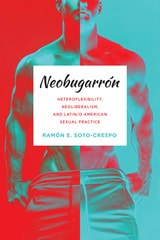
cover of Neobugarrón: Heteroflexibility, Neoliberalism, and Latin/o American Sexual Practice

Neobugarrón

Heteroflexibility, Neoliberalism, and Latin/o American Sexual Practice

Ramón E. Soto-Crespo

The Ohio State University Press, 2023

How should we understand the bugarrón, a man who has sex with other men while regarding himself as heterosexual? Reaching beyond queer and gay studies, Ramón E. Soto-Crespo’s research suggests that this paradoxical figure mutated into what he calls the “neobugarrón,” a neoliberal market-oriented actor who used the traditional sexual practice as an optimizing strategy for manipulating the forces of globalization during the 1990s. In Neobugarrón: Heteroflexibility, Neoliberalism, and Latin/o American Sexual Practice, Soto-Crespo chronicles the cultural modifications of bugarrón, a distinct male-male sexual practice in Latin/o America and the Caribbean, during the twentieth and twenty-first centuries. Working with and against Foucault and Kinsey to examine diverse works from anthropology, literature, cinema, and social media, he investigates a wide array of bugarrón sources, ranging from previously underexamined multimedia to ethnographies, fiction, films, and beyond. These works constitute a neobugarrón archive and attest to a sexual practice currently metamorphosing on the cusp of extinction. Soto-Crespo’s analysis challenges conventional understandings of “heteroflexible” sex between men and reveals a hitherto unnoticed transformation in neoliberal ecologies of bugarrón sexual practice.
[more]
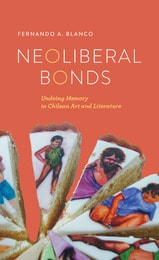
cover of Neoliberal Bonds: Undoing Memory in Chilean Art and Literature

Neoliberal Bonds

Undoing Memory in Chilean Art and Literature

Fernando A. Blanco

The Ohio State University Press, 2015

Fernando A. Blanco’s Neoliberal Bonds: Undoing Memory in Chilean Art and Literature analyzes the sociocultural processes that have reshaped subjectivities in post-Pinochet Chile. By creatively exploring the intersections among memory, gender, post-trauma, sociology, psychoanalysis, and neoliberalism, Neoliberal Bonds draws on Lacan’s notion of perversion to critique the subjective fantasies that people create to compensate for the loss of the social bond in the wake of a dictatorship founded on individualism, competition, and privatization.
 
Neoliberal Bonds vehemently criticizes how Chile’s transition governments, through a series of political and legal maneuvers, created the state’s official memory narratives. Blanco argues that the state, the media, academia, and the neoliberal market colluded to colonize and mediatize the “memory scene.” In contrast to these official narratives, Neoliberal Bonds analyzes alternative memory accounts within the visual arts and literature that push back against the state, its institutions, and its economic allies. These alternative memory narratives highlight the ontological fracture of the new neoliberal subjects; they also bring into sharp relief the urgent need for democratization that still poses a challenge to Chile a quarter century after its “transition to democracy” began.
[more]
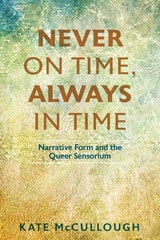
cover of Never on Time, Always in Time: Narrative Form and the Queer Sensorium

Never on Time, Always in Time

Narrative Form and the Queer Sensorium

Kate McCullough

The Ohio State University Press, 2024

Queer futures begin with the body. In Never on Time, Always in Time, Kate McCullough explores how writers summon queer bodily experiences by way of the senses: these experiences have much to tell us about the pasts, presents, and futures of queer life. The author discusses how narrative form and techniques represent the senses in order to open a more expansive temporality for writers and readers. Can queer futures contain the utopic, while also addressing the violence of the past and present? McCullough argues that a narratology that incorporates the senses is integral to conceptions of queer time, which in its most potent, palpable, and radical expression depends on a rendering of the senses. Never on Time, Always in Time looks at works by Monique Truong, Carol Rifka Brunt, Mia McKenzie, and Alison Bechdel to explore how they invoke the senses to narrate what otherwise seems to be non-narrativizable. McCullough thus reveals a vital queer narratology at work, a mode of reading and writing the senses toward a survivable future. She calls this cluster of contemporary texts “narratives of the queer sensorium” and argues that representations of the senses in these texts open new perspectives onto history, futurity, and relationality.
[more]
cover of Night Logic

Night Logic

Matthew Gellman

Tupelo Press, 2023

The poems in Night Logic deal with queer coming-of-age and desire, as well as the persistent impact that childhood trauma can have on queer relationship-building. Focusing on the speaker’s longing to be seen, as well as his frequent desire to hide, Night Logic charts the speaker’s journey out of the closet and into an adult world that is both daunting and liberating at once. These confessional poems use the natural imagery of the speaker’s childhood to evoke longing and loss, as the landscape around him functions as both mirror and conduit. Again and again, the poems analyze the role that the closet has played in his struggles with self-articulation, as well as his parents’ divorce and the ways in which that rupture disorients him in his search for connection (romantic or otherwise). Night Logic explores the psychology of suppression in lucid, cinematic detail, presenting an elegant portrait of the pain that often comes with individuation.
[more]
cover of Night breaks apart, like pomegranate seeds in my palm: Poems

Night breaks apart, like pomegranate seeds in my palm

Poems

Aakriti Kuntal

Seagull Books, 2025

Aakriti Kuntal wields language like a blade and a balm, carving out poetry that is urgent and unafraid to ask what it means to exist.

What does it mean to exist within language—to shape it, and in turn, to be shaped by it? In Night breaks apart, like pomegranate seeds in my palm, Aakriti Kuntal crafts poems that unravel at the edges of self and myth, where language is neither home nor escape, but a threshold to something more elemental. Her verses move like water rolling and sifting through sediment, shifting between dream and flesh. Through intimate confessions and stark observations, she confronts the absurdity of suffering, the weight of the body, and the vast, unknowable machinery of the universe. Each poem resists easy meaning, instead offering raw honesty: language as both wound and salve.

For readers drawn to the introspective and the experimental, Kuntal’s poetry echoes the emotional depth of Ocean Vuong and the intellectual play of Anne Carson. This collection is for those who seek poetry not as answers, but as an experience—visceral, and unafraid to press against the limits of being.
[more]
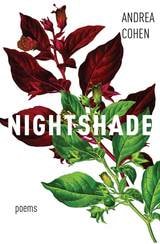
cover of Nightshade

Nightshade

Andrea Cohen

Four Way Books, 2019
The poems in Andrea Cohen’s Nightshade, her sixth full-length collection, are constructed from the wisdom of loss—of lovers and loved ones and a world gone awry. Cohen builds a short poem the way a master carpenter does a tiny house, in lines that are both economic and precise, with room enough for sorrow and wit to exist comfortably in their spaces. The great pleasure in reading these poems is their surprise in the way the endings arrive again and again in startling truths: The bride whose dress is sewn “from a hundred/tattered flags/of surrender” and the ever-present reminder of the title poem that the things of this world are both “poison and . . . balms” that “We /call . . . bitter- / sweet––what / living isn’t?”
[more]
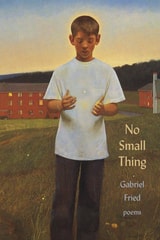
cover of No Small Thing

No Small Thing

Gabriel Fried

Four Way Books, 2025
Like an itinerant evangelist, poet Gabriel Fried transforms every space he enters with a sacred kind of attention. If “the big-top makes a chapel of the fetid / lot between the ballpark and the river, / where the air sticks like a rancid jam,” Fried erects poetry in each humid landscape of our feverish lives. And the roaming world of childhood to which No Small Thing returns us is one where shapes and selves may shift in one blessed blink. Defter than nostalgia, slyer than sentiment, the voices of these poems cast just so many spells of indeterminacy. Behind their looking glass, Gabriel Fried guides us down the corridors where sociality and gender, religion and ethnicity, language and identity negotiate their forms.  The richly saturated subjects of No Small Thing range from pastoral youth, ancestral tenements, and remembered ghettos to the revival tent, child preachers, and the word-encrusted performances of the grown but still enchanted poet. Fried’s work captures the earthy and illusory magic of poetry, as if performing a “negative-numbered, phantasmagoric” self-portraiture with only  “a fogged-up looking glass.” 
 
[more]
cover of Nonbinary Jane Austen

Nonbinary Jane Austen

Chris Washington

University of Minnesota Press, 2025

A bold and provocative analysis of Jane Austen as an early gender abolitionist

Chris Washington reads Jane Austen differently than we have classically understood her: rather than the doyen of the cisheteronormative marriage plot, the author theorizes how Austen envisions a nonbinary future that traverses the two-sex model of gender that we can supposedly see solidifying in the eighteenth century. Instead, Washington argues, Austen leverages the generic restraints of the novel to write a disguised autofiction in which Austen imagines herself as transgender and works to abolish gender exclusivity altogether. In doing so, she establishes a politics that ushers in a future beyond the cisheteronormative binary, one built on plurality and possibility.
[more]
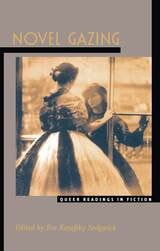
cover of Novel Gazing: Queer Readings in Fiction

Novel Gazing

Queer Readings in Fiction

Eve Kosofsky Sedgwick, ed.

Duke University Press, 1997

Novel Gazing is the first collection of queer criticism on the history of the novel. The contributors to this volume navigate new territory in literary theory with essays that implicitly challenge the "hermeneutic of suspicion" widespread in current critical theory. In a stunning introductory essay, Eve Kosofsky Sedgwick delineates the possibilities for a criticism that would be "reparative" rather than cynical or paranoid. The startlingly imaginative essays in the volume explore new critical practices that can weave the pleasures and disorientations of reading into the fabric of queer analyses.

Through discussions of a diverse array of British, French, and American novels—including major canonical novels, best-sellers, children’s fiction, and science fiction—these essays explore queer worlds of taste, texture, joy, and ennui, focusing on such subjects as flogging, wizardry, exorcism, dance, Zionist desire, and Internet sexuality. Interpreting the works of authors as diverse as Benjamin Constant, Toni Morrison, T. H. White, and William Gibson, along with canonical queer modernists such as James, Proust, Woolf, and Cather, contributors reveal the wealth of ways in which selves and communities succeed in extracting sustenance from the objects of a culture whose avowed desire has often been not to sustain them. The dramatic reframing that these essays perform will make the significance of Novel Gazing extend beyond the scope of queer studies to literary criticism in general.

Contributors. Stephen Barber, Renu Bora, Anne Chandler, James Creech, Tyler Curtain, Jonathan Goldberg, Joseph Litvak, Michael Lucey, Jeff Nunokawa, Cindy Patton, Jacob Press, Robert F. Reid-Pharr, Eve Kosofsky Sedgwick, Melissa Solomon, Kathryn Bond Stockton, John Vincent, Maurice Wallace, Barry Weller
[more]
cover of neckbone: visual verses

neckbone

visual verses

avery r. young; foreword by Theaster Gates

Northwestern University Press, 2019

The “blk alter” of Avery R. Young’s poetic vision makes its stunning debut in a multidisciplinary arsenal entitled, neckbone: visual verses. Young’s years of supernatural fieldwork within the black experience and the gospel of his transitions between poetry, art and music, become the stitch, paint brush, metaphor, and narrative of arresting visual metaphors of childhood teachings and traumas, identity, and the personal reverence of pop culture’s beauty and beast. A mastermind in a new language of poetry, that engages and challenges readers to see beyond the traditional spaces poems are shaped and exist, Young’s neckbone extends tentacles in literature, art, and activism--redefining the collective and the sermon of the “blk” experience.  
 
[more]