Results by title
372 books match the query 'Language' and 5 start with n
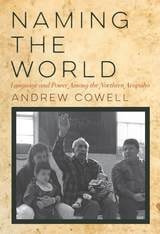
Naming the World
Language and Power Among the Northern ArapahoAndrew Cowell
University of Arizona Press, 2018
As the Arapaho people resist Euro-American assimilation or domination, the Arapaho language and the idea that the language is sacred are key rallying points—but also key points of contestation. Cowell finds that while many at Wind River see the language as crucial for maintaining access to more-than-human power, others primarily view the language in terms of peer-oriented identities as Arapaho, Indian, or non-White. These different views lead to quite different language usage and attitudes in relation to place naming, personal naming, cultural metaphors, new word formation, and the understudied practice of folk etymology.
Cowell presents data from conversations and other natural discourse to show the diversity of everyday speech and attitudes, and he links these data to broader debates at Wind River and globally about the future organization of indigenous societies and the nature of Arapaho and indigenous identity.
Narrative Structures and the Language of the Self
Matthew Clark
The Ohio State University Press, 2010
Narrative Structures and the Language of the Self by Matthew Clark offers a new way of thinking about the interrelation of character and plot. Clark investigates the characters brought together in a narrative, considering them not as random collections but as structured sets that correspond to various manifestations of the self. The shape and structure of these sets can be thought of as narrative geometry, and various geometries imply various theories of the self. Part One, “Philosophical Fables of the Self,” examines narratives such as The Talented Mr. Ripley,A Farewell to Arms,A Separate Peace, and The Master of Ballantrae in order to show successively more complex versions of the self as modeled by Descartes, Hegel, Freud, and Mead. Part Two, “The Case of the Subject,” uses Case Grammar to extend the discussion to additional roles of the self in narratives such as The Waves,The Great Gatsby,Fifth Business, and Howards End as examples of the self as experiencer, the self as observer, the instrumental self, and the locative self. The book ends with an extended analysis of the subject in Hartley’s The Go-Between. Throughout, the discussion is concerned with practical analysis of specific narratives and with the development of an understanding of the self that moves beyond the simple dichotomy of the self and the other, the subject and the object.
Nietzsche on Language, Consciousness, and the Body
Christian J. Emden
University of Illinois Press, 2005
Emden situates Nietzsche’s writings on language and rhetoric within their wider historical context. He demonstrates that Nietzsche is not as radical in his thinking as has been often supposed, and that a number of problems with Nietzsche disappear when Nietzsche’s works are compared to works on the same subjects by writers of the 18th and 19th centuries. Further, the relevance of rhetoric and the history of rhetoric to philosophy and the history of philosophy is reasserted, in consonance with Nietzsche’s own statements and practices. Important in this regard are the role of fictions, descriptions, and metaphor.

North American Icelandic
The Life of a LanguageBirna Arnbjornsdottir
University of Manitoba Press, 2006
Northwest Voices
Language and Culture in the Pacific NorthwestKristin Denham
Oregon State University Press, 2019
Although not often considered a bastion of diversity, linguistic or otherwise, in fact the Pacific Northwest has had a surprising number of influences on the English language, and a great number of other languages have left their mark on the region in a variety of ways. Individual essays examine the region's linguistic diversity, explore the origins and use of place names, and detail efforts to revive indigenous languages.
Written for both general readers and language scholars, Northwest Voices brings together research and perspectives from linguistics, history, and cultural studies to help readers understand how and why the language of our region is of utmost importance to our pasts, presents, and futures.
CONTRIBUTORS
Edwin Battistella
Kara Becker
Kathy Cole
Kristin Denham
Betsy Evans
Russell Hugo
Danica Sterud Miller
David Pippin
Allan Richardson
Jordan B. Sandoval
Alicia Beckford Wassink
Henry Zenk