622 books match the query 'Language Study' and 20 start with n
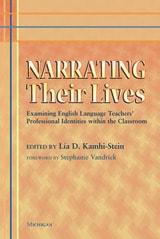
cover of Narrating Their Lives: Examining English Language Teachers' Professional Identities within the Classroom

Narrating Their Lives

Examining English Language Teachers' Professional Identities within the Classroom

Edited by Lia Kamhi-Stein

University of Michigan Press, 2013

“…a groundbreaking book that will…engage, inform, and connect with present and future teachers and teacher educators.”                 

---Stephanie Vandrick, Foreword to Narrating Their Lives

The field of TESOL has called attention to the ways that the issues of race and ethnicity, language status and power, and cultural background affect second language learners’ identities and, to some degree, those of teachers. In Narrating Their Lives, Kamhi-Stein examines the process of identity construction of classroom teachers so as to make connections between their personal and professional identities and their instructional practices. To do that, she has selected six autobiographical narratives from teachers who were once part of her TESL 570 (Educational Sociolinguistics) class in the MA TESOL program at California State University, Los Angeles. These six narratives cover a surprisingly wide range of identity issues but also touch on broader instructional themes that are part of teacher education programs.

Because of the reflective nature of the narratives—with the teachers using their stories to better understand how their experiences shape what they do in the classroom—this volume includes provocative chapter-opening and reflective chapter-closing questions. An informative discussion of the autobiographical narrative assignment and the TESL 570 course (including supplemental course readings and assessment criteria) is also included.

[more]
cover of Navigating Academia: Writing Supporting Genres

Navigating Academia

Writing Supporting Genres

John M. Swales & Christine B. Feak

University of Michigan Press, 2011

Navigating Academia is a bit different from the other volumes in the series because it focuses on the supporting genres that facilitate the more public genres that form the building blocks of an academic and/or research career. Included are statements of purpose for graduate school applications, letters of recommendation, and responses to journal reviewers.

One feature that these genres have in common is that they are largely hidden from public view; it is difficult to find examples of them in university libraries. Although guidance about these genres can increasingly be found on the Internet, this guidance is often too general to be helpful in an individual particular situation. This is unfortunate because in almost all cases, the individual needs to be seen as both a serious scholar, researcher, or instructor (whether beginning or getting established) and as a collegial but objective person. As a result, many of these academic communications need to be carefully considered, particularly with regard to the likely effect this communication will have on its intended recipients, who, more often than not, are established figures in the field (as with a job application letter). Because of the roles of these genres, this volume also differs somewhat from the others in that it is as much concerned with social academic practice as it is with more formal academic texts.

This volume represents a revision and expansion of the material on academic correspondence  that appeared in English in Today's Research World.
[more]
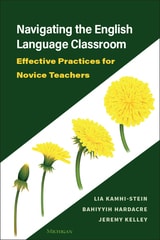
cover of Navigating the English Language Classroom: Effective Practices for Novice Teachers

Navigating the English Language Classroom

Effective Practices for Novice Teachers

Lía D. Kamhi-Stein, Bahiyyih Hardacre, and Jeremy Kelley

University of Michigan Press, 2024

Although language teacher preparation programs expose future teachers to a variety of approaches, methods, and techniques, the transition from training environments to real classrooms is not a straightforward one. Navigating the English Language Classroom is designed to bridge the gap between the highly theorized view of the language classroom presented in language teacher preparation programs and the first years of teaching. Written in accessible language and filled with principled pedagogical practices, the chapters can be integrated into any teacher training program. Novice K–12 and post-secondary teachers can turn to Navigating the English Language Classroom as a self-study resource to help them navigate the first few years in their classrooms. 

Each chapter offers context; a case study; common concerns; and concrete, research-based practices that link theory to practice in an easy-to-access manner. Readers will learn how to face several challenges, including:
  • lesson planning and delivery
  • classroom assessment
  • integrating technology into the classroom
  • using corpora in the classroom
  • establishing a professional identity
[more]
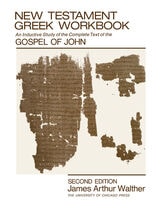
cover of New Testament Greek Workbook: An Inductive Study of the Complete Text of the Gospel of John

New Testament Greek Workbook

An Inductive Study of the Complete Text of the Gospel of John

James Arthur Walther

University of Chicago Press, 1981

In this new edition, the Greek text of the United Bible Societies is used throughout. The beginning student is involved at once in reading Greek and learns grammar and syntax as he encounters them in the text. Each unit of the workbook contains three parts—vocabulary, study notes, and end-of-unit quizzes. The vocabulary is introduced as it occurs in the text. Study notes are designed to aid the student in translating the text and to supplement the teacher's help. End-of-unit questions help the student consolidate what he has learned.
[more]
cover of Nineteenth-Century English

Nineteenth-Century English

Richard W. Bailey

University of Michigan Press, 1998
Jane Austen's English is far different from Virginia Woolf's, but historians of the English language have given scant attention to the ways in which English changed over the course of the nineteenth century. In Nineteenth-Century English, Richard W. Bailey treads new ground by showing the extent to which the language changed as cultural and economic transformations brought us into the modern world.
Six aspects of nineteenth-century English are treated in separate chapters: writing, sounds, words, slang, grammar, and "voices." In each domain, innovation and obsolescence are discussed as they were observed by contemporary writers. Thus Bailey shows how linguistic details gained powerful social meaning in the emergent stratification by class, region, race, and gender of the anglophone community.
At the beginning of the century, the "Italian" sound of a in dance was thought to be an intolerable vulgarity; by the end, it was a sign of the highest refinement. At the beginning, OK had yet to be invented; by the end, it was being used in nearly all varieties of English and had appeared as a loanword in many languages touched by English. At the beginning, mixed forms of English--pidgins and creoles--were little known and thoroughly despised; by the end some of them had become vehicles for Bible translation. As English became a global language, it took on the local color of its surroundings, and proper usage became ever more important as an index of social worth, as a measure of intelligence, and as a gauge to a person's suitability for employment, often resulting in painful consequences. What the language was like changed dramatically. What people thought about the language changed even more.
"The tale that Bailey has to tell . . . is little short of enthralling. Drawing on previously neglected material--novels, magazines, letters and diaries--he shows how the language came into the century a Georgian popinjay and left it a sober-suited man of business, purged of quirks and flashy curiosities. Along the way, Bailey uncovers a language which, while it seems familiar enough on the printed page of a Jane Austen novel, was actually quite different from the English we use today. . . ." --Robert McCrum, Observer (London)
Language changes as time goes by. Modern listeners can barely comprehend Old and Middle English. Although we are able to understand nineteenth-century English, the language changed with the effects of industrialization, urbanization, bilingualism, and growing literacy. In this book, Richard Bailey uses numerous examples and illustrations to demonstrate the changes in English. Furthermore, he identifies the connections between social events and linguistic transformation.
". . . a highly engaging study of a broad and difficult subject. Bailey is an excellent writer--the chapters are well-organized and written in a vigorous style that is buoyed by a wry sense of humor. . . ." --Lexicographia
". . . entertaining, lucid, packed with detail, and refreshingly alert to the arresting quotation. If it is unusual to associate pleasurable reading with the scholarly analysis of language, Bailey also makes clear the serious philological and political implications of his study." -- Times Literary Supplement
Richard Bailey is Professor of English, University of Michigan, and is known internationally as an expert on social and regional varieties of English.
[more]
cover of Nominal Constructions in Modern Greek: Implications for the Architecture of Grammar

Nominal Constructions in Modern Greek

Implications for the Architecture of Grammar

Dimitra Kolliakou

CSLI, 2003

The study of nominals—lingustic expressions whose core constituent is characteristically a noun—is of great interest to both theoretical and computational linguistics. Their internal structure, meaning, and use address intriguing issues of semantics and pragmatics that are intrinsically related to syntactic matters. Dimitra Kolliakou provides a detailed description and formal analysis of a wide range of intricate linguistic phenomena concerning nominal constructions in Modern Greek, while exploring the implications of those phenomena for the architecture of grammar both at a theoretical and computational level. In particular, this book supports the integration of semantic and contextual information in the grammar, formalizing it within the multi-dimensional framework of Head-Driven Phrase Structure Grammar.
[more]
cover of Norsk, nordmenn og Norge 1: Textbook for Beginning Norwegian

Norsk, nordmenn og Norge 1

Textbook for Beginning Norwegian

Kathleen Stokker and Odd Haddal

University of Wisconsin Press, 1981

This introduction to Norwegian helps students acquire the basic units of vocabulary and structure and use that knowledge to learn about Norway and Norwegian culture.
    Once students acquire the basic units of vocabulary and structure, they will use their knowledge of the language to learn about Norway. Students will learn about the cities of Oslo and Bergen, how to converse when eating in a Norwegian home or restaurant, and about Norwegian schools. Emphasis is also given to travel and communications, as well as the seasons of the year and Norwegian holidays.
    The present edition of the text features a short grammar summary, a reference for review to assist in drawing together aspects of the grammar that are presented throughout the text. To aid in developing good pronunciation and intonation habits, as well as to internalize certain items of vocabulary and structure, most chapters contain a practice dialogue for students to practice repeatedly while studying the chapter.

[more]
cover of Norsk, nordmenn og Norge 2, Antologi: Textbook for Intermediate Norwegian

Norsk, nordmenn og Norge 2, Antologi

Textbook for Intermediate Norwegian

Kathleen Stokker

University of Wisconsin Press, 1993

This intermediate-level anthology offers a lively collection of writingsfor students learning Norwegian. Introductions to selected Norwegian authors, vocabulary lists, and maps promote discussions of Norwegian history, culture, geography and literature.

[more]
cover of Norsk, nordmenn og Norge: Workbook

Norsk, nordmenn og Norge

Workbook

Louis E. Janus

University of Wisconsin Press, 1981

The Norsk, nordmenn og Norge series regards communication as the primary goal of language learning. This workbook provides meaningful structural practice in socially relevant and useful ways, combining entertaining activities with more traditional exercises.
[more]
cover of North American Icelandic: The Life of a Language

North American Icelandic

The Life of a Language

Birna Arnbjornsdottir

University of Manitoba Press, 2006
North American Icelandic evolved mainly in Icelandic settlements in Manitoba and North Dakota and is the only version of Icelandic that is not spoken in Iceland. But North American Icelandic is a dying language with few left who speak it.North American Icelandic is the only book about the nature and development of this variety of Icelandic. It details the social and linguistic constraints of one specific feature of North American Icelandic phonology undergoing change, namely Flámæli, which is the merger of two sets of front vowels. Although Flámæli was once a part of traditional Icelandic, it was considered too confusing and was systematically eradicated from the language. But in North America, Flámæli use spread unchecked, allowing the rare opportunity of viewing the evolution of a dialect from its birth to its impending demise.
[more]
cover of Northern California Texts

Northern California Texts

Victor Golla and Shirley Silver

University of Chicago Press Journals, 1977
This volume includes stories from 13 languages of Northern California with word-by-word glosses and free translation, each accompanied by grammatical notes. This collection will be of interest to linguists, typologists, and aficionados of oral narrative, as well as to speakers and learners of Native American languages.
[more]
cover of Northern Iroquoian Texts

Northern Iroquoian Texts

Marianne Mithun and Hanni Woodbury

University of Chicago Press Journals, 1980
This volume includes 18 texts in a variety of genres from Northern Iorquoian languages with word-by-word glosses, making explicit the richness of Iroquoian grammar as it is used in context. This collection will be of interest to anthropologists, linguists, typologists, and aficionados of oral narrative, as well as to speakers and learners of Iroquoian languages.
[more]
cover of Northern Paiute–Bannock Dictionary

Northern Paiute–Bannock Dictionary

Compiled by Sven Liljeblad, Catherine S. Fowler, and Glenda Powell

University of Utah Press, 2011
Based on extensive fieldwork that spanned more than 50 years, this comprehensive dictionary is a monumental achievement and will help to preserve this American Indian language that is nearing extinction.
[more]
cover of Northwest Coast Texts: Stealing Light

Northwest Coast Texts

Stealing Light

Barry F. Carlson

University of Chicago Press Journals, 1977

This volume includes 4 tellings of the Northwest Coast legend of how the Sun was stolen and brought to Earth from four different Northwest Coast languages, two Salishan (Lushootseed and Halkomelem) and two Wakashan (Nitinaht and Kwak’wala). Each of the stories in this collection is presented in interlinearized format with full morpheme-by-morpheme glosses and English translations. This format makes explicit the structure of the language and illustrates the richness of grammar as it is used in context. These texts will be of interest to anthropologists, linguists, typologists, and aficionados of oral narrative, as well as to speakers and learners of Native American languages.
[more]
cover of Norwegian-English Dictionary: A Pronouncing and Translating Dictionary of Modern Norwegian (Bokmål  and Nynorsk) with a Historical and Grammatical Introduction

Norwegian-English Dictionary

A Pronouncing and Translating Dictionary of Modern Norwegian (Bokmål and Nynorsk) with a Historical and Grammatical Introduction

Editor-in-Chief Einar Haugen

University of Wisconsin Press, 1974

For more than forty years, the Haugen Norwegian–English Dictionary has been regarded as the foremost resource for both learners and professionals using English and Norwegian. With more than 60,000 entries, it is esteemed for its breadth, its copious grammatical detail, and its rich idiomatic examples. In his introduction, Einar Haugen, a revered scholar and teacher of Norwegian to English speakers, provides a concise overview of the history of the language, presents the pronunciation of contemporary Norwegian, and introduces basic grammatical structures, including the inflection of nouns and adjectives and the declension of verbs.
[more]
cover of Notes on the Greek Text of Deuteronomy

Notes on the Greek Text of Deuteronomy

John William Wevers

SBL Press, 1995

This volume of notes on the Greek texts of the Pentateuch focuses on the book of Deuteronomy. John William Wevers's volume includes verse by verse notes for each chapter, sigla, proposed changes to Deuteronomy, and indexes of Greek and Hebrew words and phrases.
[more]
cover of Notes on the Greek Text of Exodus

Notes on the Greek Text of Exodus

John William Wevers

SBL Press, 1990
A result of John Wevers’s twenty-five-year association with the Göttingen LXX, this work records his textual notes on the Greek Exodus. The Greek text of Exodus departs in places radically from the Hebrew of the Masoretic tradition. These Notes presuppose that the Hebrew parent text was not all that different from the Masoretic tradition text and that the Greek translator throughout tried to formulate an understanding of the Hebrew from an Alexandrian-Jewish perspective. Included in the Notes are assessments of major textual variants by later readers. This volume is intended for serious students interested in using the LXX text, rather than for the professional LXX scholar.
[more]
cover of Notes on the Greek Text of Genesis

Notes on the Greek Text of Genesis

John William Wevers

SBL Press, 1993
This volume of notes on the Greek texts of the Pentateuch focuses on the book of Genesis. John William Wevers's volume includes verse by verse notes for each chapter, sigla, proposed changes to Genesis, and indexes of Greek and Hebrew words and phrases.
[more]
cover of Notes on the Greek Text of Leviticus

Notes on the Greek Text of Leviticus

John William Wevers

SBL Press, 1997
This volume of notes on the Greek texts of the Pentateuch focuses on the book of Levitcus. John William Wevers's volume includes verse by verse notes for each chapter, sigla, proposed changes to Leviticus, and indexes of Greek and Hebrew words and phrases.
[more]
cover of Notes on the Greek Text of Numbers

Notes on the Greek Text of Numbers

John William Wevers

SBL Press, 1998

This volume of notes on the Greek texts of the Pentateuch focuses on the book of Numbers. John William Wevers's volume includes verse by verse notes for each chapter, sigla, proposed changes to Numbers, and indexes of Greek and Hebrew words and phrases.
[more]