Results by title
172 books match the query 'Legislative Branch' and 3 start with n
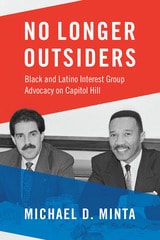
No Longer Outsiders
Black and Latino Interest Group Advocacy on Capitol HillMichael D. Minta
University of Chicago Press, 2021
In No Longer Outsiders, Minta provides a comprehensive account of the effectiveness of minority civil rights organizations and their legislative allies. He finds that the organizations’ legislative priorities are consistent with black and Latino preferences for stronger enforcement of civil rights policy and immigration reform. Although these groups focus mainly on civil rights for blacks and immigration issues for Latinos, their policy agendas extend into other significant areas. Minta concludes with an examination of how diversity in Congress helps groups gain greater influence and policy success despite many limits placed upon them.
No Middle Ground
How Informal Party Organizations Control Nominations and Polarize LegislaturesSeth E. Masket
University of Michigan Press, 2011
"This is a fascinating book. It is one of the best studies of the ways that parties and politics get conducted in any American state. Masket shows that legislators can be perfectly content without parties that control agendas and does a terrific job of explaining the transition from free-wheeling legislators to rigidly partisan voting blocs."
---Sam Popkin, University of California at San Diego
"No Middle Ground makes a significant contribution to the study of American parties and legislative politics."
---Matthew Green, Catholic University of America
Despite concerns about the debilitating effects of partisanship on democratic government, in recent years political parties have gained strength in state governments as well as in Washington. Whereas political machines of the past manipulated votes, today's machines determine which candidates can credibly compete in a primary.
Focusing on the history and politics of California, Seth E. Masket reveals how these machines evolved and how they stay in power by directing money, endorsements, and expertise to favored candidates, who often tend toward the ideological extreme. Masket argues that politicians are not inherently partisan. Instead, partisanship is thrust upon them by actors outside the government with the power to manipulate primary elections.
Seth E. Masket is Associate Professor of Political Science at the University of Denver.
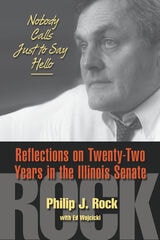
Nobody Calls Just to Say Hello
Reflections on Twenty-Two Years in the Illinois SenatePhilip J. Rock, with Ed Wojcicki
Southern Illinois University Press, 2011
A native of Chicago's West Side, Rock became one of the most influential politicians in Illinois during the 1970s and 1980s. As a senator in the 1970s and senate president from 1979 to 1993, he sponsored historic legislation to assist abused and neglected children and victims of domestic violence, ushered the state through difficult income tax increases and economic development decisions, shepherded an unruly and fragmented Democratic senate caucus, and always was fair to his Republican counterparts. Covering in great detail a critical period in Illinois political history for the first time, Rock explains how making life better for others drove his decisions in office, while also espousing the seven principles he advocates for effective leadership and providing context for how he applied those principles to the legislative battles of the era.
Unlike many Illinois politicians, Rock, a former seminarian, was known for having a greater interest in issues than in partisan politics. Considered a true statesman, he also was known as a skilled orator who could silence a busy floor of legislators with his commentary on important issues and as a devoted public servant who handled tens of thousands of bills and sponsored nearly five hundred of them himself.
Nobody Calls Just to Say Hello, which takes its title from the volume of calls and visits to elected officials from constituents in need of help, perfectly captures Rock's profound reverence for the institutions of government, his respect for other government offices, and his reputation as a problem solver who, despite his ardent Democratic beliefs, disavowed political self-preservation to cross party lines and make government work for the people. Taking readers through his legislative successes, bipartisan efforts, and political defeats-including a heartbreaking loss in the U.S. Senate primary to Paul Simon in 1984-Rock passionately articulates his belief that government's primary role is to help people, offering an antidote to the current political climate with the simple legislative advice, "Just try to be fair, give everyone a chance, and everything else comes after that."