Results by title
642 books match the query 'Linguistics' and 12 start with n
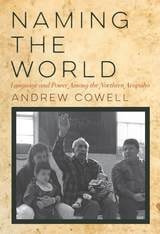
Naming the World
Language and Power Among the Northern ArapahoAndrew Cowell
University of Arizona Press, 2018
As the Arapaho people resist Euro-American assimilation or domination, the Arapaho language and the idea that the language is sacred are key rallying points—but also key points of contestation. Cowell finds that while many at Wind River see the language as crucial for maintaining access to more-than-human power, others primarily view the language in terms of peer-oriented identities as Arapaho, Indian, or non-White. These different views lead to quite different language usage and attitudes in relation to place naming, personal naming, cultural metaphors, new word formation, and the understudied practice of folk etymology.
Cowell presents data from conversations and other natural discourse to show the diversity of everyday speech and attitudes, and he links these data to broader debates at Wind River and globally about the future organization of indigenous societies and the nature of Arapaho and indigenous identity.
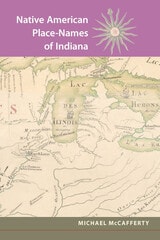
Native American Place Names of Indiana
Michael McCafferty
University of Illinois Press, 2007
A linguistic history of Native American place-names in Indiana
In tracing the roots of Indiana place names, Michael McCafferty focuses on those created and used by local Native Americans. Drawing from exciting new sources that include three Illinois dictionaries from the eighteenth century, the author documents the language used to describe landmarks essential to fur traders in Les Pays d’en Haut and settlers of the Old Northwest territory. Impeccably researched, this study details who created each name, as well as when, where, how and why they were used. The result is a detailed linguistic history of lakes, streams, cities, counties, and other Indiana names. Each entry includes native language forms, translations, and pronunciation guides, offering fresh historical insight into the state of Indiana.
Native Studies Keywords
Edited by Stephanie Nohelani Teves, Andrea Smith, and Michelle Raheja
University of Arizona Press, 2015
Take sovereignty, for example. The word has served as the battle cry for social justice in Indian Country. But what is the meaning of sovereignty? Native peoples with diverse political beliefs all might say they support sovereignty—without understanding fully the meaning and implications packed in the word.
The field of Native studies is filled with many such words whose meanings are presumed, rather than articulated or debated. Consequently, the foundational terms within Native studies always have multiple and conflicting meanings. These terms carry the colonial baggage that has accrued from centuries of contested words.
Native Studies Keywords is a genealogical project that looks at the history of words that claim to have no history. It is the first book to examine the foundational concepts of Native American studies, offering multiple perspectives and opening a critical new conversation.
New Perspectives on Case Theory
Edited by Ellen Brandner and Heike Zinsmeister
CSLI, 2003
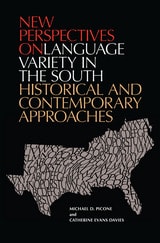
New Perspectives on Language Variety in the South
Historical and Contemporary ApproachesMichael D. Picone
University of Alabama Press, 2015
Beginning with an introduction to American Indian languages of the Southeast, five fascinating essays discuss indigenous languages, including Caddo, Ofo, and Timucua, and evidence for the connection between the Pre-Columbian Southeast and the Caribbean.
Five essays explore the earlier Englishes of the South, covering topics such as the eighteenth century as the key period in the differentiation of Southern American English and the use of new quantitative methods to trace the transfer of linguistic features from England to America. They examine a range of linguistic resources, such as plantation overseers’ writings, modern blues lyrics, linguistic databases, and lexical and locutional compilations that reveal the region’s distinctive dialectal traditions.
New Perspectives on Language Variety in the South: Historical and Contemporary Approaches widens the scope of inquiry into the linguistic influences of the African diaspora as evidenced in primary sources and records. A comprehensive essay redefines the varieties of French in Louisiana, tracing the pathway from Colonial Louisiana to the emergence of Plantation Society French in a diglossic relationship with Louisiana Creole. A further essay maps the shift from French to English in family documents.
An assortment of essays on English in the contemporary South touch on an array of compelling topics from discourse strategies to dialectal emblems of identity to stereotypes in popular perception.
Essays about recent Latino immigrants to the South bring the collection into the twenty-first century, taking into account the dramatic increase in the population of Spanish speakers and illuminating the purported role of “Spanglish,” the bilingual lives of Spanish-speaking Latinos in Mississippi, and the existence of regional Spanish dialectal diversity.
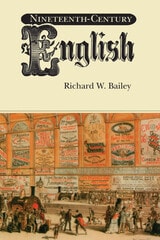
Nineteenth-Century English
Richard W. Bailey
University of Michigan Press, 1998
Nivaclé Grammar
Lyle Campbell, Luis Díaz, and Fernando Ángel
University of Utah Press, 2020
This book offers an extensive description of Nivaclé, an indigenous language spoken in the Gran Chaco region of Argentina and Paraguay. Nivaclé’s phonology, morphology, and syntax are complex; the language has no tenses marked on verbs, essentially no prepositions, and a sizable number of lexical suffixes whose content is so concrete they would be expected to be independent words in most other languages. Nivaclé has a unique speech sound, /k͡ l/, known nowhere else. In some locations where it is spoken, multilingual conversations are the norm. These and other rare traits make Nivaclé an especially fascinating language for linguists, with many implications for language typology and linguistic theory. The book is based on dozens of audio and video recordings of narratives and on hundreds of hours of elicitation and analysis with native speakers. Four lengthy texts are included here to demonstrate the language in action. Scholars—whether in anthropology, folklore, geography, history, or language—will find value in the narratives included here and in the insights into Nivaclé life and culture found throughout the book.
Nominal Constructions in Modern Greek
Implications for the Architecture of GrammarDimitra Kolliakou
CSLI, 2003
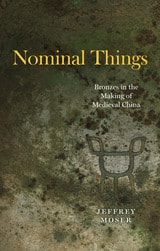
Nominal Things
Bronzes in the Making of Medieval ChinaJeffrey Moser
University of Chicago Press, 2023
This book opens in eleventh-century China, where scholars were the first in world history to systematically illustrate and document ancient artifacts. As Jeffrey Moser argues, the visual, technical, and conceptual mechanisms they developed to record these objects laid the foundations for methods of visualizing knowledge that scholars throughout early modern East Asia would use to make sense of the world around them.
Of the artifacts these scholars studied, the most celebrated were bronze ritual vessels that had been cast nearly two thousand years earlier. While working to make sense of the relationship between the bronzes’ complex shapes and their inscribed glyphs, they came to realize that the objects were “nominal things”—objects inscribed with names that identified their own categories and uses. Eleventh-century scholars knew the meaning of these glyphs from hallowed Confucian writings that had been passed down through centuries, but they found shocking disconnects between the names and the bronzes on which they were inscribed. Nominal Things traces the process by which a distinctive system of empiricism was nurtured by discrepancies between the complex materiality of the bronzes and their inscriptions. By revealing the connections between the new empiricism and older ways of knowing, the book explains how scholars refashioned the words of the Confucian classics into material reality.
Nominals
Inside and OutEdited by Miriam Butt and Tracy Holloway King
CSLI, 2003

North American Icelandic
The Life of a LanguageBirna Arnbjornsdottir
University of Manitoba Press, 2006
Northwest Voices
Language and Culture in the Pacific NorthwestKristin Denham
Oregon State University Press, 2019
Although not often considered a bastion of diversity, linguistic or otherwise, in fact the Pacific Northwest has had a surprising number of influences on the English language, and a great number of other languages have left their mark on the region in a variety of ways. Individual essays examine the region's linguistic diversity, explore the origins and use of place names, and detail efforts to revive indigenous languages.
Written for both general readers and language scholars, Northwest Voices brings together research and perspectives from linguistics, history, and cultural studies to help readers understand how and why the language of our region is of utmost importance to our pasts, presents, and futures.
CONTRIBUTORS
Edwin Battistella
Kara Becker
Kathy Cole
Kristin Denham
Betsy Evans
Russell Hugo
Danica Sterud Miller
David Pippin
Allan Richardson
Jordan B. Sandoval
Alicia Beckford Wassink
Henry Zenk