328 books match the query 'Literature and society' and 6 start with n
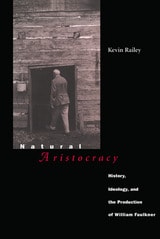
cover of Natural Aristocracy: History, Ideology, and the Production of William Faulkner

Natural Aristocracy

History, Ideology, and the Production of William Faulkner

Kevin Railey

University of Alabama Press, 1999
Kevin Railey uses a materialist critical approach--which envisions literature as a discourse necessarily interactive with other forces in the world--to identify and historicize Faulkner’s authorial identity. Working from the assumption that Faulkner was deeply affected by the sociohistorical forces that surrounded his life, Railey explores the interrelationships between American history and Faulkner’s fiction, between southern history and Faulkner’s subjectivity. Railey argues that Faulkner’s obsession with history and his struggle with specific ideologies affecting southern society and his family guided his development as an artist, influencing and overdetermining characterizations and narrative structures as well as the social vision manifest in his work. By seeing Faulkner the artist and Faulkner the man as one and the same, Railey concludes that the celebrated author wrote himself into history in a way that satisfied the image he had of himself as a natural, artistic aristocrat, based on the notion of natural aristocracy.
 
After examining two prevailing and opposing ideologies in the South of Faulkner’s lifetime--paternalism and liberalism--Railey shows how Faulkner’s working-through of his identifications with these forces helped develop his values and perceptions as an artist and individual. Railey reads Faulkner’s fiction as exploring social concerns about the demise of paternalism, questions of leadership within liberalism, and doubts about both an aristocracy of heritage and one of wealth. This reading of The Sound and the Fury, As I Lay Dying, Sanctuary, Light in August, Absalom, Absalom!, the Snopes trilogy and The Reivers details Faulkner’s explorations of various manifestations of paternalism and liberalism and the intense conflict between them, as well as his attempts to resolve that conflict.
 
Providing new insights into the full range of Faulkner’s fiction, Natural Aristocracy is the first systematic materialist critique of the author and his world.
[more]
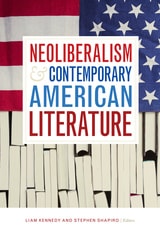
cover of Neoliberalism and Contemporary American Literature

Neoliberalism and Contemporary American Literature

Edited by Liam Kennedy and Stephen Shapiro

Dartmouth College Press, 2019
Neoliberalism is the rare buzzword that has fully crossed over from academic theorizing into mainstream discussion. Neoliberalism and Contemporary American Literature is the first book to examine the ways that US literature has responded to the dominance of our neoliberal regime. The essays collected here reveal how contemporary American writers have both propped up and interrogated the foundations of neoliberalism. The contributors look at a host of literary genres and styles, from the utopian sci-fi of Kim Stanley Robinson and the dark fantasy of Karen Russell to the poetic memoir-fiction hybrids of Ben Lerner, exploring how the relationships between politics, economics, and literary form have become both distorted and revitalized in the age of neoliberalism. Most pressingly, they ask if contemporary literature can still imagine either the end of capitalism or any realistic alternative to it.
 
[more]
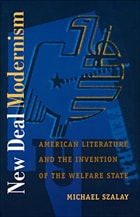
cover of New Deal Modernism: American Literature and the Invention of the Welfare State

New Deal Modernism

American Literature and the Invention of the Welfare State

Michael Szalay

Duke University Press, 2000

In New Deal Modernism Michael Szalay examines the effect that the rise of the welfare state had on American modernism during the 1930s and 1940s, and, conversely, what difference this revised modernism made to the New Deal’s famed invention of “Big Government.”
Szalay situates his study within a liberal culture bent on security, a culture galvanized by its imagined need for private and public insurance.
Taking up prominent exponents of social and economic security—such as Franklin Delano Roosevelt, John Maynard Keynes, and John Dewey—Szalay demonstrates how the New Deal’s revision of free-market culture required rethinking the political function of aesthetics. Focusing in particular on the modernist fascination with the relation between form and audience, Szalay offers innovative accounts of Busby Berkeley, Jack London, James M. Cain, Robert Frost, Ayn Rand, Betty Smith, and Gertrude Stein, as well as extended analyses of the works of Ernest Hemingway, John Steinbeck, and Richard Wright.
[more]
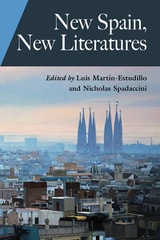
cover of New Spain, New Literatures

New Spain, New Literatures

Luis Martín-Estudillo

Vanderbilt University Press, 2010
This volume, which includes essays on Catalonia, the Basque country, Galicia, and literature written by African immigrants, focuses on issues of "difference" that are at the center of current debates in Spain and elsewhere--the emergence of minoritized literatures, multilingualism and identity, new relationships between culture and institutions, the negotiation of historical memories, the connections between migrations and the redefinition of nationhood, and the impact of global trends on local symbolic systems.
[more]
cover of Notes on Nowhere: Feminism, Utopian Logic, and Social Transformation

Notes on Nowhere

Feminism, Utopian Logic, and Social Transformation

Jennifer Burwell

University of Minnesota Press, 1997

Notes on Nowhere was first published in 1997. Minnesota Archive Editions uses digital technology to make long-unavailable books once again accessible, and are published unaltered from the original University of Minnesota Press editions.

The term utopia implies both "good place" and "nowhere." Since Sir Thomas More wrote Utopia in 1516, debates about utopian models of society have sought to understand the implications of these somewhat contradictory definitions. In Notes on Nowhere, author Jennifer Burwell uses a cross section of contemporary feminist science fiction to examine the political and literary meaning of utopian writing and utopian thought.

Burwell provides close readings of the science fiction novels of five feminist writers-Marge Piercy, Sally Gearhart, Joanna Russ, Octavia Butler, and Monique Wittig-and poses questions central to utopian writing: Do these texts promote a tradition in which narratives of the ideal society have been used to hide rather than reveal violence, oppression, and social divisions? Can a feminist critical utopia offer a departure from this tradition by using utopian narratives to expose contradiction and struggle as central aspects of the utopian impulse? What implications do these questions have for those who wish to retain the utopian impulse for emancipatory political uses?

As one way of answering these questions, Burwell compares two "figures" that inform utopian writing and social theory. The first is the traditional abstract "revolutionary" subject who contradicts existing conditions and who points us to the ideal body politic. The second, "resistant," subject is partial, concrete, and produced by conditions rather than operating outside of them. In analyzing contemporary changes in the subject's relationship to social space, Burwell draws from and revises "standpoint approaches" that tie visions of social transformation to a group's position within existing conditions.

By exploring the dilemmas, antagonisms, and resolutions within the critical literary feminist utopia, Burwell creates connections to a similar set of problems and resolutions characterizing "nonliterary" discourses of social transformation such as feminism, gay and lesbian studies, and Marxism. Notes on Nowhere makes an original, significant, and persuasive contribution to our understanding of the political and literary dimensions of the utopian impulse in literature and social theory.

Jennifer Burwell teaches in the Department of English at Wesleyan University in Connecticut.
[more]
cover of Novel Competition: American Fiction and the Cultural Economy, 1965-1999

Novel Competition

American Fiction and the Cultural Economy, 1965-1999

Evan Brier

University of Iowa Press, 2024

Novel Competition describes the literary and institutional struggle to make American novels matter between 1965 and 1999. As corporations took over the book business, Hollywood movies, popular music, and other forms of mass-produced culture competed with novels as never before for a form of prestige that had mostly been attached to novels in previous decades. In the context of this competition, developments like the emergence of Rolling Stone magazine, regional publishers, Black studies programs, and “New Hollywood” became key events in the life of the American novel. Novels by Truman Capote, Ann Beattie, Toni Cade Bambara, Cynthia Ozick, and Larry McMurtry—among many others—are recast as prescient reports on, and formal responses to, a world suddenly less hospitable to old claims about the novel’s value. This book brings to light the story of the novel’s perceived decline and the surprising ways American fiction transformed in its wake.
 
[more]