Results by title
97 books match the query 'Louisiana' and 5 start with n

Nature, Culture, and Big Old Trees
Live Oaks and Ceibas in the Landscapes of Louisiana and GuatemalaBy Kit Anderson
University of Texas Press, 2004
Big old trees inspire our respect and even affection. The poet Walt Whitman celebrated a Louisiana live oak that was solitary "in a wide flat space, / Uttering joyous leaves all its life without a friend a lover near." Groves and alleys of live oaks remain as distinctive landscape features on Louisiana's antebellum plantations, while massive individuals still cast their shade over churches, graveyards, parks, and roads. Cajuns have adopted the "Evangeline Oak" as one of their symbols. And the attachment that Louisianians feel for live oaks is equaled by that of Guatemalans for ceibas, the national tree of Guatemala. Long before Europeans came to the Americas, the ceiba, tallest of all native species, was the Mayan world tree, the center of the universe. Today, many ceibas remain as centers of Guatemalan towns, spreading their branches over the central plaza and marketplace.
In this compelling book, Kit Anderson creates a vibrant portrait of the relationship between people and trees in Louisiana and Guatemala. Traveling in both regions, she examined and photographed many old live oaks and ceibas and collected the stories and symbolism that have grown up around them. She describes who planted the trees and why, how the trees have survived through many human generations, and the rich meanings they hold for people today. Anderson also recounts the natural history of live oaks and ceibas to show what human use of the landscape has meant for the trees. This broad perspective, blending cultural geography and natural history, adds a new dimension to our understanding of how big old trees and the places they help create become deeply meaningful, even sacred, for human beings.
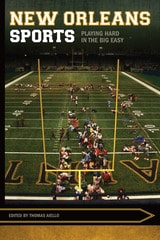
New Orleans Sports
Playing Hard in the Big EasyThomas Aiello
University of Arkansas Press, 2019
Tracing that history from the early nineteenth century to the present, while also surveying the state of the city’s sports historiography, New Orleans Sports places sport in the context of race relations, politics, and civic and business development to expand that historiography—currently dominated by a text that stops at 1900—into the twentieth century, offering a modern examination of sports in the city.

New Orleans Style and the Writing of American Jazz History
Bruce Boyd Raeburn
University of Michigan Press, 2009

New Orleans and the Creation of Transatlantic Opera, 1819–1859
Charlotte Bentley
University of Chicago Press, 2022
New Orleans and the Creation of Transatlantic Opera, 1819–1859 explores the thriving operatic life of New Orleans in the first half of the nineteenth century, drawing out the transatlantic connections that animated it. By focusing on a variety of individuals, their extended webs of human contacts, and the materials that they moved along with them, this book pieces together what it took to bring opera to New Orleans and the ways in which the city’s operatic life shaped contemporary perceptions of global interconnection. The early chapters explore the process of bringing opera to the stage, taking a detailed look at the management of New Orleans’s Francophone theater, the Théâtre d’Orléans, as well as the performers who came to the city and the reception they received. But opera’s significance was not confined to the theater, and later chapters of the book examine how opera permeated everyday life in New Orleans, through popular sheet music, novels, magazines and visual culture, and dancing in its many ballrooms. Just as New Orleans helped to create transatlantic opera, opera in turn helped to create the city of New Orleans.
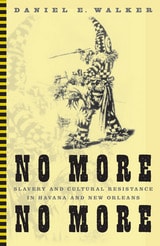
No More, No More
Slavery And Cultural Resistance In Havana And New OrleansDaniel E. Walker
University of Minnesota Press, 2004
An illuminating look at the festival performances of slaves in Havana and New Orleans
However urban slave societies might have differed from their rural counterparts, they still relied on a concerted assault on the psychological, social, and cultural identity of their African-descended inhabitants to maintain power and control. This ambitious book looks at how people of African descent in two such societies—Havana and New Orleans in the nineteenth century—created and maintained their own forms of cultural resistance to the slave regime’s assault and, in the process, put forth autonomous views of self and the social landscape.
In Havana’s annual Día de Reyes festival and in the weekly activities that took place at New Orleans’s Congo Square, author Daniel Walker identifies specific cultural beliefs and activities that Africans brought to the New World and modified in order to withstand and contest the dehumanizing effects of oppression. No More, No More crosses disciplinary boundaries as well, elucidating the economic, social, cultural, and demographic operations at work in two cities and the wide-scale efforts at cultural resistance embodied in public performances.