Results by title
85 books match the query 'Men's Studies' and 4 start with n
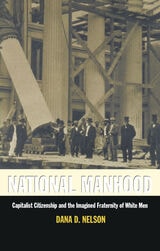
National Manhood
Capitalist Citizenship and the Imagined Fraternity of White MenDana D. Nelson
Duke University Press, 1998
Using political, scientific, medical, personal, and literary texts ranging from the Federalist papers to the ethnographic work associated with the Lewis and Clark expedition to the medical lectures of early gynecologists, Nelson explores the referential power of white manhood, how and under what conditions it came to stand for the nation, and how it came to be a fraternal articulation of a representative and civic identity in the United States. In examining early exemplary models of national manhood and by tracing its cultural generalization, National Manhood reveals not only how an impossible ideal has helped to form racist and sexist practices, but also how this ideal has simultaneously privileged and oppressed white men, who, in measuring themselves against it, are able to disavow their part in those oppressions.
Historically broad and theoretically informed, National Manhood reaches across disciplines to engage those studying early national culture, race and gender issues, and American history, literature, and culture.

Native Men Remade
Gender and Nation in Contemporary Hawai'iTy P. Kawika Tengan
Duke University Press, 2008
The sharing of personal stories is an integral part of Hale Mua fellowship, and Tengan’s account is filled with members’ first-person narratives. At the same time, Tengan explains how Hale Mua rituals and practices connect to broader projects of cultural revitalization and Hawaiian nationalism. He brings to light the tensions that mark the group’s efforts to reclaim indigenous masculinity as they arise in debates over nineteenth-century historical source materials and during political and cultural gatherings held in spaces designated as tourist sites. He explores class status anxieties expressed through the sharing of individual life stories, critiques of the Hale Mua registered by Hawaiian women, and challenges the group received in dialogues with other indigenous Polynesians. Native Men Remade is the fascinating story of how gender, culture, class, and personality intersect as a group of indigenous Hawaiian men work to overcome the dislocations of colonial history.
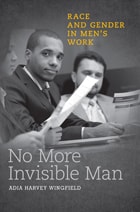
No More Invisible Man
Race and Gender in Men's WorkAdia Harvey Wingfield
Temple University Press, 2012
The “invisible men” of sociologist Adia Harvey Wingfield’s urgent and timely No More Invisible Man are African American professionals who fall between extremely high status, high-profile black men and the urban underclass. Her compelling interview study considers middle-class, professional black men and the challenges, obstacles, and opportunities they encounter in white male–dominated occupations.
No More Invisible Man chronicles these men’s experiences as a tokenized minority in the workplace to show how issues of power and inequality exist—especially as they relate to promotion, mobility, and developing occupational networks. Wingfield’s intersectional analysis deftly charts the ways that gender, race, and class collectively shape black professional men’s work experiences.
In its examination of men’s interactions with women and other men, as well as men’s performances of masculinity and their emotional demeanors in these jobs, No More Invisible Man extends our understanding of racial- and gender-based dynamics in professional work.
No One Really Knows Me
Helping Young Men Find Connection, Love, and PurposeMichael C. Reichert and Gary Barker
University of Chicago Press, 2027
Counters common and harmful myths about manhood today and offers recommendations for what young men really need as they mature.
From the “manosphere” and LooksMaxxers to Proud Boys, it increasingly feels these days like the kids—particularly the boys—are not all right. Social expectations around what masculinity means are in flux, while algorithms push out misogynist content with no regard for its radicalizing effects. In 2023 and again in 2025, a representative survey of 2,000 American men aged 18-23 found that over two-thirds agreed with the statement: “No one really knows me.” This dramatic finding revealed the failure of American boyhood to account for young men’s full humanity and equip them with the skills, relationships, and support needed for success in these modern times.
In No One Really Knows Me, psychologists Michael C. Reichert and Gary Barker seek to uncover the root causes of and solutions to our contemporary crisis of masculinity. Based on single and group interviews and a wealth of survey data, including their own national survey of 2,000 men ages 18 to 45 from a broad range of economic, racial, and social backgrounds, their findings were clear: across the board, men are struggling to build the social networks they desperately need for health and success. Underlying this failure is a set of historic, pernicious myths that continue to dominate boyhood and shape the imaginations of boys in families, schools, and relationships. Reichert and Barker use each chapter to highlight one myth of masculinity, offer data from their own research and practice to debunk it, and then present life-changing, evidence-based alternatives.
Young men today are in quite a different position than they were a generation ago. As he emerges from boyhood on his way to manhood, each young man needs to be grounded in emotionally open connections, deep relationships with people who have his back, and opportunities to engage with purpose. This book shows us how we can provide young men with surer footing for their passage to adulthood.